


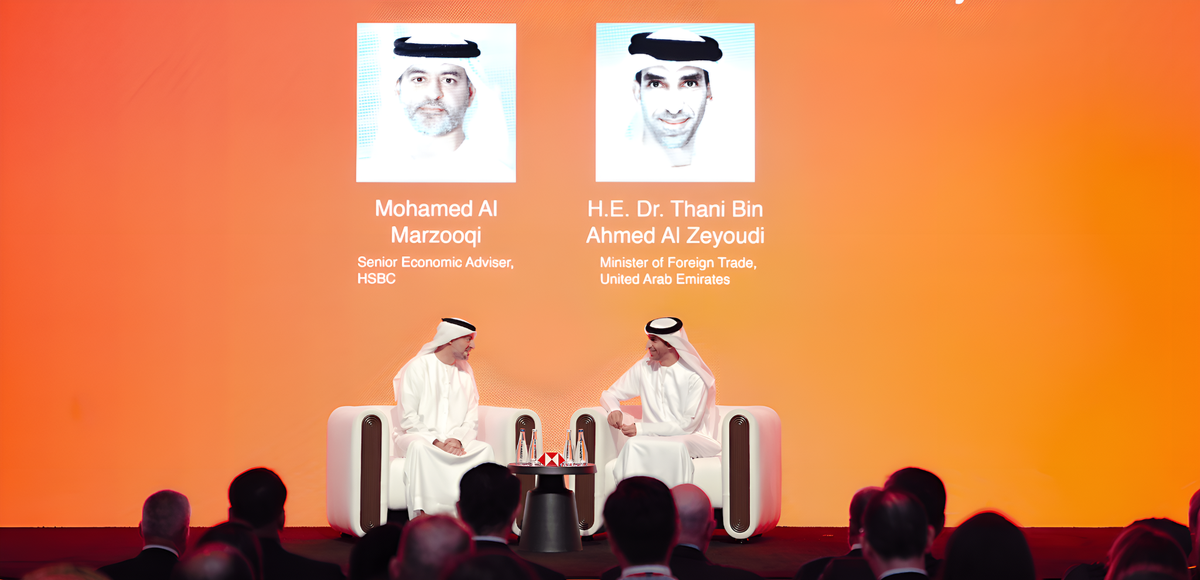

The Gulf’s next phase of growth will depend on its ability to keep trade, energy and capital moving through periods of disruption according to speakers at HSBC’s Future Forum.
As governments and investors turn their attention to infrastructure, supply-chain diversification and long-term financing will remain central.
HSBC’s New Networks of Capital for MENAT Infrastructure report, launched at the forum, identified $1.4T pipeline of infrastructure projects across the Middle East and North Africa through 2030, spanning transport, energy, power, water, waste and digital infrastructure.
Report findings
The report found that 97% of institutional investors surveyed expected the MENAT to attract significantly more infrastructure capital by 2030, while 90% of businesses expected to increase their investment in the region over the coming years.
The figures point to an investment opportunity extending beyond traditional energy and transport projects into the infrastructure required to support artificial intelligence, digital networks and increasingly interconnected trade corridors.
“Financial strength matters, but financial strength alone is not resilience,” said UAE Minister of Foreign Trade: H.E. Dr Thani bin Ahmed Al-Zeyoudi. “Resilience is the ability to keep energy, goods, food, data and capital moving when critical roles, assets or markets are disrupted.”
H.E. identified alternative export routes, interconnected ports, strategic storage, stronger power grids and secure digital networks as priorities for building resilience into the region’s economic infrastructure.
UAE accelerates infrastructure investment
The UAE is translating lessons from recent disruption into new infrastructure projects, with energy exports and eastern-coast logistics among the priorities outlined at the forum.
The Undersecretary at the Ministry of Investment, H.E. Mohammad Alhawi, said the government had identified 11 strategic projects following consultations with public- and private-sector stakeholders. Work on the projects had already progressed after their identification in June, the official said.
The country’s existing pipeline connecting Abu Dhabi to the port of Fujairah enabled it to export approximately two million barrels of oil a day during the crisis, according to the official. A second pipeline, designed to provide equivalent capacity, is expected to enter operation by FY27.
“We will have an export capacity of 4M barrels by the middle 2027” according to H.E. Mohammed Alhawi.
The UAE is also looking to strengthen port and logistics infrastructure along its eastern coast, including at Fujairah, Khor Fakkan and Kalba. The objective is to give the country additional options for moving goods and energy when established routes face disruption.
Energy diversification
Energy diversification remains another part of the strategy.
UAE officials described the UAE’s renewable capacity. The Emirates had just over 8 gigawatts of renewable energy capacity and 5.6GW of nuclear power available, with plans to increase total clean-energy supply to approximately 29GW by 2031.
The investment programme reflects a broader shift in how governments approach infrastructure planning: building additional capacity and alternative routes before they are urgently needed, rather than relying solely on the most cost-efficient systems.
Resilience at a price
HSBC’s Elhedery told the forum that supply-chain diversification had accelerated following trade tensions and the Covid-19 pandemic, with companies increasingly spreading manufacturing and sourcing across different markets.
The recent conflict has reinforced the need to design resilience into business models from the outset, rather than treating it as a response to individual disruptions.
“What we really accelerated, what we’ve seen accelerated following the conflict is this resilience is the fact that you don’t build anymore for the most optimal cost efficiency streamlining you built for the most resilient, sustainable agile business model that can face challenges,” the CEO said.
He acknowledged that this approach carries higher costs and could prove inflationary but argued that it allows businesses to continue operating through severe disruption.
The shift also has implications for capital allocation. Infrastructure projects that provide alternative routes, secure energy supplies or strengthen digital networks may require additional upfront investment, while offering businesses greater flexibility when established systems are interrupted.
For the Gulf, attracting that investment will require more than public spending. HSBC’s opening remarks stressed that government balance sheets alone could not finance the infrastructure pipeline, pointing instead to banks, capital markets, institutional investors, private capital and public-private partnerships.
Competing for international capital
The opportunity comes as governments and companies worldwide compete for funding in a higher-interest-rate environment, with significant investment needs in energy, infrastructure and AI.
Elhedery said the Gulf remained attractive to international investors despite recent disruption, citing the continued participation of overseas capital in regional projects.
However, the CEO stressed the importance of structuring projects appropriately and ensuring that financing terms remained competitive against international alternatives.
The region’s investment case is increasingly tied to its position between Asia, Africa and Europe. Transport, energy and digital corridors can connect markets, support manufacturing and services, and expand the role of Gulf economies in global trade.
The same infrastructure agenda is also relevant to AI. Data centres and computing capacity depend on reliable power, cooling, secure data systems and long-term financing, linking technology investment to the region’s wider energy and infrastructure requirements.
For investors, the challenge will be distinguishing projects that provide durable economic value from those whose costs rise faster than their commercial returns. For governments, the task is to convert strategic plans into bankable projects capable of attracting private and international capital.
Resilience becomes investment priority
Together the forum emphasised the pecuniary value of supply-side investments in the MENAT if resilience is taken into consideration at the time of investment. Returns must price in risk and with-it resilience.
Resilience is becoming an investment priority rather than simply a contingency measure.
As supply chains and trade flows are reconfigured, the Gulf’s ability to finance alternative routes, expand domestic capacity and connect markets could help determine how much of the next infrastructure cycle it captures, and the returns investors get for their buck.
Stay Up to Date with the Latest Updates at Finance ME
Dubai Real Estate Reports 20% YoY Gain in 2025 Transactions
Defence Stocks Rally in EMEA and APAC with 50% U.S. Spending Boost
2PointZero Posts AED 9.5B Profit as Energy Investments Expand Across U.S. and Africa