
Gulf banks can boost equity value not only through returns but also by aligning their strategy, execution, and equity narrative, according to Bain & Company’s latest insights on banking valuation strategies.
Bank valuations today depend less on model type and more on clarity of strategy and consistency of execution, according to Bain. The consulting firm’s report, “Perform Today, Prove Tomorrow, Propel the Stock Valuation,” found that return on equity (ROE) explains only 43–49% of the variations in price-to-book ratios across banks in North America, Europe, and the Asia-Pacific. The remaining valuation gap often reflects a bank’s “equity story”—how it articulates future direction and competitive advantage.
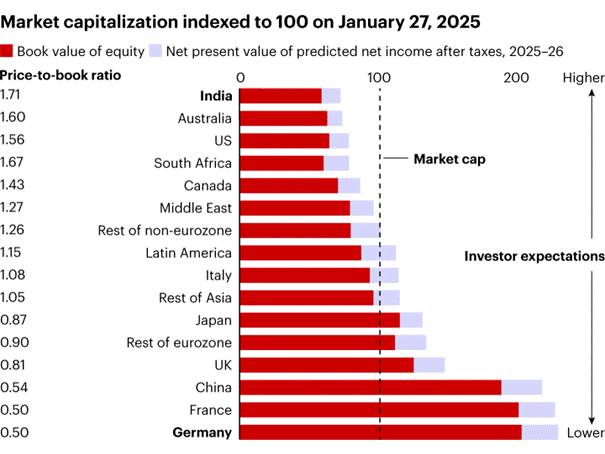
In mature markets like Europe and Japan, banks are often priced like utilities, being stable but lacking upside, largely due to regulatory constraints, capital intensity, and compressed margins. In contrast, institutions in India, Australia and North America enjoy greater perceived earnings potential. Yet, even in low-growth regions, focused banks can outperform through a disciplined strategy and adept storytelling.
A standout example is Glacier Bank, which serves seven communities in the western US with a local‑first model. Despite a modest ROE of 5.6%, its focus on core markets, conservative lending and practical digital tools has earned it a price‑to‑book multiple of 1.6.
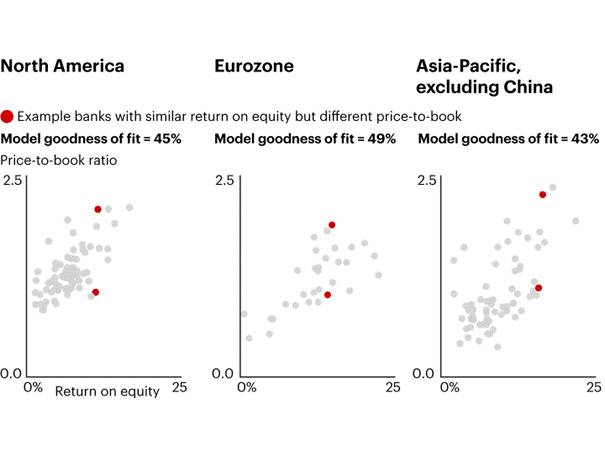
Bain’s analysis shows that the most effective banks balance “today-forward” actions—such as cost discipline, digital transformation and automation—with a “future-back” vision grounded in AI, open banking and programmable money. Morgan Stanley exemplifies this dual approach, having shifted from investment banking to wealth management while incorporating AI tools to aid financial advisers.
Absent a credible equity narrative, banks—even those with strong financials—are often valued for stagnation rather than growth. Bain warns that roughly 30% of a bank’s valuation depends on investor confidence in the bank’s future strategy.
To close the valuation gap, bank leaders are urged to treat investor confidence not as a by‑product but as a strategic asset. Clear capital allocation, selective investment in key geographies and product capabilities, and frequent, transparent communication of strategic progress are now essential.