

The global video game industry generated $219 billion in revenue in 2024 and is forecast to grow at 4% annually through 2028, according to Bain & Company’s 2025 Gaming Report: Breaking Boundaries to Win. Growth is being driven by platform-style games, user-generated content (UGC), direct-to-consumer distribution, and expansion of game intellectual property (IP) across media formats.
Platform-style games outpace AAA studios
Bain’s analysis shows platform-style titles, games that provide open worlds, social features, and creator tools, are expanding active user bases by 10%–20% annually. These games are becoming central hubs for players, creators, and brands, often outperforming traditional AAA titles in engagement and monetisation.
Independent developers are also gaining market share. From 2018 to 2024, indie PC game revenues grew at a 22% compound annual growth rate (CAGR), compared with 8% for AAA and AA studios. Lower overheads and faster innovation cycles are key drivers of this trend.
By contrast, AAA studios face rising development costs, longer production cycles, and shrinking margins, making it harder to compete in a market shifting towards flexible, community-driven experiences.
UGC becomes core to engagement
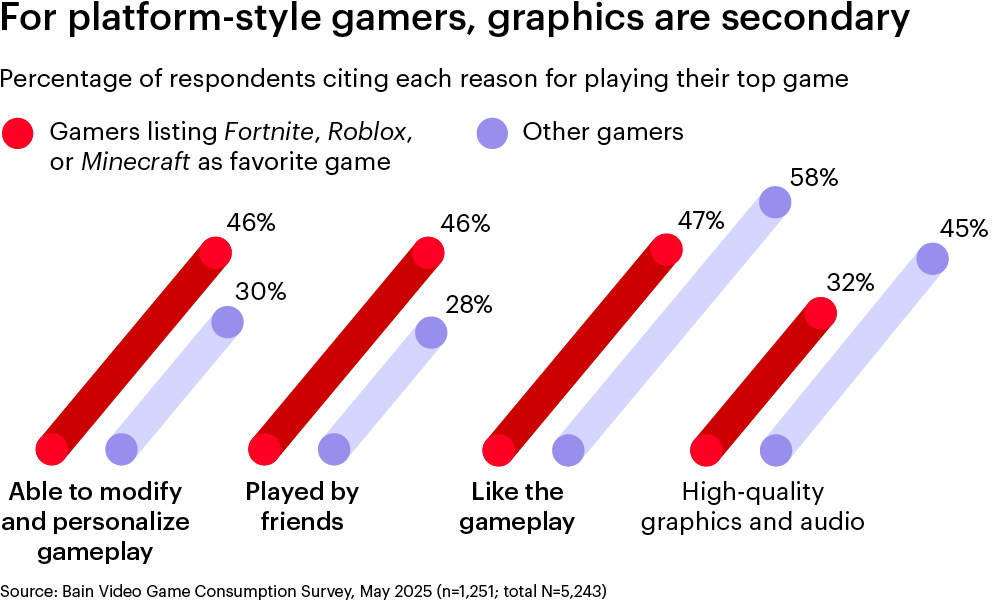
Bain’s 2025 survey of over 5,000 gamers in the US, Brazil, Indonesia, Japan, the UK, and the UAE found that nearly half of creators are spending more time making in-game content than a year earlier. This trend extends beyond younger demographics: even players over 35 have increased their participation in content creation.
The strongest growth is among players aged 2–17, who are 20 percentage points more likely to play the same games as their peers. This peer-driven behaviour strengthens retention in UGC-enabled titles, creating a “flywheel effect” where new content keeps players engaged over longer cycles.
Direct-to-consumer distribution gains share
Influencers and content creators are now the leading channels for game discovery. Bain’s survey shows 24% of players find new games through online creators, 14% via social media, and only 12% through digital storefronts such as Steam or console marketplaces.
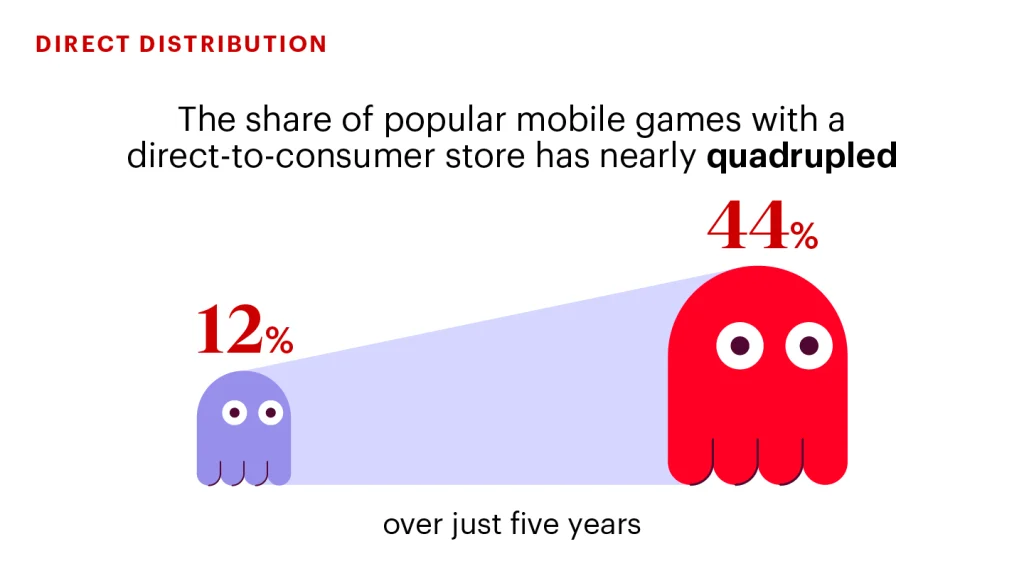
To capture more margin and customer data, developers are increasingly launching proprietary web stores. The share of top-grossing mobile games with their own stores rose from 12% in 2019 to 44% in 2024. This trend is reinforced by regulatory changes in the US, EU, and Brazil, which prevent app stores from blocking developers from directing users to external purchase links.
Cross-media IP expansion boosts engagement
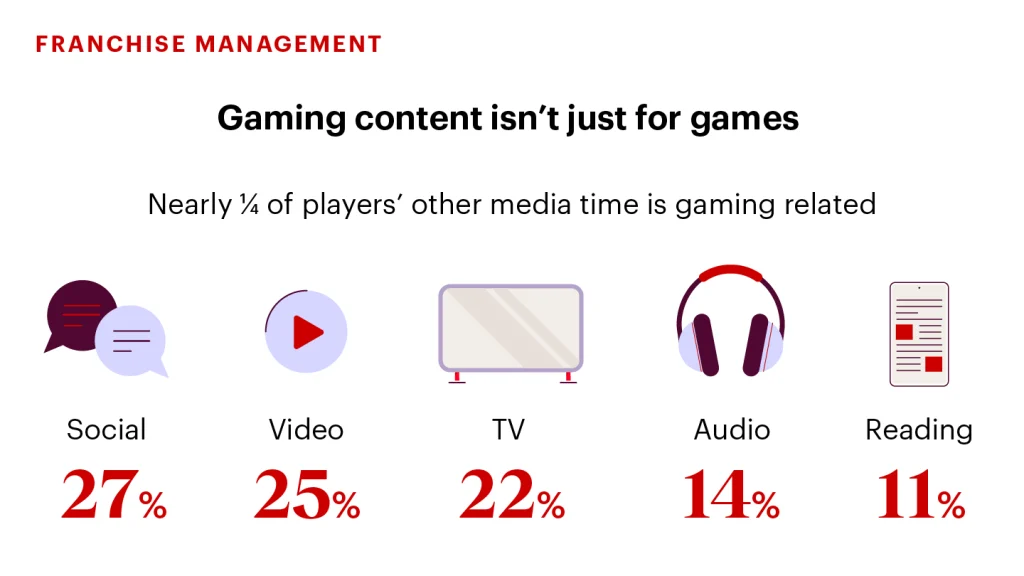
A quarter of gamers’ non-gaming media consumption is now linked to game IP, including films, series, music, and merchandise. Successful adaptations can increase average concurrent users (ACUs) by up to 69% for games tied to highly rated TV or film releases.
Bain identifies four practices used by leading IP owners: maintaining authenticity to game lore to protect fan trust; expanding into new media formats only when strategically relevant; building long-term engagement roadmaps rather than one-off marketing campaigns; investing in organisational capabilities for interactive storytelling and IP management.
Industry outlook
While the market is set for steady growth, Bain’s report signals that competitive advantage will shift towards studios that act as ecosystem builders. Future winners will be those who: integrate UGC as a core product feature; control distribution channels and first-party sales; extend IP into multi-media ecosystems without eroding quality.
The report highlighted that graphics and sequels are no longer sufficient differentiators; community engagement, creative freedom, and cross-platform integration will define the next era of gaming.