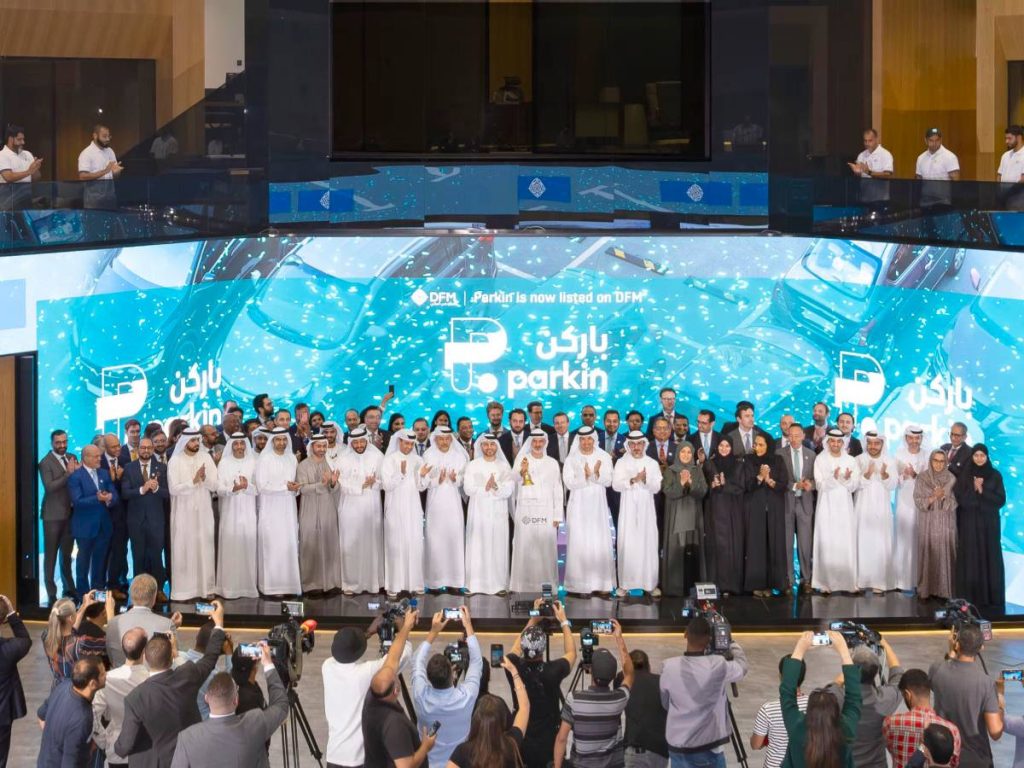
When Parkin made its debut on the Dubai Financial Market (DFM) in March 2024, the company raised Dh1.57 billion, setting a new benchmark for what successful listings in the region can achieve. The parking infrastructure firm, spun out from Dubai’s Roads and Transport Authority (RTA), captured investor interest with an oversubscription rate of 165 times, the highest ever recorded on the DFM. Yet, behind the headline-grabbing numbers lies a deeper story of capital discipline, strategic positioning, and digital-first execution that offers a blueprint for other state-linked enterprises preparing to list.
“At a simplistic level, oversubscription is a function of market supply and demand,” Khattab Abu Qaoud, CFO of Parkin. “But what really helped was that we were able to innovate in terms of our dividend policy versus other RTA IPOs.”
While investors were drawn to the company’s utility-like stability, thanks to its 49-year concession and dominant market share in Dubai’s parking infrastructure, it was Parkin’s dividend yield proposition that truly set it apart. By designing a policy linked to both net income and free cash flow, Parkin tapped into a valuation metric that resonates strongly in the Gulf. “By moving away from a dividend policy linked only to net income and adding in that all-important free cash flow element, we became even more attractive to investors,” he said.
For buyers at the IPO price of Dh2.10 per share, the forward dividend yield was 6.25%. In reality, they ended up with a yield of 7.6%, underpinned by “four strong quarters of operational and financial results,” as Abu Qaoud noted. For a business with low capital expenditure and predictable revenue from regulated tariffs, it was an irresistible combination.
The first-ever post-listing price buffer
Parkin also broke new ground by introducing DFM’s first post-listing price stabilisation mechanism, commonly known in global markets as a reverse greenshoe. “While common in the US and Europe, price stabilisation is a new concept here,” the CFO said. “We took the collective view that it would be unlikely a stabilisation agent would need to intervene, but simply having one on standby would provide comfort to investors.”
That comfort clearly paid off. In the immediate aftermath of listing, Parkin’s share price surged 35%, and trading volumes exceeded 175 million shares on opening day. The move also served as a soft trial balloon for future listings, such as Spinneys, which also adopted a similar post-listing cushion.
The dividend playbook
If investor enthusiasm was initially sparked by the capital-light infrastructure model and long-term concession, it was cemented by Parkin’s capital discipline. “Our unique dividend policy is central to our investment case,” Abu Qaoud said. For H1 2024, Parkin distributed 100% of its net income. In H2, it went further, distributing 100% of free cash flow to equity, a move that outpaced even its strong earnings-per-share growth.
This is particularly notable given the context: IPOs of infrastructure-adjacent firms like Salik and Dubai Taxi Company (DTC) had attracted large institutional interest, but were priced to yield slightly higher dividends. Parkin’s tighter dividend yield, therefore, was not an anomaly but a calculated choice, backed by confidence in growth and return stability.
Rewriting the government IPO playbook
Behind the IPO success is a broader shift in the way government-related entities are preparing to engage public markets. For Parkin, the journey meant internal reinvention. “One of the biggest challenges was aligning our operations, financial systems and company culture with the expectations of a publicly listed company,” Abu Qaoud said. “This involved implementing new systems and policies, ensuring financial transparency and shifting the company mindset.”
Parkin’s evolution reflects the maturing of Dubai’s capital markets. Since 2022, six state-owned entities have listed on DFM, collectively raising over Dh34.5 billion. Total investor demand across these deals has exceeded Dh1 trillion. Parkin’s listing shows that appetite is far from exhausted.
Turning parking into a data business
While most public utilities are cautious in their tech investments, Parkin has gone the other way, fully digitising both front- and back-end operations. The company processes over 400,000 transactions on a typical chargeable day, and this flow of behavioural data has created opportunities far beyond traditional parking enforcement.
Abu Qaoud pointed to their advanced AI-powered Automatic Number Plate Recognition (ANPR) camera system as a cornerstone of this strategy. These cameras enable barrierless, ticketless access at some of the company’s car parks and feed real-time behavioural data into Parkin’s analytics systems. “These cameras form part of our digital ecosystem,” he said, noting that the system is also being used at locations like Mall of the Emirates and City Centre Deira, as part of Parkin’s collaboration with Majid Al Futtaim.
In January, the company launched the Parkin mobile app, which has since clocked nearly 350,000 downloads. “Aside from basic park-and-pay functionality, the app features a suite of advanced functions like auto-renew, scheduled parking, fine dispute management and wallet top-up,” he said. New value-added services, including EV charging, car washing, and fuel delivery, are also in the pipeline.
The goal? To make the parking experience “feel more like an experience than a transaction.”
Locking in stability
Much of Parkin’s resilience stems from its contractual moat. Under a long-term agreement with the RTA, Parkin holds complete exclusivity over all current and future public parking in Dubai for the next five decades. That alone gives it remarkable predictability in an otherwise fast-changing urban landscape.
Moreover, the pricing model is linked to inflation, offering insulation against cost escalations. “The overall concession framework provides strong insulation through long-dated exclusivity, inflation-linked pricing and contractual compensation clauses,” the CFO explained. The Dh1.1 billion upfront payment to the RTA has already paid off in terms of future revenue visibility. In addition to the Dh1.1 billion, Parkin also pays the RTA 20% of all public parking revenue each quarter. However, the parking infrastructure firm keeps 100% of private / developer and enforcement revenue, which is not subject to the concession fee.
But public parking is only part of the story. Parkin is actively growing its developer parking portfolio and introducing new services for clients. As urban mobility patterns evolve, particularly with the rise of electric and shared vehicles, this diversity could be key to maintaining margin resilience.
Exporting the Dubai model
Dubai may be the home market, but Parkin’s aspirations extend well beyond the emirate. In Q4 2024, the company signed a memorandum of understanding with Saudi Arabian conglomerate, BATIC Investment and Logistics Company, a move Abu Qaoud described as “particularly exciting” in the context of Vision 2030. The partnership aims to combine Parkin’s renowned operational capabilities with the extensive local public parking network managed by Smart City Solutions Company, a BATIC subsidiary and Saudi Arabia’s largest paid public parking provider.
“Rapid population growth and increasing car ownership continue to present complex transportation challenges,” he said. “Our unique blend of operational excellence, technological know-how and enforcement capability is a competitive advantage that other cities can leverage.”

Whether it’s Riyadh’s metro-linked smart mobility hubs or Neom’s AI-driven city model, Parkin believes its integrated platform could find applications in other GCC markets. The company is also in talks with stakeholders in other UAE emirates.
Growth expectations
While Parkin behaves like a low-risk utility in terms of dividend stability, its share price trajectory has resembled that of a growth stock. This hybrid identity poses a unique challenge as to how to satisfy both income-focused investors and those chasing capital gains.
“Although nobody complains about share price appreciation, the ongoing focus still tends to be around growth, future cash flows and dividend distribution,” said Abu Qaoud. The key, he believes, lies in conservative yet credible guidance. “You can manage expectations by delivering on what you promised and clearly articulating how you got there and how you will continue to do this in the future.”
In the end, Parkin’s story is more than parking; it’s about precision. It’s about building an equity story that merges state-backed stability with tech-driven efficiency. It’s about satisfying dividend-hungry investors without compromising future innovation. And most of all, it’s about delivering on every metric that matters, from pricing and oversubscription to transparency and future growth. Delivering at the IPO is one thing; you then have that crucial 12 months where you try to meet the guidance you announced during the IPO process. After that, you continue into a cycle of setting ambitious targets and trying to meet them, ensuring you have long-term shareholders in your sights.
As Dubai’s capital market strategy unfolds, Parkin has emerged as a benchmark IPO and as a playbook in itself.