While Abu Dhabi saw a 226% expansion in assets under management (AUM) in the first half of 2024 compared to the first half of 2023, the emirate faces an opportunity to disrupt the global wealth management industry and establish itself as one of the world’s leading hubs for offshore assets. Unprecedented technological innovation—specifically in Generative AI—promises to alter existing wealth management operating models, creating the potential for nimbler financial ecosystems to disrupt industry incumbents.
Wealth management incumbents worldwide are facing declining profitability amid a trend toward commoditised passive investment products and rising operating costs. According to BCG, passive investment products attracted 70% of total global mutual fund and ETF capital in 2023, representing $920 billion, up from 57% between 2019 and 2022. According to Morgan Stanley, global wealth management firms suffered a 16% drop in revenue margins over the past four years.
While the share of lower-fee passive investments has steadily increased, wealth managers have yet to offer broad access to private assets outside a select set of ultra-high net worth (UHNW) clients and family offices.
The potential benefits of private market investments are well-documented, with private equity and venture capital generating average annual returns of 14.8% and 11.8%, respectively, compared to 9.4% for the S&P 500 over the 20 years ended June 2022, according to Cambridge Associates.
According to JP Morgan, private market allocations within the high net worth (HNW) retail investor channels represent about 5% of AUM, compared to nearly 50% for specific endowments and UHNW family offices.
According to BCG, wealth manager expenses rose by 80% between 2010 and 2023, equating to a compound annual growth rate of 5%, caused by more intense competition for human capital. In the UAE and other financial hubs, wealth managers compete with hedge funds and investment banks for top talent. A report published by Mckinsey cites Aik-Ping Ng and Edith Ang, both of HSBC, “There is increased attrition in talent, especially in less professionalised family offices. Greater efforts are needed to improve retention because when professionals are removed from structured environments like banks, they lose access to critical information, knowledge bases and networks, which may prompt them to seek new employment opportunities.”
The bespoke nature of many private asset categories requires financial analyst resources to conduct market research, analyse investment documents, and ultimately deliver thoughtful investment recommendations to clients. Given the cost pressures and challenges associated with attracting and retaining talent, wealth managers still need to build the infrastructure necessary to grow beyond more commoditised investment strategies.
The coming boom in AI investment applications will enable firms of all sizes to analyse and deliver broader investment options, including bespoke private market assets. Given large language models’ (LLMs) remarkable capabilities to perform tasks such as summarisation and question-answering, AI tools offer immediate solutions to time-intensive financial analyst tasks, as shown below.
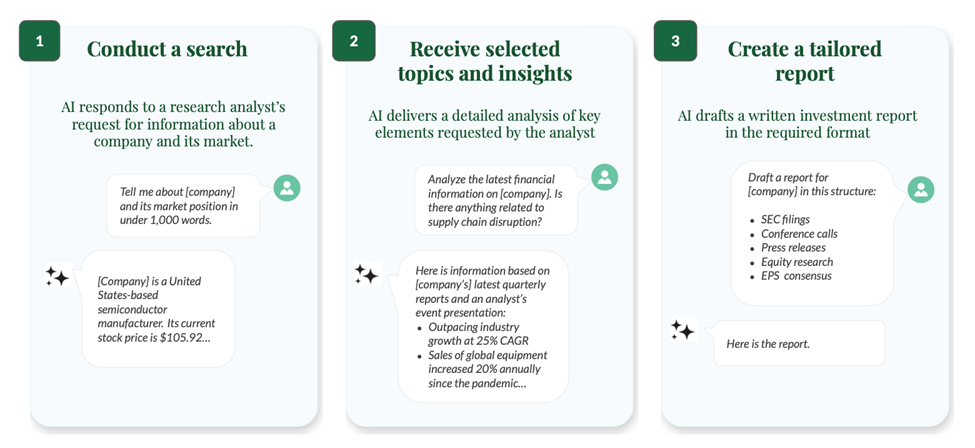
Existing AI tools allow small teams to screen, analyse and distribute alternative investments at a fraction of existing costs, providing a much-needed boost to today’s wealth management operating model. Abu Dhabi’s regulators and financial services firms must recognise the benefits likely to accrue to the early adopters to succeed in this new landscape. A recent example of this shift can be seen in how private banks like UBS have begun piloting AI tools to streamline investment screening and client communications. Abu Dhabi’s financial institutions could follow suit, leveraging similar technologies to regain market share from competitors like Singapore.
For Abu Dhabi to disrupt the global wealth management industry, it must act swiftly. Wealth managers who embrace AI now while working closely with regulators and tech innovators will be best positioned to capitalise on this transformative wave. The future belongs to those who see AI as an enabler, not a threat.