
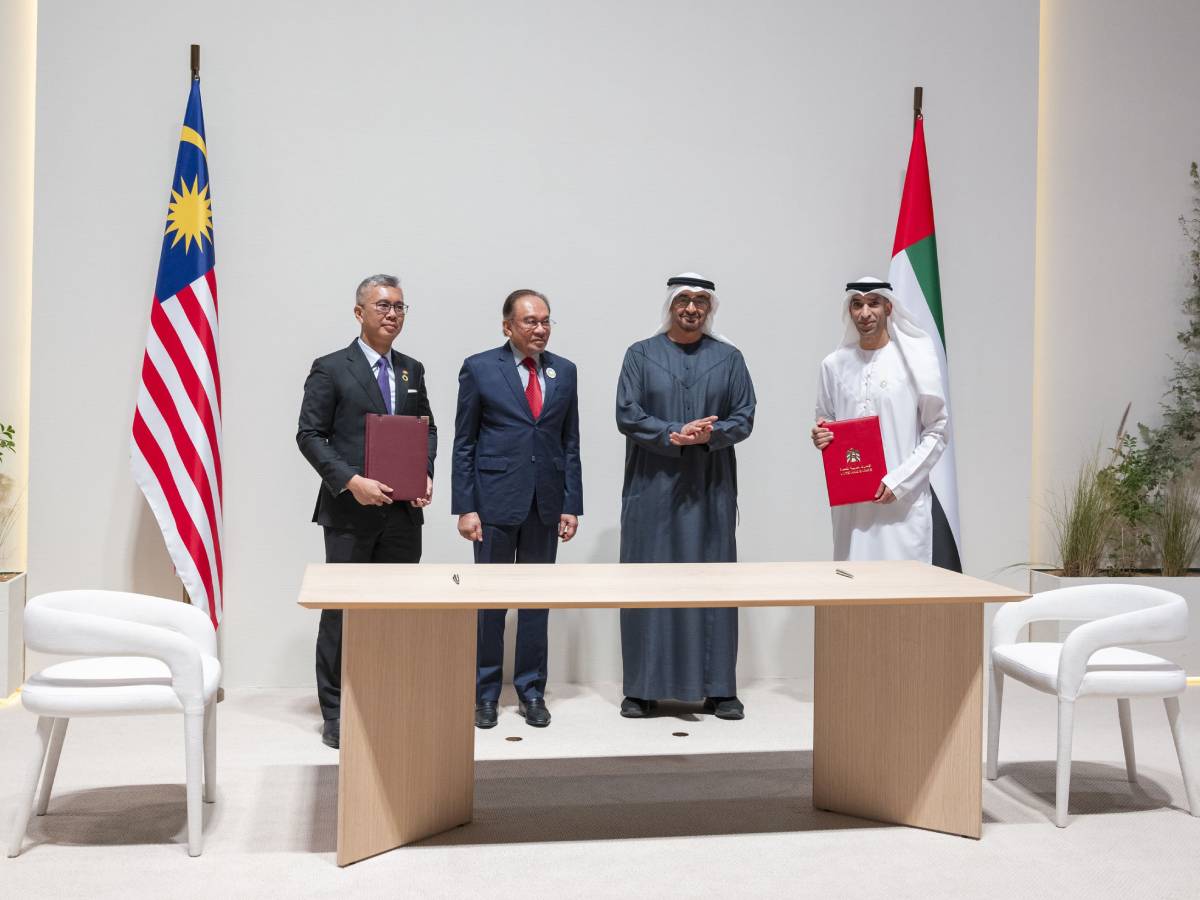
The UAE and Malaysia have signed a Comprehensive Economic Partnership Agreement (CEPA) to strengthen bilateral trade and expand private-sector collaboration.
The agreement was signed by UAE Minister of State for Foreign Trade, Dr Thani bin Ahmed Al Zeyoudi, and Malaysia’s Minister of Investment, Trade, and Industry, Tengku Zafrul Aziz, at the Abu Dhabi National Exhibition Centre (ADNEC).
The CEPA aims to reduce tariffs on goods, streamline trade regulations, and improve access to service exports. According to official trade figures, Malaysia is currently the UAE’s second-largest trade partner in the ASEAN region, with non-oil bilateral trade totalling $4.9 billion in 2023 and $4 billion in the first nine months of 2024.
The UAE, which accounts for 32% of Malaysia’s trade with Arab countries, expects the CEPA to strengthen its position as a gateway for Malaysian exports to the Middle East and North Africa. The agreement also aims to open up the ASEAN market—worth $2.9 trillion in GDP with a population of 647 million—to UAE investors.
The CEPA forms part of the UAE’s broader strategy to drive non-oil foreign trade to AED 4 trillion ($1.1 trillion) by 2031. Similar agreements with Indonesia and Cambodia have already expanded the UAE’s trade footprint in Southeast Asia.
Data from Malaysia’s trade ministry shows that the ASEAN bloc accounted for 26% of Malaysia’s total trade in 2023. The UAE’s Ministry of Economy highlighted that the CEPA program is critical to positioning the country as a global trade hub connecting high-growth economies.