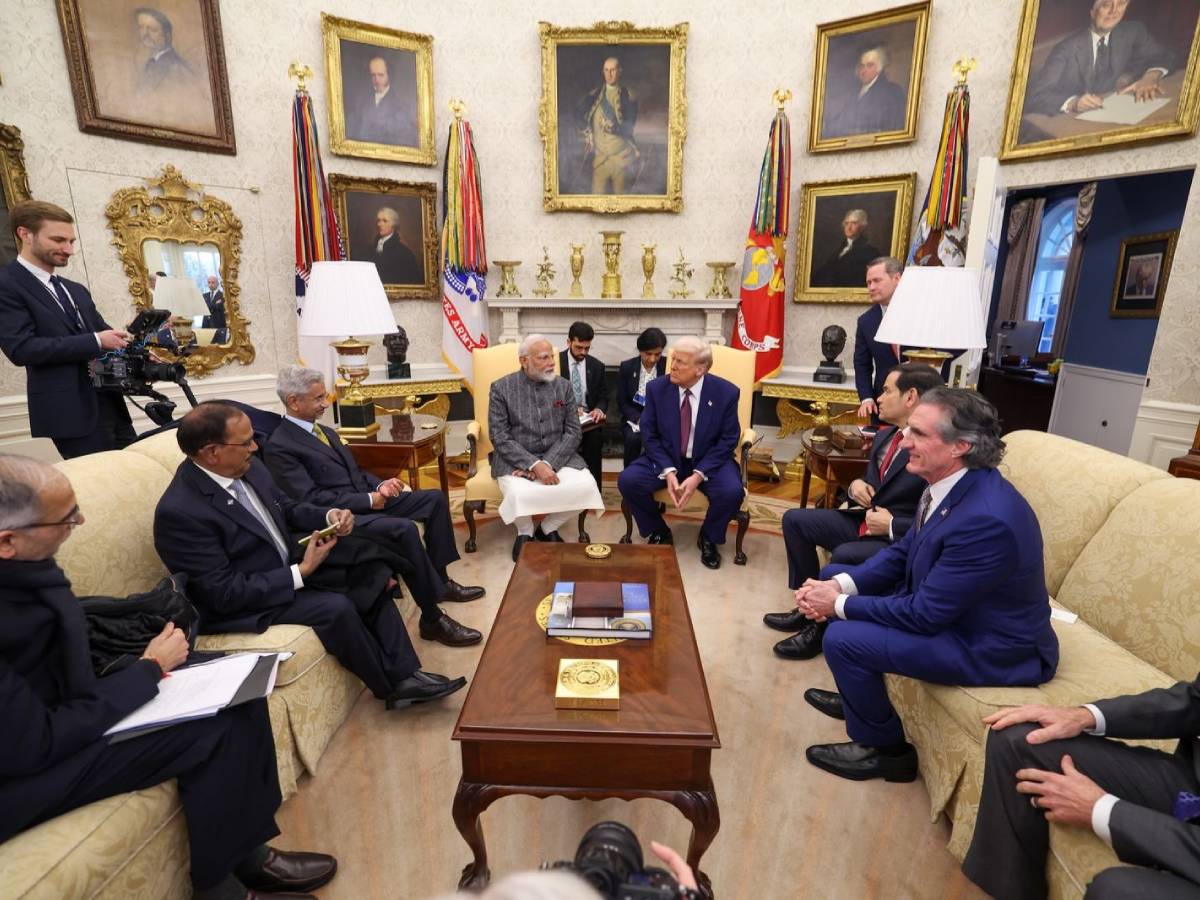
The meeting between US President Donald Trump and Indian Prime Minister Narendra Modi in Washington marked a pivotal moment in US-India relations, producing key agreements across defence, trade, energy, and technology sectors. The leaders launched the “US-India COMPACT for the 21st Century,” emphasising their commitment to deeper collaboration and mutual growth.
Defence collaboration
The two nations agreed to a new ten-year US-India Major Defence Partnership framework. This includes plans for India to procure advanced US defence systems, notably the potential acquisition of F-35 fighter jets. President Trump stated, “The United States will enhance its military sales to India from 2025, including eventually providing F-35 fighter jets.” Additionally, both countries will pursue co-production arrangements for “Javelin” anti-tank guided missiles and “Stryker” infantry combat vehicles in India. The partnership also encompasses elevated military cooperation across all domains—air, land, sea, space, and cyberspace—through enhanced training, exercises, and operations. The forthcoming “Tiger Triumph” tri-service exercise, to be hosted in India, exemplifies this commitment.
Trade and investment
Aiming to double bilateral trade to $500 billion by 2030, the leaders announced plans to negotiate the initial phase of a Bilateral Trade Agreement by fall 2025. This agreement seeks to increase market access, reduce tariff and non-tariff barriers, and deepen supply chain integration. India has pledged to purchase more US oil and gas, addressing the trade imbalance. President Trump noted, “India has agreed to purchase more US oil and gas to help reduce the trade deficit.” Both nations also plan to facilitate greenfield investments in high-value industries, with Indian companies already investing approximately $7.35 billion in the US, supporting over 3,000 jobs.
Energy security
The leaders reaffirmed their commitment to the US-India Energy Security Partnership, focusing on oil, gas, and civil nuclear energy. They emphasised the importance of enhancing hydrocarbon production to ensure stable global energy prices and reliable access for their citizens. The US supported India’s full membership in the International Energy Agency. Both countries plan to increase energy trade, with the US positioning itself as a leading supplier of crude oil, petroleum products, and liquefied natural gas to India. Collaborative efforts will also extend to building US-designed nuclear reactors in India, facilitated by amendments to India’s Atomic Energy Act and the Civil Liability for Nuclear Damage Act.
Technology and innovation
The “US-India TRUST” initiative was launched to promote collaboration in critical and emerging technologies, including defence, artificial intelligence, semiconductors, quantum computing, biotechnology, energy, and space. A central component is the development of a roadmap to accelerate AI infrastructure, enabling industry partnerships and investments in next-generation data centres. The leaders also announced the “INDUS Innovation” bridge, modelled after the “INDUS-X” platform, to advance industry and academic partnerships in space, energy, and other emerging technologies. Efforts will be made to build trusted and resilient supply chains for semiconductors, critical minerals, advanced materials, and pharmaceuticals.
Multilateral cooperation
Both leaders emphasised the importance of a close US-India partnership for a free, open, peaceful, and prosperous Indo-Pacific region. As Quad partners, they reiterated support for ASEAN centrality, adherence to international law, and the peaceful resolution of maritime disputes. Prime Minister Modi invited President Trump to New Delhi for the upcoming Quad leaders’ summit. The leaders also resolved to enhance cooperation with Middle Eastern partners, focusing on critical infrastructure investments and economic corridors to promote regional peace and security.
People-to-people ties
Recognising the significant contributions of the Indian diaspora, the leaders committed to strengthening collaborations between higher education institutions through joint degree programs and establishing offshore campuses of premier US educational institutions in India. They also agreed to streamline legal mobility pathways for students and professionals, facilitate short-term tourist and business travel, and address illegal immigration and human trafficking through decisive law enforcement cooperation.