
Startup funding in the Middle East and North Africa dropped to $127.5 million in March 2025, down 76% from $530 million in February, according to data from Wamda. The total covers 28 equity deals and excludes debt financing in both months.
Despite the March decline, MENA startups raised $1.5 billion in Q1 2025, marking a 244% increase compared to Q1 2024. Excluding debt, quarterly funding was still up 44% year-on-year.
The UAE led the region with $104.4 million raised across 14 deals in March. Egypt followed with $11.6 million from four deals, while Saudi Arabia recorded $8 million across five startups.
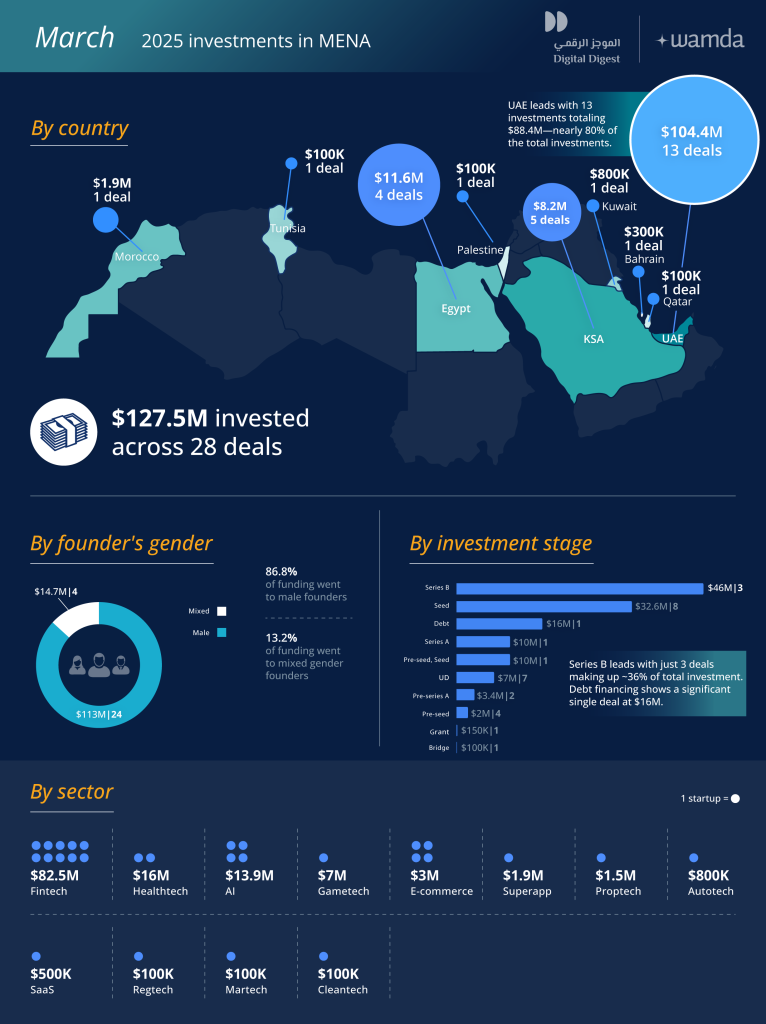
Fintech remained the top-performing sector, attracting $82.5 million through 10 deals. Healthtech accounted for $16 million, followed by AI with $14 million across four companies. No funding was reported for SaaS startups for the second consecutive month.
B2B startups drew the majority of funding in March, securing $97 million across 16 companies, while B2C ventures raised $24 million from six deals. The remainder went to mixed-model businesses.
Late-stage startups raised $46 million, representing 36% of March funding, with three Series B rounds. Early-stage companies (pre-seed to Series A) attracted $58 million. Debt financing accounted for 12.5% of total capital raised in the month.
No female-founded startups received funding in March. Male-led ventures raised $113 million, with the rest going to mixed-gender founding teams.
According to Wamda, the sharp monthly decline reflects a broader slowdown in investment linked to global trade tensions and regional macroeconomic uncertainty. However, Q1’s performance signals continued investor interest in the region, particularly in fintech, which raised more than $1 billion across 36 deals in the quarter.
Looking ahead, Wamda expects investor caution in Q2 amid geopolitical uncertainty, with more capital likely shifting to later-stage companies. Sectors such as logistics, mobility, and e-commerce may face further volatility due to shifting global trade dynamics.