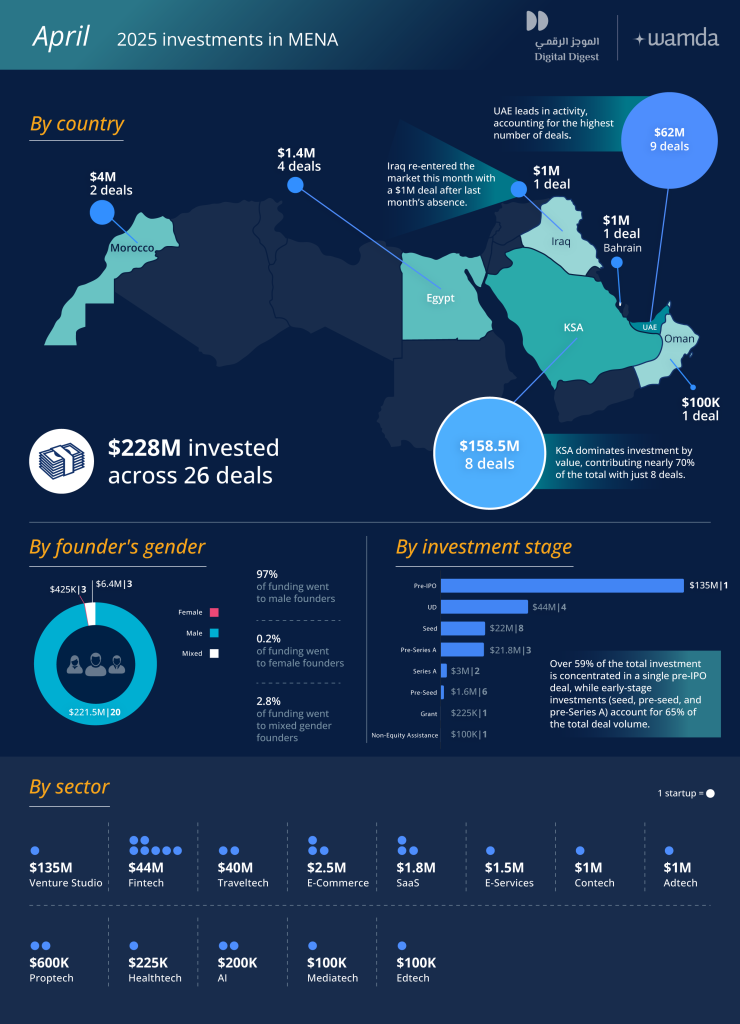

Startups in the Middle East and North Africa (MENA) region raised $228.4 million across 26 equity deals in April 2025, marking a 105% increase from March and nearly a 300% rise compared to April 2024, Wamda reported.
Saudi Arabia led the region, attracting $158.5 million across eight deals, largely due to iMENA Group’s $135 million pre-initial public offering (IPO) round. The UAE followed, with nine startups securing a total of $62 million.
iMENA Group’s funding round was led by Sanabil Investments, a unit of the Public Investment Fund, and included participation from FJ Labs and entrepreneur Saygin Yalcin. The capital will increase iMENA’s shareholding in its core businesses—OpenSooq, SellAnyCar, and Jeeny—and support vertical and geographic expansion.
Morocco ranked third in regional funding, with two startups raising $4 million. Egypt followed, where four startups secured a combined $1.5 million.
Fintech remained the top sector, attracting $44 million across seven deals. Travel technology saw increased activity, notably with HRA Experience’s transaction, while e-commerce startups raised $2.5 million across three deals. Software-as-a-service (SaaS) startups re-emerged, securing $1.8 million in three deals after minimal activity in the first quarter.
Early-stage startups dominated the investment landscape, raising $49 million across 20 transactions. Late-stage activity was limited to iMENA’s pre-IPO round.
Business-to-business (B2B) startups led in funding, securing $180 million across 12 deals. Business-to-consumer (B2C) startups followed, raising $43 million across seven deals. Six startups operating both B2B and B2C models accounted for the remaining disclosed funding.
Funding for female-led startups continued to decline, falling below $500,000 in April. In contrast, startups with male founders secured 97% of all disclosed investments. An additional $6.5 million went to three startups with both male and female co-founders.
Notably, April saw no debt-financed deals, indicating a shift towards equity-based funding and suggesting increased investor confidence in the region’s startup ecosystem.