Dubai is strengthening its position as a leading financial hub, with new data showing rising equity and debt capital market activity, surging foreign investor interest, and targeted regulatory reforms. According to a joint Dubai Financial Market (DFM) and HSBC report, Dubai is accelerating efforts to attract capital and listings from across the Middle East, Africa and South Asia (MEASA) as part of its D33 economic agenda, which aims to position the city among the world’s top four financial centres by 2033.
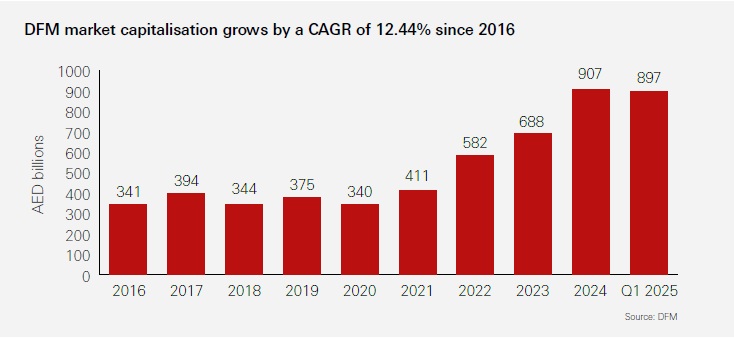
The report highlights that DFM’s market capitalisation has grown at a compound annual rate of 12.44% since 2016, reaching Dh907 billion by Q1 2025. Government-led IPOs have accounted for the bulk of market expansion since 2021, raising Dh43 billion across deals including DEWA, Salik, Parkin, and DTC. Newer listings, including Talabat and Spinneys in 2024, signal a pivot towards private sector participation.
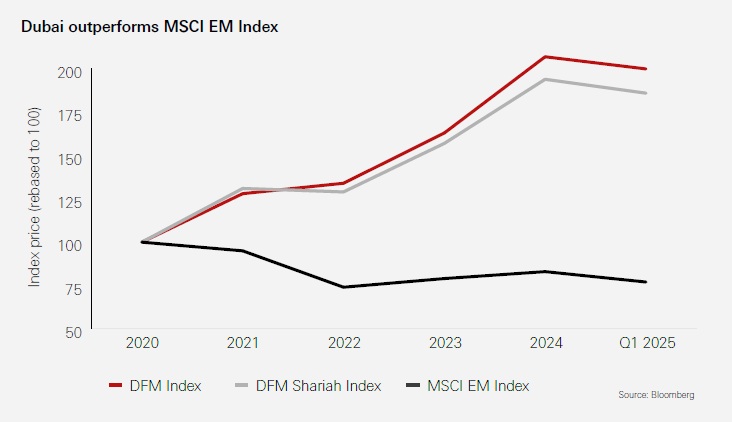
DFM’s average daily trading value reached Dh663 million ($180 million) as of Q1 2025, more than doubling from previous years. The exchange’s forward price-to-earnings ratio stands at 9.6x, compared to 12.4x for other Gulf markets and 12.0x for the broader MSCI Emerging Markets Index. HSBC Global Research maintains an overweight rating on the UAE, citing relatively defensive characteristics, including structural insulation from oil price swings and geopolitical risks.
A key development in 2025 is the reduction of the minimum free float requirement from 30% to 20%, lowering the barrier for new listings. The use of stabilisation mechanisms in IPOs—first applied during Parkin’s listing—has also enhanced post-listing price performance and investor confidence. Foreign ownership limits have been liberalised, with some companies allowing up to 100% non-domestic holdings.
DFM is also moving to expand its secondary market and pre-IPO financing capabilities. Its new platform, ARENA, targets SMEs, family-owned businesses, and early-stage growth companies with pre-money valuations of around $100 million. It aims to bridge the funding gap before public listing, offering capital raises starting from $10 million.
On the debt side, Dubai’s capital markets continue to deepen. Nasdaq Dubai and DFM collectively host Dh521.5 billion ($142 billion) in outstanding sukuk and bonds. The UAE ranked third among emerging markets for dollar-denominated debt issuance in 2024, excluding China. In Q1 2025, sukuk issuance surged 42% year-on-year, with ESG-linked instruments accounting for 21% of Nasdaq Dubai’s total DCM listings.
Chinese and Indonesian sovereigns have issued on the exchange, and Nasdaq Dubai now hosts 45% of all non-UAE issuers. Dubai has also emerged as the global leader for ESG sukuk, with 35% of global outstanding volumes listed in the city. The UAE government’s treasury sukuk programme has increased local currency activity, pushing the AED share of DCM listings to nearly 25%.
Investor demographics are also shifting. Foreign investors now account for 53% of DFM ownership and represent half of all trades. DFM surpassed 1.2 million registered investors in 2024, with 85% of new registrations from outside the UAE. DIFC now hosts eight of the world’s top ten asset managers and more than 75 hedge funds managing over $1 billion each.
Dubai introduced a range of infrastructure enhancements to support further market development in 2024 and 2025. These include omnibus accounts, cross-listing MOUs with Hong Kong, Shenzhen and Switzerland’s SIX exchange, a robo-advisor regulatory framework, and a tokenisation sandbox. The Central Bank’s Financial Infrastructure Transformation (FIT) programme is also 85% complete.