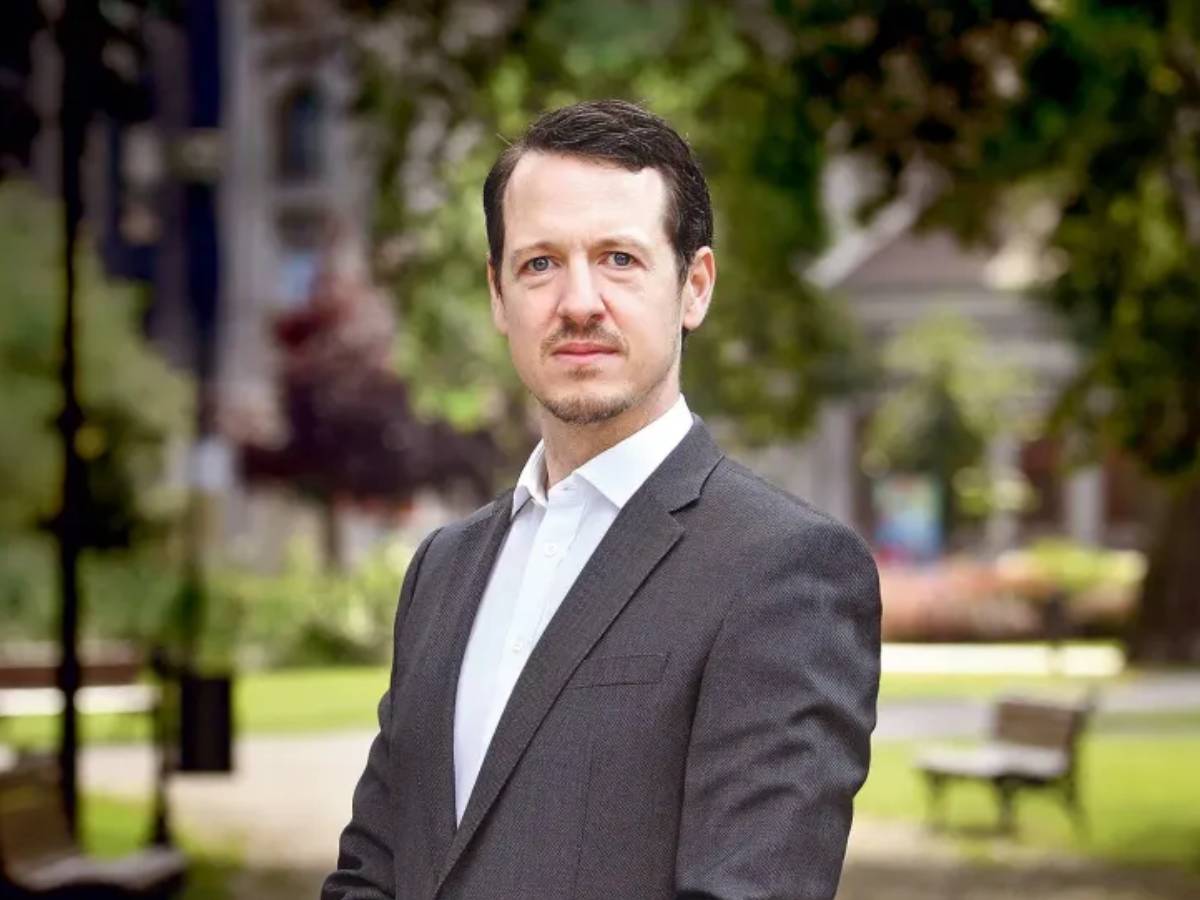
When one envisions meeting a royal for the first time, the setting is usually grand. A party at a palace or an official ceremony at the Parliament building. A Bitcoin conference in Abu Dhabi, instead, comes as quite a surprise.
Young, educated and down-to-earth, Filip Karađorđević, referred to in English as HRH Prince Philip Karageorgevitch, is the unofficial Hereditary Prince of Serbia and Yugoslavia. With a career in traditional finance and asset management, he is the second grandson of the last King of Yugoslavia, Peter III, and a great believer in Bitcoin.
How does a representative of one of the most traditional institutions in society embrace something as unconventional as Bitcoin? For Prince Philip, the answer is clear.
“Bitcoin is freedom, something I want for Serbia and the world,” the prince said in 2022, shortly after a TV interview in one of Serbia’s top TV talk shows, which marked his first public act of advocacy for the cryptocurrency. The prince then described Bitcoin as a “fungible” and “censorship-free” tool that can empower individuals and promote economic growth. His influence, combined with his knowledge of financial systems, has led him to advise on initiatives that aim to integrate Bitcoin within nation-states’ financial systems. However, his support for Bitcoin does not extend to other cryptocurrencies. In an interview with Finance Middle East during the Bitcoin MENA conference in Abu Dhabi, the prince clarified: “It’s not about crypto. It’s all about Bitcoin.”
The prince’s crypto journey
The conversation starts with a reflection on the past. How did he get here? Prince Philip recalls first learning about cryptocurrencies around 2010, when credit card companies began blocking donations to WikiLeaks. Yet, he did not look into it at the time. “I wished I had listened,” he admitted. “I wish I had studied harder.”
Seven years later, crypto came calling back when Prince Philip received advice from one of his close friends to buy Bitcoin as an inflation hedge. He decided to give the new technology a chance and opened his first Coinbase account and wallet. “I was always buying Bitcoin when I had a good paycheck.”
However, it wasn’t until 2020 that the prince went all-in on the cryptocurrency. At the time, Prince Philip was working in traditional finance and asset management in London. Despite his experience in the sector, or perhaps because of it, he was confused by the market’s reaction to the virus and the stimulus being pumped into the market. Curiosity led him, once again, towards Bitcoin.
“I joined the Bitcoin Twitter space,” he said. “I learned a lot there. Next thing I know, by the end of 2020-start of 2021, I sold everything and went straight into Bitcoin.”
The career shift also allowed Philip to change location, leaving the UK for Serbia alongside his wife and children. The move, he said, was a way to reconnect with the people of the country his family once ruled. “We wanted to live downtown, with our people,” he said. “We take our son to nursery. I’m going to the market all the time. I’m just there, living life normally.”
A Bitcoin monarchy?
When people think about the monarchy, they think tradition. Alternatively, when Bitcoin comes up in conversation, it is generally related to the future of finance, decentralisation, risk and reward. For Prince Philip, the two of them are more alike than they may seem.
“Monarchy and Bitcoin have close synergies,” Prince Philip states confidently. “Both are about strong private property rights and low time preference.”
A “good monarchy”, by the prince’s standard, cares for its people. Monarchs also want their dynasty to stretch for generations. “That means strong private property rights, minimal taxation, minimal intervention and a good legal system so people are happy and will not want to revolt,” he said, stressing the importance of ensuring that “people are free to do what they want, as long as they don’t break the rules.”
In Prince Philip’s view, the same can be said of Bitcoin. “It’s a similar situation, where it’s rules and not rulers.” Rules are one of the key reasons why he focuses on this specific currency above all others. “We have rules that you can’t break,” he notes. “If you break them, Bitcoin doesn’t work for you, and you just get ostracised.”
Low time preference is also a shared trait. Monarchies want to last for generations. For this reason, they are careful about the long-term impact of their decisions, knowing the ruling family will be held accountable for any negative consequences. “A monarch holds accountability for his decisions,” the prince stated. “If he makes a bad decision, his sons and his grandchildren will bear that bad decision as well.”
The preference for instant, visible results can, in the prince’s view, take away from the potential of longer-term strategies that could create far greater value. “Those short-term cycles just lead to high time preference,” he said. “They lead to an ‘instant gratification’ world, whereas with monarchy, it led more to a delayed gratification world. When you especially couple it with hard money such as Bitcoin, then you have the ability to grow civilisation further.”
“When you have security for the future, you can start investing in yourself, your family and your community,” he stated.
But what about volatility? Prince Philip has a quick answer: “Bitcoin is only volatile when compared to FIAs. But if you’re living inside a Bitcoin standard when there was no Fiat around, then life is very calm. There’s no volatility.” In his view, one of the most common mistakes when regulating crypto assets is not differentiating between Bitcoin and other cryptocurrencies.
“Bitcoin is a commodity,” he said. “Anything that’s made after Bitcoin is a security. It’s a company that needs a separate set of regulations. Bitcoin should not be regulated. The others should, to protect individuals.”
At the same time, he stresses the importance of taking advantage of volatility. “As Bitcoiners, who are trying to hopefully transition into a Bitcoin world, you use that volatility in your favour,” he said, highlighting how this ultimately benefits individual investors over large corporations. “Volatility is not something that many people can stomach, and it’s definitely something that a lot of companies cannot stomach because it’s not, it’s it breaks their models. Their models are not designed to invest in assets that are so volatile. That favours the little people.”
How to build a Bitcoin nation
We discussed monarchies and large companies. What about governments and nation states?
Prince Philip’s strong belief in Bitcoin’s potential to have a positive impact on society has led him to join JAN3, a startup focused on accelerating “hyperbitcoinisation” for nation-states and individuals. As the company’s Chief Strategy Officer, the prince engages with heads of state, legislators, monarchs, politicians, and C-suite executives, advocating for strong individual property rights and financial freedom through Bitcoin.
“We all know that Bitcoin is a bottom-up strategy and it’s decentralisation,” he said. “But we also need a bit of a top-down strategy, and that will help with Bitcoin’s marketing and credibility.”
This was the view of Samson Mow, JAN3’s CEO, best known for his work with El Salvador’s Bitcoin initiatives, and also of the prince. “If we meet with politicians, leaders, ministers, residents, influential individuals, corporate leaders around the world, and teach them about Bitcoin and the benefits of Bitcoin, not just for them, but for their people, then we see that as helping to speed up bitcoinisation.”
What is hyperbitcoinisation? In short, it’s what the future holds, according to JAN3. “Humans will choose the hardest and the best assets, and that is Bitcoin, once they learn about it,” Prince Philip said. To accelerate this process, the prince meets with decision-makers and encourages Bitcoin adoption in whichever form best suits them, from mining to storing value, and many more.
JAN3 is not just talk. The company builds Bitcoin infrastructure and increases accessibility to Layer 2 technologies such as Lightning and Liquid. It has created AQUA, the first Bitcoin and Liquid wallet with native stablecoin support, which enables users to spend in USDt and save in Bitcoin. In Prince Philip’s words, it’s “complete, open-source and non-custodial”.
“We released this at the beginning of 2024, and we have not marketed it. We have not spent any money on marketing,” he said, stressing how the app had achieved over 50,000 downloads in under a year. Why? “Because it works,” he claimed.
A prince’s duty
“I am a prince,” he stated proudly. Although Serbia (and, previously, Yugoslavia) has been a republic for over half a century, Prince Philip still maintains a sense of commitment towards the country where he lives, and the dynasty he belongs to. His current work perfectly combines his royal and financial background, allowing the prince to use his expertise to create impact. “It’s all about banking the unbanked,” he said, highlighting his desire to bring financial sovereignty to the world. And he believes Bitcoin is the way to achieve it.
“I feel I have a duty,” Prince Philip reflects. “I believe that Bitcoin is going to liberate a lot of people. It’s doing that all over the world, in countries that have hard financial situations, like Nigeria, Venezuela, and Lebanon. It’s a human rights thing, and so, the Western world—comfortable and financially privileged—doesn’t see the need for Bitcoin yet. One day, they’ll understand.”