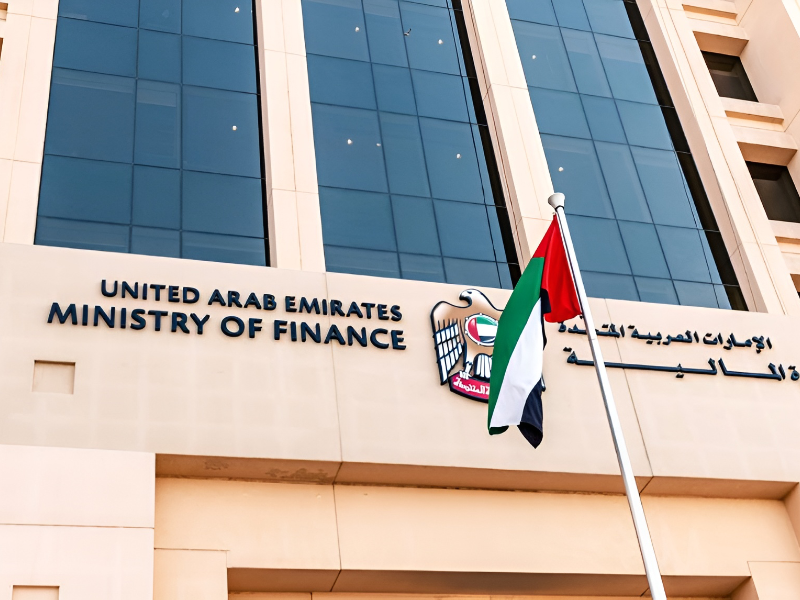

How are global tax and regulatory changes shaping corporate financial strategies in the GCC today?
I think over the last few years, we’ve seen a massive shift in how businesses have started to think about tax. I think this is because the adoption of tax has only sort of emerged because of the introduction of corporate tax. Before, it was always an afterthought for companies here, but I think as the tax deadline has approached closer, we’ve seen a massive shift in how finance functions are now dealing with tax. It’s now becoming part of the strategy, rather than an afterthought. It’s something that you think about for every large transaction, acquisition, M&A, whatever it is that you’re doing, rather than just something that you
would think about later.
I think a big part of it is also the OECD BEPS Pillar Two implementation. It’s compelled companies to think about their tax structures and their documentation so that they’re defensible when it comes to regulations. Regulatory bodies are scrutinising them on why they’ve taken a particular approach and so on. And I think in the GCC, because things move so fast, we can see rapid evolution of how things are moving. Back in 2018, VAT was introduced. And now we have corporate tax next year. We’re supposed to get invoicing. We’re also seeing the adoption of domestic minimum top-up tax from this year and so on. I think it’s shifting quite a fair bit, and I think as and when people get more and more educated, it’s going to become something that’s going to be paramount for every function.
What are the key risks businesses often overlook in their tax and financial reporting that they should be mindful of?
I think one of the biggest risks I’ve seen when we advise companies is the lack of data, or let me put it this way, it’s lack of clean, connected data. There is a lot of scattered data in bits and pieces, but there are very little connectors that bind those together. And I think that’s very important. I think this is because companies here have traditionally never thought of consolidating this, so you have data in multiple systems, sometimes even on spreadsheets like Excel, where stuff is managed and reconciliations are not done at regular intervals and so on. I think that poses a big challenge because if you want to get to the right position, or the most accurate possible position, you need to have clean, connected data to work with.
I think another potentially sort of concerning avenue is intercom in transactions. A lot of companies here are grouped together. They do a lot of pooling of cash, intercompany loans or services that are provided by one entity to five different entities, etc. I think there are a lot of agreements in place to reflect that properly, but not a lot of invoices or paperwork to reflect what kind of services they’re offering and what’s the markup, and if that markup has stood the test of benchmarking.
I think it’s also the world we live in today, especially when you talk about e-commerce or digital media. It’s very easy for companies to overlook the concept of permanent establishment. So, they can be providing services in, say Saudi, while they’re registered here, but inadvertently, they may be creating a permanent establishment in Saudi Arabia, Bahrain or another country and then they also have to make sure they’re registered for tax there and pay their obligations there. So, as your business grows, it’s always nice to be mindful of these things as fundamental points you’re supposed to cater to.
How do regional business environments differ from global markets when it comes to corporate governance and financial planning?
I think the GCC is a very unique business ecosystem. Many companies are family-owned, they’re backed by the government or they’re semi-government, which is a bit different from how you see it in the rest of the world, where it’s mostly private and government. I think decisions tend to be more centralised. I think relationships over here are key. And I think because this is a tightly knit market, it’s usually easier to get a hold of someone if you want to, within the tax authorities.
At least in the UAE, it’s fairly easier compared to the rest of the GCC or Europe. Wherever you want to communicate with the Federal Tax Authority, it’s usually is pretty approachable, and I think that’s because of the ecosystem they’ve developed. I think the regulation here is evolving incredibly fast, like I mentioned. We’ve come from no tax to suddenly VAT and corporate tax, e-invoicing, BEPS, OECD and DMTT. And I think overall this has an influence on everything: how capital markets think of decisions. When it comes to M&As and sovereign wealth funds, when they think of acquisitions, tax was nowhere to be featured, but now everyone’s got to think of these regulations and make sure that the companies that they’re acquiring are complying with these regulations. Otherwise, they can be exposed to big penalties.
How can AI realistically complement, rather than replace, traditional financial advisory?
I think this is a very good point. I think people often mistake AI to be something that’s a replacement. I think it’s supposed to be a tool that’s supposed to augment you, right? And I think that’s where the fear stems from. But I think if there’s a routine, data-heavy task, AI can handle that pretty well because it learns from the data that you share with it. So, things like capturing data from invoices is very simple to do. When it comes to AI, you could load it up on ChatGPT, and it’ll extract most things and then you have specialised tools to do that. We’ve got Simpla that does that. So AI can do a lot of routine tasks really well and it hallucinates a lot less. When you think of AI, think of stuff that is repeated or repetitive in nature, and that is something that AI can do really well. When you have to apply a lot of creativity, that’s where AI still needs some time to go and, you know, do a lot of learning. But I think repetitive and routine tasks are something it can do pretty well.
Where do you see the most immediate implications of AI and data analytics in tax advisory and corporate finance?
So I think in tax advisory, if you were to load up a fair bit of invoices contracts, give it a dump on your GL or trial balance, as we call it, it can start pulling out a lot of things and ask you several questions based o nit. You can get to a point where you have a decent starting point, even if you’re not a tax expert. It will carve out things, like anything that’s disallowable. It will pick up interest to make sure it doesn’t reach the de minimis threshold and so on. It’ll also look at your contracts, telling you accounting-wise when your liability is actually being triggered or when your revenue is supposed to be captured under IFRS 15 and so on. That’s on the advisory front.
I think even on the accounting front, it can process volumes of data and maybe even get to a point where it provides you with insights that you and I would probably take an hour or two to get. It would do that really fast, but I still think there has to be a layer of human intervention that’s supervising it and reviewing the data that it produces
Which sectors do you think will face the greatest disruption in financial management due to technology?
I think we’re going to see significant transformation in banking and financial services across the GCC. Traditional banking processes—like SME financing applications that currently take weeks—could be compressed into hours through AI-powered risk assessment and automated compliance checks. The technology exists today; it’s about regulatory frameworks catching up and institutions being willing to evolve.
Cross-border payments is another area ripe for disruption. Right now, international transfers can take up to five days, but with tokenization combined with AI-driven KYC processes, we could see near-instantaneous settlements. This is particularly relevant for the GCC given our role as a global trading hub.
I’d also highlight professional services—including advisory firms like ours. AI is fundamentally changing how we deliver insights to clients. What used to require days of data analysis can now be done in hours, allowing us to focus on strategic interpretation and implementation rather than data processing. At Oblique, we help clients in these sectors understand not just the technology, but how to integrate it strategically into their financial management frameworks.
How is Oblique leveraging AI today?
At Oblique, we’re already embedding AI into our service delivery model. When a potential client submits an inquiry through our website, an AI agent conducts the initial discovery call—asking the right questions, understanding their needs, and gathering essential information. This data then flows into our proposal development system, significantly accelerating our response time.
The goal isn’t just speed for its own sake. It’s about deploying AI where it excels—data capture, pattern recognition, routine processing— so our human experts can focus entirely on what requires genuine expertise: strategic thinking, creative problem-solving, and nuanced advisory. We’re seeing that this hybrid model delivers both faster turnaround and deeper insights for our clients.
This is exactly what we advise our clients to do: identify the repetitive, data-heavy processes in their operations and augment them with AI, while keeping human judgment at the centre of strategic decisions. We’re not just talking about AI’s potential—we’re demonstrating it every day in how we run our own practice.
Listen to the podcast here:
Listen to all Cheque Point podcast episodes here.