

The majority of UAE banks recorded increased profitability and high return rations in 2023 compared to the year prior, according to the UAE Banking Pulse 2023 report published by professional services firm Alvarez & Marsal (A&M).
The combined net income for banks increased by 54.1% year-on-year in 2023, reaching Dh76.9 billion, the report found. This was primarily due to higher interest income, significant growth in advances, expanded net interest margins, and improved asset quality.
The report examines public disclosures from the 10 largest listed banks in the country, identifying the changes between the FY’23 and FY’22 results. It assessed banks’ key performance areas, including size, liquidity, income, operating efficiency, risk, profitability, and capital.
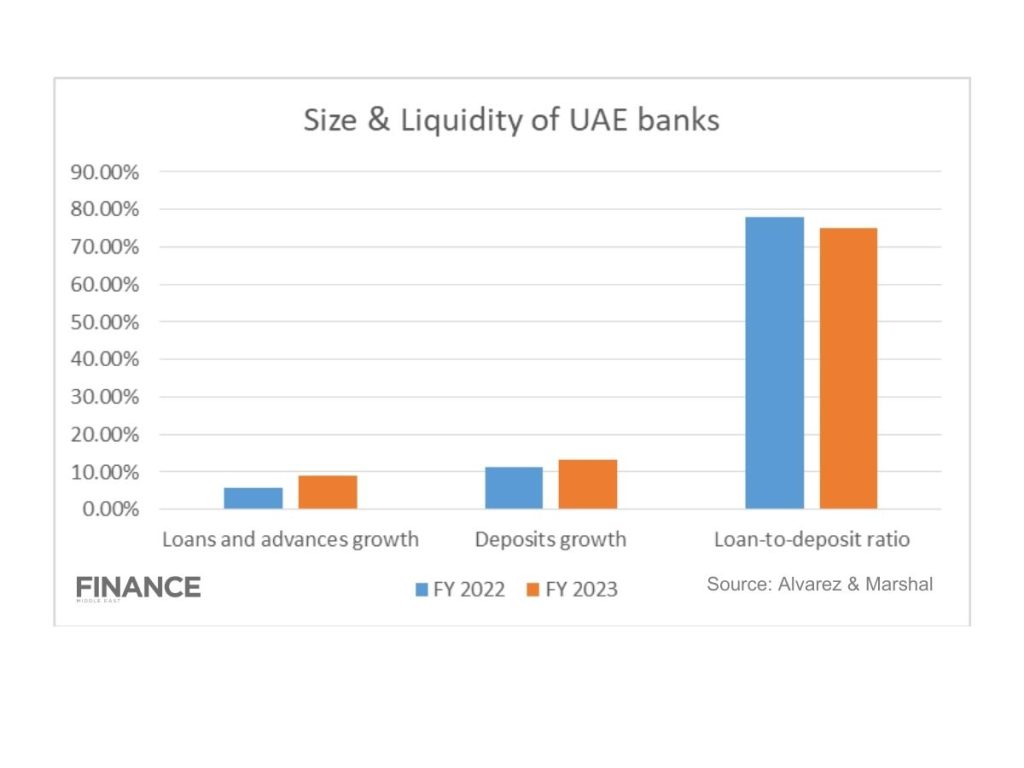
The report found that the aggregate deposits for the top 10 UAE banks grew at 13.4% YoY whereas aggregate loans & advances (L&A) increased by only 9.0% YoY in 2023. As a result, the loan-to-deposit ratio (LDR) slipped 3.1 percentage points YoY to 74.9%.
The total operating income of the banks researched increased by 28.8%, primarily driven by a growth in net interest income of 27.6% YoY. The non-funded income rose by 31.4% YoY.
The net interest margins expanded by 36bps YoY to 2.8% due to a higher yield on credit of 11.5% in FY’23. Aggregate net interest income (+27.6% YoY) grew due to an increase in the Central Bank of the UAE (CBUAE) policy rate (+100bps) during the year.
The cost of funds increased by 2.2 percentage points YoY to 4.0%.
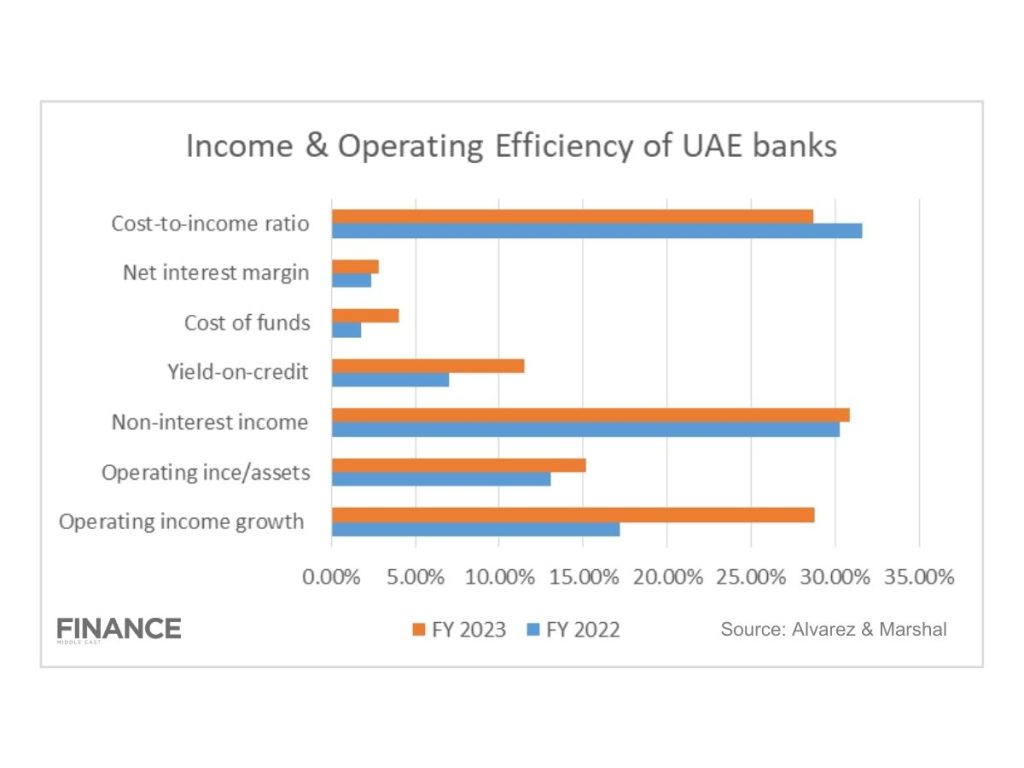
During this period, the analysed bank’s operational cost efficiencies improved. The cost-to-income ratio improved (-2.8 percentage points YoY) to 28.7% in 2023. The operating income grew by 28.8% YoY and the operating expense increased by 17.2% compared to the year before.
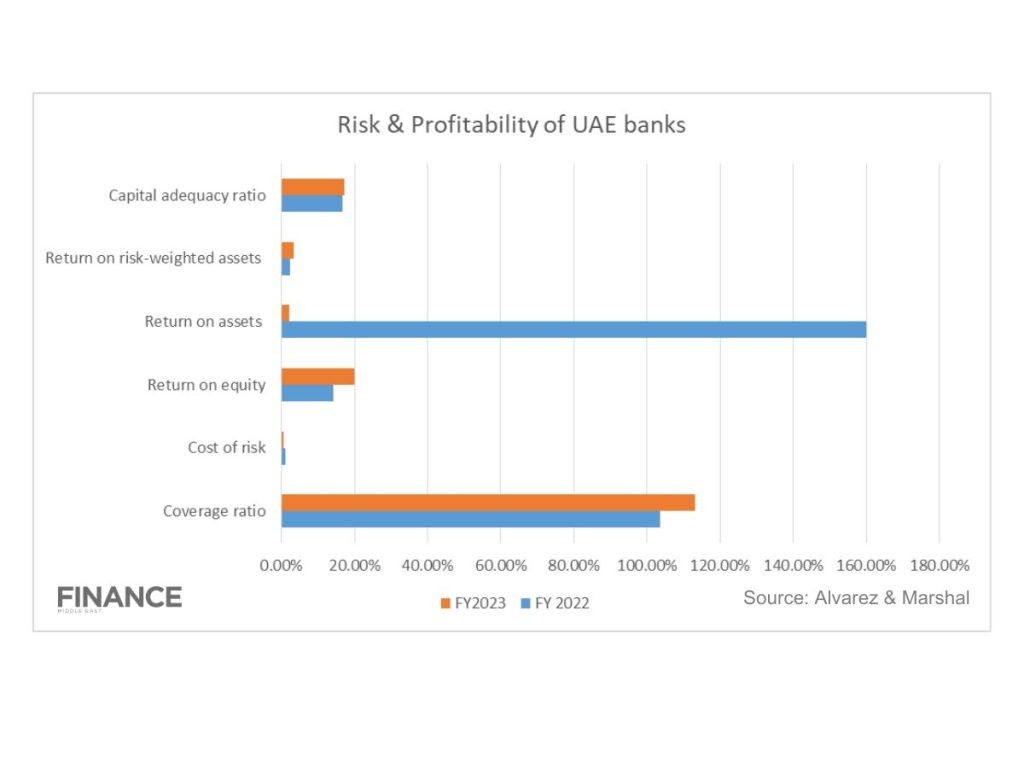
At the same time, the cost of risk (CoR) improved by 25bps YoY to 0.7% as banks reported a decline of 19.8 % YoY in impairment charges in 2023, amounting to Dh13.7bn.
The majority of banks reported an increase in profitability resulting from rising interest rates over the course of 2023. Aggregate net income increased by 54.1% during this period and, as a result, return ratios such as return on equity (ROE) and return on assets (ROA) improved by 5.7 percentage points to 19.9% and 0.6 percentage points to 2.2%, respectively.
Looking ahead, as the Central Bank of the UAE continues to align its benchmark rate with that of the US Federal Reserve, A&M said it anticipates a shift in the second half of 2024 when rate reversals are expected to commence.
This may present some short-term margin enhancement as deposit costs are likely to reduce relatively faster in response to rate cuts compared to the pace at which asset pricing may adjust.
“In general, the sentiment is optimistic, though cautious given the geopolitical scenario. Given that the UAE banks are mostly well capitalized, profitable, liquid, and well supported by regulators, we look forward to a stable 2024,” said Mr. Asad Ahmed, A&M Managing Director and Head of Middle East Financial Services.
The banks included in the report are First Abu Dhabi Bank (FAB), Emirates NBD (ENBD), Abu Dhabi Commercial Bank (ADCB), Dubai Islamic Bank (DIB), Mashreq Bank (Mashreq), Abu Dhabi Islamic Bank (ADIB), Commercial Bank of Dubai (CBD), National Bank of Fujairah (NBF), National Bank of Ras Al-Khaimah (RAK) and Sharjah Islamic Bank (SIB).