As the UAE considers freezing Iranian assets in the Emirates, UAE officials ought to look at on-chain finance as one of the fundamental pillars sustaining illicit trade finance across sanctioned state actors and their shadow corporations.
In 2025, sanctioned entities moved at least $154B via crypto networks, a 694% YoY surge, highlighting how Iran and Russia leverage blockchain to sustain economic activity despite sanctions.
One question stands out: how can Iran maintain economic activity — as fuel stations remain open and trade continues — while networks linked to the IRGC and Russian state hold assets across the global financial system.
Crypto increasingly serves as a parallel financial system for sanctioned actors. This raises urgent questions for GCC regulators for the day after the current war.
Iran’s Crypto Capital Flight (USD)
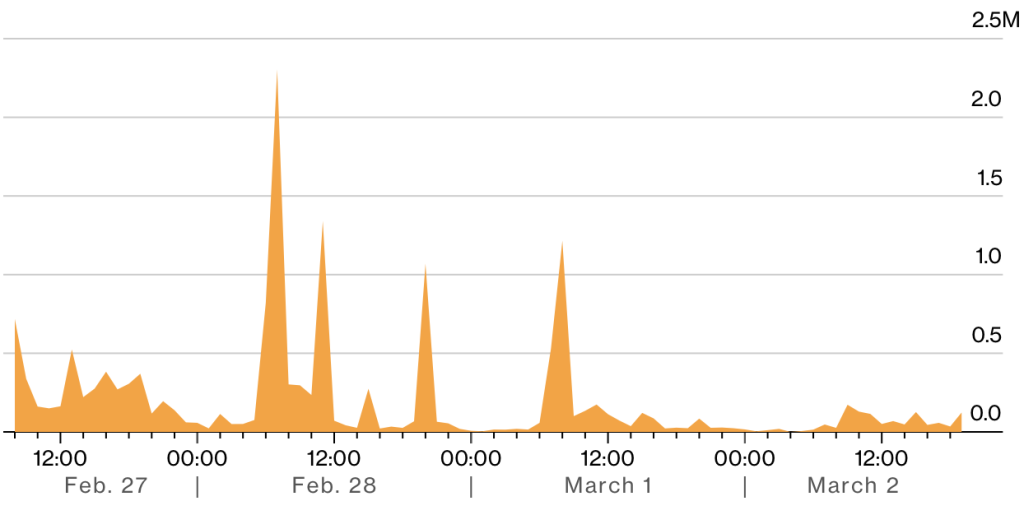
Source: Chainalysis (Hourly Outflows of Stablecoins)
Crypto outflows, from Iran, peaked at $2.3M at the time of U.S.-Israeli bombing on 28 February according to Chainalysis. The timing of the bombing and outflows of stablecoins suggests that crypto is becoming a tool for illicit finance just as much as it can be leveraged by the private sector.
In the hours before the strike, outflows remained relatively modest. Yet hourly volumes surged sharply within several hours of the strike, reaching or exceeding $2M.
Crypto in the UAE and U.S.
Corporations in the UAE are embracing crypto as a means of agency, inclusion, and accessibility. DeFi empowers the private sector, providing decentralised control in entrepreneurial markets, supports SMEs in developing markets, whilst supporting the GCC real estate market through smart contracts.
Essentially, crypto is a double-edged sword: a force for sanctions and AML evasion in specific sectors, such as real estate, yet an overall enabler for accessible, inclusive, and cost-effective finance.
While jurisdictions such as the UAE and the U.S. are strengthening crypto regulation, sanctioned states are increasingly exploiting the same infrastructure to “move funds, facilitate trade, and maintain financial connectivity at scale,” according to Kaitlin Martin, Senior Intelligence Analyst at U.S. based crypto compliance firm: Chainalysis.
Because blockchain transactions are recorded on an immutable, time-stamped ledger, compliance firms can monitor and trace these flows, offering regulators and industry unprecedented transparency and insight.
DeFi in Russia: Ruble-backed A7A5 token
Decentralised finance offers cross-border, instantaneous liquid capital access, bypassing traditional banking channels.
In Iran, networks linked to the IRGC received more than $3B on-chain in 2025. Stablecoins now dominate illicit crypto transaction volume, accounting for approximately 84% of total illicit flows, highlighting their liquidity, stability, and adoption says Martin.
Similarly, in Russia — subject to extensive U.S., UK, and EU sanctions — Russia, like Iran, has maintained international trade and payments despite sanctions because of crypto networks.
The Ruble-backed A7A5 token has “allowed Russian firms to on-ramp fiat assets to the blockchain, swap them for stablecoins, and conduct cross-border trades while circumventing sanctions,” the Senior Intelligence Analyst said.
Regulatory Lessons: FATF and GCC Approaches
The Financial Action Task Force – dubbed the ‘global financial watchdog’ – leads AML compliance oversight.
Recommendations 15 and 16 are the global best practices for regulating crypto and DeFi, says Martin.
Recommendation 15 focuses on licensing and supervising virtual asset service providers (VASPs), while Recommendation 16 — the Travel Rule — requires sharing sender and recipient information for transfers between Virtual Asset Service Providers (VASPs). Both clauses are pivotal for institutions looking to cut off illicit financial flows between states, corporations, and individuals.
The UAE broadly aligns its crypto regulation with FATF guidance, though operational enforcement is still evolving as the DeFi market grows. Travel Rule compliance is being phased in across licensed entities.
Multiple regulators, including the Central Bank of the UAE (CBUAE), FSRA (Abu Dhabi Global Market), VARA (Dubai), and DFSA (DIFC), recently established and updated clear licensing rules, conduct standards, and AML/CFT requirements for crypto activity, aligning with international norms and providing market clarity.
In 2024, the UAE exited the FATF grey list while Kuwait was recently added earlier this year citing enforcement gaps.
Blockchain: Advantages for Regulators
GCC regulators should continue to embrace blockchain, but understand the loopholes that need shutting.
By integrating blockchain intelligence, firms and regulators can implement robust AML/CFT controls, including KYC/EDD, continuous on-chain monitoring, and sanctions screening.
This visibility allows regulators to identify systemic risks, allocate resources efficiently, and respond quickly to emerging threats. Countries building data-driven, cross-border public-private partnerships are positioning themselves to adapt to the evolving on-chain ecosystem.
Over time, many jurisdictions — including the EU through MiCA and Switzerland — are expanding frameworks beyond AML, introducing prudential and market conduct requirements that mirror traditional finance. These steps aim to build institutional trust, encourage safe adoption, and maintain market integrity.
Capital Flight and Real Estate
Despite regulatory frameworks, global financial hubs will remain channels for laundered illicit funds.
Real estate continues to be a preferred vehicle for moving illicit capital. Recent Iranian capital flight has flowed to domestic exchanges, overseas exchanges, intermediary services, and self-custody wallets.
Capital markets, specifically illiquid assets like property, have less stringent KYC and AML requirements than banks or bond markets. Even with regulation, cross-border exchanges using conventional banking can often bypass local oversight via brokers, lawyers, and other intermediaries. Crypto, although regulated, makes AML enforcement difficult as regulators adjust to DeFi.
Crypto adds complexity: while regulated, DeFi platforms can make AML enforcement more challenging. Tracking state-linked transactions requires disentangling retail activity, service-level wallet management, and cross-border transfers.
Tracking the surge in capital following U.S. and Israeli strikes is therefore complex, as it involves disentangling retail activity, service-level wallet management, and state-linked transactions.
Next Steps: (De-)Centralised Finance
Sanctions alone cannot prevent illicit finance if regulators fail to enforce robust oversight.
For the UAE now, striking a balance between fostering crypto innovation and closing regulatory gaps is essential to safeguard regional markets from abuse by state and non-state actors alike.
Freezing Iranian assets will only address part of the problem. As illicit finance moves increasingly on-chain, regulators must treat blockchain finance with the same sanctions and AML scrutiny applied to banks.
For the UAE and the GCC, closing these regulatory gaps will determine whether crypto becomes a pillar of innovation or a channel for evasion.
NOTE: Thank you to Kaitlin Martin, Senior Intelligence Analyst at Chainalysis, for her insights that guided this article.
Stay Up to Date with the Latest Updates at Finance ME!
‘Force Majeure’: Hormuz Closure Seeps into Global Energy Markets