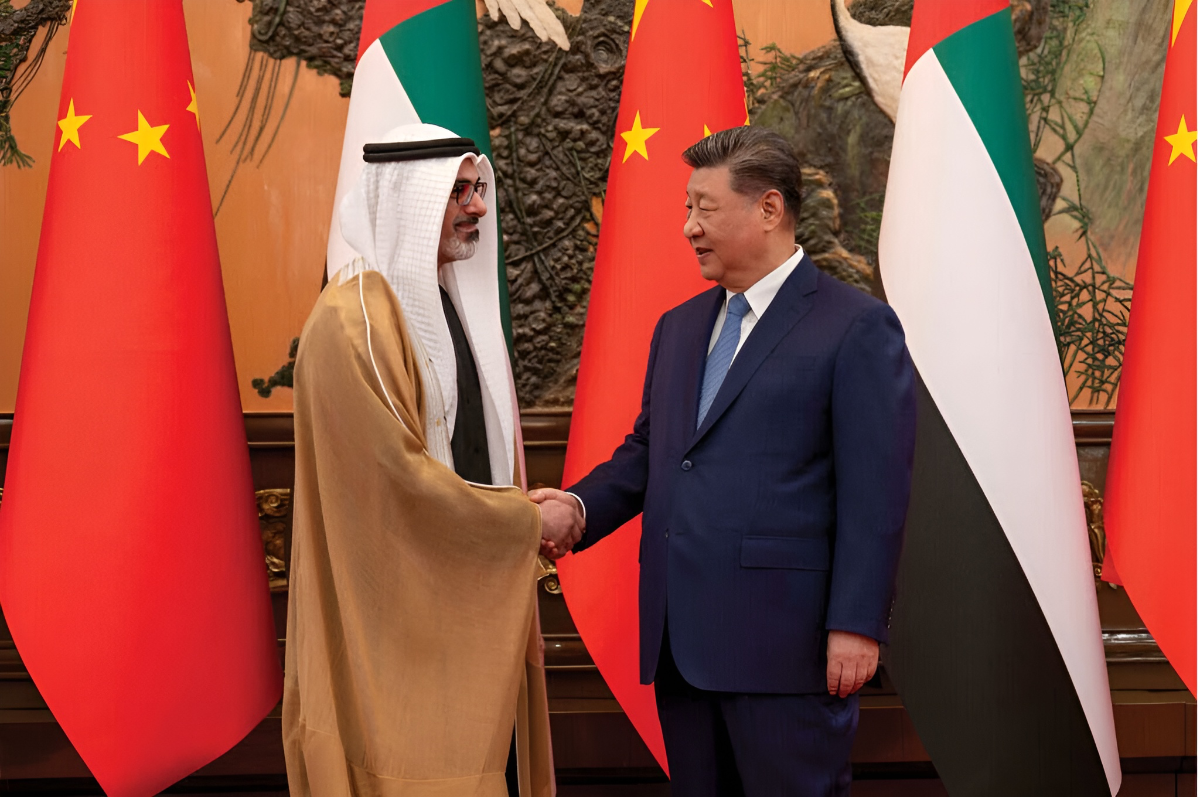

The latest visit by Abu Dhabi Crown Prince, HH Sheikh Khaled bin Mohamed Al-Nahyan, to Beijing signals a broader shift in the relationship between Abu Dhabi and Beijing from traditional cross-border investment toward a deeper strategic partnership spanning artificial intelligence, clean energy and long-duration infrastructure.
China Seen as More than a Capital Destination
During the recent visit, senior UAE officials met key Chinese institutions underscoring the scale and importance of sovereign capital links between the two countries.
“During the visit the UAE leadership met China Investment Corporation (CIC) Chairman and CEO among others, showing the important cross-border investment relationship between UAE and China,” said former Managing Director and Head of North America at CIC, Prof. Winston Ma, who worked inside CIC for over 10 years.
The visit comes as Gulf sovereign investors increasingly reassess how they deploy capital globally amid shifting geopolitical and economic conditions. Since 108, ADIC is operating as Mubadala’s indirect investment arm whilst Mubadala Investment Co. has inked more than 300 deals in the last five years since 2020.
Mubadala Investment Company reported a 17% rise in AUM in FY25, boasting a significant achievement for Abu Dhabi.
Yet China remains a major market for UAE overseas AUM, but also for “access to manufacturing capacity, technology ecosystems and energy transition supply chains,” according to Prof. Ma.
Potential Asset Consolidation Could Create Larger Strategic Platform
Earlier reports showed that L’imad Holding Company and Mubadala Investment Company were considering merging the assets of two of its sovereign funds in China.
The venture will be jointly owned by L’imad and Mubadala, Bloomberg reported.
Prof. Ma said reports that Abu Dhabi-linked investors could consolidate certain China holdings into a unified structure would mark a strategic evolution rather than a simple portfolio reshuffle.
“This consolidation creates a ‘Sovereign Mega-Buyer,’ aligning all Abu Dhabi-based China holdings into a single strategic front,” he said.
“From a Sovereign AI perspective — having discussed exactly this dynamic with Core42 and ADIA’s infrastructure investment team in Abu Dhabi in January — a unified portfolio enables coordinated investment across all five layers of the AI stack.”
That reflects a broader trend in sovereign investing, where funds increasingly seek strategic exposure to sectors such as semiconductors, data centres, energy systems and digital infrastructure rather than purely passive allocations.
AI and Energy
Looking ahead, the next decade of China-UAE investment cooperation could be defined by industrial-scale partnerships.
“The next decade will be defined by ‘Integrated Sovereign Stacks’ — joint ventures building gigawatt-scale AI factories powered by Chinese renewable technology and financed by UAE sovereign capital, for example.”
The UAE will need access to the clean energy manufacturing that China is leading in globally.
Investment Focus: Venture Capital to AI Factories
Sector alignment is also changing. Winston said momentum is moving away from conventional venture capital and toward infrastructure-heavy technology deployment.
“Alignment is shifting from traditional venture capital to the ‘AI Factory’ model — where Chinese green-energy manufacturing meets UAE compute infrastructure.”
“The convergence is most visible across Jensen Huang’s five-layer AI stack: Chinese industrial capability supplies the hardware and energy layers; UAE sovereign capital funds the cloud and infrastructure build-out.”
“Both sides operate on decade-long investment horizons, and that shared patience is the structural alignment Western PE cannot replicate.”
UAE Funds Becoming More Active in Chinese Technology Markets
He added that UAE sovereign investors have also become more active participants in Chinese technology markets.
“These entities have moved from passive allocators to active technology integrators, exemplified by ADIA’s $65M cornerstone investment in MiniMax’s January 2026 IPO, which saw a 6 fold return in just three months.”
By doing so, he said, Gulf investors are seeking exposure to foundational technologies expected to drive future industrial growth.
Regional Risks Could Reinforce Diversification Toward China
Regional instability may also reinforce that trend.
“Heightened regional conflict probably drives UAE SWFs to further diversify its portfolio holdings and to tap China market exposure as a critical geopolitical hedge,” Winston said.
ADQ and Mubadala’s investments in China were ongoing before the onset of the Iran war.
However, the downside risks facing sovereign wealth fund portfolios are likely to accelerate capital allocation abroad in the immediate term.
Stay Up to Date with the Latest Updates at Finance ME
“We Can’t Stand Still”: Alserkal SMEs Break Even
Saudi Arabia Added to J.P. Morgan EM Bond Index Watchlist
EDGE’s Rodrigo Torres on Risk, Sovereignty and Defence Finance in a Multipolar World