
Cryptocurrency investment is peaking today, with family offices increasingly exploring this sphere. A recent survey by Citibank highlights this trend — around a quarter of family offices either had already invested in crypto or are planning to do so.
Nevertheless, the world of investment in this kind of asset presents unprecedented challenges for evaluating asset managers’ performance. Traditional financial metrics such as the Sharpe, Sortino, and Treynor ratios have long been used to measure risk-adjusted returns in established markets. However, the unique characteristics of crypto markets — extreme volatility, fluctuating liquidity, and unpredictable price behaviour — necessitate a different approach.
My recent discussion on the right criteria for evaluating crypto asset managers made it clear that even C-level experts from the largest investment banks do not have a solution for evaluating the crypto industry. In this piece, I will try to outline why conventional measures fall short in the crypto realm and introduce a new, sophisticated ratio tailored for this dynamic market.
The main limitations of the existing evaluation approaches
Sharpe Ratio
The Sharpe ratio measures risk-adjusted returns using standard deviation as a proxy for risk. However, it assumes returns follow a normal distribution, which does not reflect the reality of the crypto market. Cryptocurrencies exhibit sharp, unpredictable price swings and heavy-tailed distributions that this metric fails to capture.
Sortino Ratio
The Sortino ratio improves on the Sharpe ratio by focusing on downside risk, ignoring upside volatility. While better suited for uneven markets, it cannot fully account for crypto’s frequent and extreme price spikes in both directions, limiting its effectiveness for this asset class.
Treynor Ratio
The Treynor ratio evaluates performance based on systematic risk relative to a benchmark index. This is problematic in the crypto market, where assets have low correlation with traditional markets and are driven by unique, idiosyncratic risks, making the ratio less relevant.
Introducing the new model
Given these limitations, a new model introduction becomes necessary to account for the distinct characteristics of crypto assets, namely their liquidity variations, high volatility, and frequent extreme movements. To address these particularities of crypto, I propose — Liquidity-Adjusted Stochastic and Crypto-Specific Performance Ratio (LASPR). In comparison with the other approaches, my suggestion handles these factors better and provides a more accurate assessment of crypto portfolio performance.
This model is designed specifically to accommodate the characteristics of crypto assets, with three main components:
- Stochastic modelling of volatility: Captures extreme fluctuations and heavy-tailed behaviour in crypto prices.
- Liquidity adjustment: Penalizes performance based on market liquidity, factoring in potential trading costs or slippage risks.
- Crypto-specific penalty factor: Incorporates adjustments for each asset’s unique risk profile, acknowledging differences in volatility and liquidity across assets.
Mathematical formulation of LASPR
The LASPR can be expressed as follows:

where:
- E[Rt ]: Expected return of the crypto portfolio at time t.
- Rf: Risk-free rate, adjusted for market volatility.
- σt: Volatility of the portfolio, modeled as a stochastic process to capture the price jumps and heavy tails common in crypto markets.
- λ : Liquidity penalty coefficient, adjusting for the liquidity risk based on trading volume or market depth.
- Lt: Liquidity measure at time t, inversely related to the depth of the market.
- α: Penalty adjustment for crypto-specific volatility and market dynamics.
- ωi: Weight of each asset i in the portfolio.
- γi: Asset-specific penalty factor, reflecting the unique volatility, liquidity, and trading constraints of each crypto asset.
Stochastic process for volatility
In the LASPR model that I offer, volatility is modeled using a Stochastic Volatility Jump-Diffusion Process, which accounts for mean-reverting behavior while allowing for sudden jumps, a common feature in crypto markets. The volatility process
can be expressed as:

where:
- κ: Rate of mean reversion, indicating how quickly volatility reverts to its average level.
- θ: Long-term average level of volatility.
- ξ: Volatility of volatility, indicating the variability of volatility itself.
- Wt: Standard Brownian motion.
- Jt: Jump size, accounting for sudden changes in volatility.
- Nt: Poisson process that models the arrival of jumps.
This jump-diffusion process allows the model to account for sudden price shifts, or “jumps,” which are frequent in the crypto market and would otherwise be missed in traditional volatility measures.
Liquidity adjustment
The liquidity adjustment term λ(1/Lt )penalizes the LASPR ratio based on liquidity constraints. In the crypto market, liquidity varies widely across assets and trading platforms. When liquidity is low, larger trades can lead to significant price slippage, which impacts overall performance.
This penalty ensures that managers holding illiquid assets, which are more challenging to exit, are evaluated with caution. The liquidity measure Lt can be based on factors like order book depth, bid-ask spreads, or average trading volume over time.
Crypto-specific penalty factor
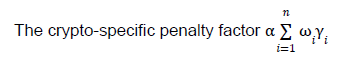
introduces an asset-specific adjustment to account for the differences in volatility, liquidity, and idiosyncratic risks across different crypto assets.
- Weights (ωi) represent each asset’s portion of the total portfolio.
- Penalty factor (γi) for each asset reflects its unique risks. For example, smaller-cap altcoins with higher volatility and lower liquidity receive a larger penalty factor than highly liquid and stable assets like Bitcoin or Ethereum.

How it works in practice
For risk managers, quantitative experts, and portfolio managers, the approach that I offer is LASPR. It delivers a more realistic measure of risk-adjusted performance that accounts for crypto-specific characteristics, helping all the aforementioned specialists to evaluate the true risk of holding certain assets, especially those with limited liquidity or heightened volatility.
For example, consider a portfolio with 60% Bitcoin, 30% Ethereum, and 10% in a high-risk altcoin. LASPR would adjust the risk measure higher for the altcoin portion due to its greater volatility and lower liquidity, penalising the portfolio for overexposure to assets that are harder to liquidate or have unpredictable price swings. This allows for a fairer assessment compared to traditional ratios.
What should the new evaluation model for 2025 look like?
Traditional performance ratios like Sharpe, Sortino, and Treynor provide valuable insights into traditional finance but lack the nuance to evaluate crypto portfolios. In contrast, LASPR that I propose to replace them delivers a sophisticated, tailored approach by addressing the high volatility, liquidity risks, and asset-specific dynamics of crypto assets.
As the digital asset market matures, more advanced models will become crucial for accurately assessing manager performance. For success in 2025, a new approach can be exactly the LASPR model, which has the potential to help investors navigate the crypto market with greater confidence and insight.