Trust is an interesting concept, one that Visa is prioritising in the age of AI.
Digital commerce is sweeping the Gulf yet the barrier to full adoption comes down to ‘trust.’ If the consumer doesn’t trust AI-driven technology at checkout, how can the business or payment provider, improve efficiency, maximise productivity while driving growth in the economy?
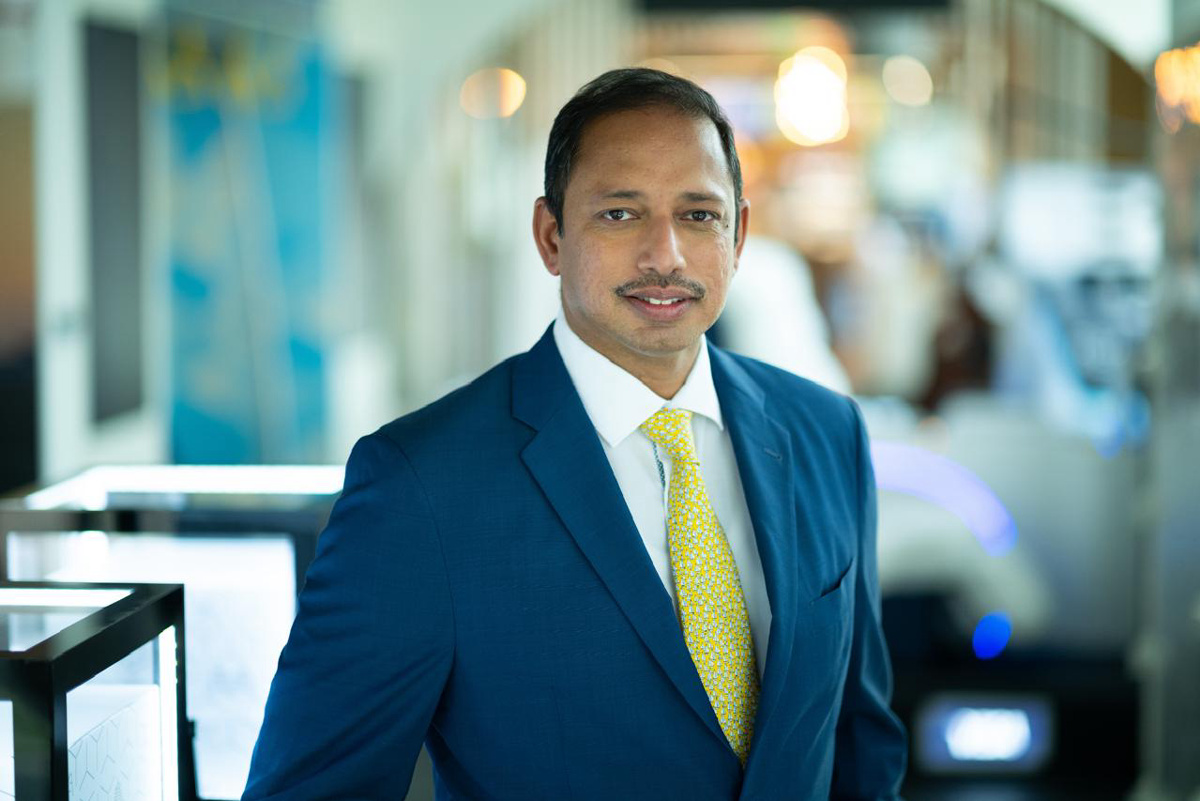
I spoke to Charles Lobo, Senior Vice President & Regional Risk Officer for Central Europe, Middle East and Africa, at Visa’s Payment Forum in Paris to understand Visa’s mission in full.
What does ‘trust’ mean to Visa?
Trust ultimately means that all parties have the confidence that the transaction will go through, and the confidence that your credential will not be used by somebody who you haven’t allowed to use it.
“That’s really foundational,” said Lobo.
How is fraud evolving, and what role does Visa’s Stay Secure survey play?
The evolution of fraud is unprecedented, and the change is being driven by AI. Generative AI in particular is enabling very sophisticated fraud to be created and then scaled across a much wider set of people, at very high velocity.
Take phishing emails. In the past, they often had telltale signs that something wasn’t right—spelling mistakes, bad grammar. Now, because of generative AI, it is becoming very hard to tell the difference between genuine and fraudulent communications.
The same applies on social media. You might see a pair of sneakers you’ve been looking at, followed immediately by another post advertising the same sneakers at an unbelievable price. The newer generations are naturally going to feel enticed by that offer.
Because of generative AI, the entire fraudulent consumer experience is being assembled with such sophistication that consumers often cannot tell the difference between a fraudulent experience and a genuine one.
What’s changing is the sophistication, the fact that fraud is becoming multimodal across different channels, and criminals are using technology to scale their attacks.
Stay Secure explores how consumers are engaging with AI, what that engagement looks like, and how much they trust it.
Those insights give us powerful data points that we can share with our partners and clients so they can build strategies around them.
For example, only 12% of consumers believe it is their responsibility to keep themselves safe when transacting online. That’s a wake-up call.
Financial institutions need to ask themselves: how do we encourage consumers to play a more active role in protecting themselves? Your bank should never call you and ask you to read out your card number. Insights like these help both Visa and our partners understand where consumer awareness needs to improve.
Are those partners banks and regulators as well?
Yes. That’s exactly why we make the research public. Everyone can access those insights, think about what they mean, and use them to shape their own strategies.
Are there transferable lessons for AML and CTF?
Absolutely. One of the biggest challenges in money laundering is mule accounts. People are persuaded to let others use their bank accounts in exchange for money. They often don’t realise that their account could then be used for something extremely damaging, such as terrorism financing or moving illicit funds.
What our research is telling us is that the entire ecosystem needs to do a better job of educating consumers. Don’t give away your credentials. If someone asks to use your bank account in return for money, consumers need to understand why that’s dangerous and why they should refuse.
What lessons should CFOs take from Stay Secure?
Not only should the Chief Risk Officer have a seat at the executive management table, but now we’re in an era where the Chief Information Security Officer also needs that seat.
The CISO is no longer a back-office function. The CISO is front and centre. CEOs and CFOs must pay attention to these trends because they show us where security investments need to go.
If you underinvest in your security protocols, your fraud detection capabilities and your cyber resilience, you’re exposing your organisation to enormous risk. Most fraud today is actually the manifestation of a cyber attack. Criminals are breaking into systems through cyber attacks, stealing data, and then using that data to conduct fraudulent transactions.
Increasingly, those cyber attacks themselves are underpinned by AI. In the world we’re living in today, I don’t think choosing not to invest in cybersecurity or fraud protection is an option.
It’s the bare minimum. It’s the minimum standard organisations should be expected to meet.
Stay Up to Date with the Latest Updates at Finance ME
Sarah Al-Shawwaf: Vision 2030 Has Unlocked the Potential of Saudi Women
UAE Reinforces Overseas FDI Commitment in U.S. Despite Iran War
EDGE’s Rodrigo Torres on Risk, Sovereignty and Defence Finance in a Multipolar World