
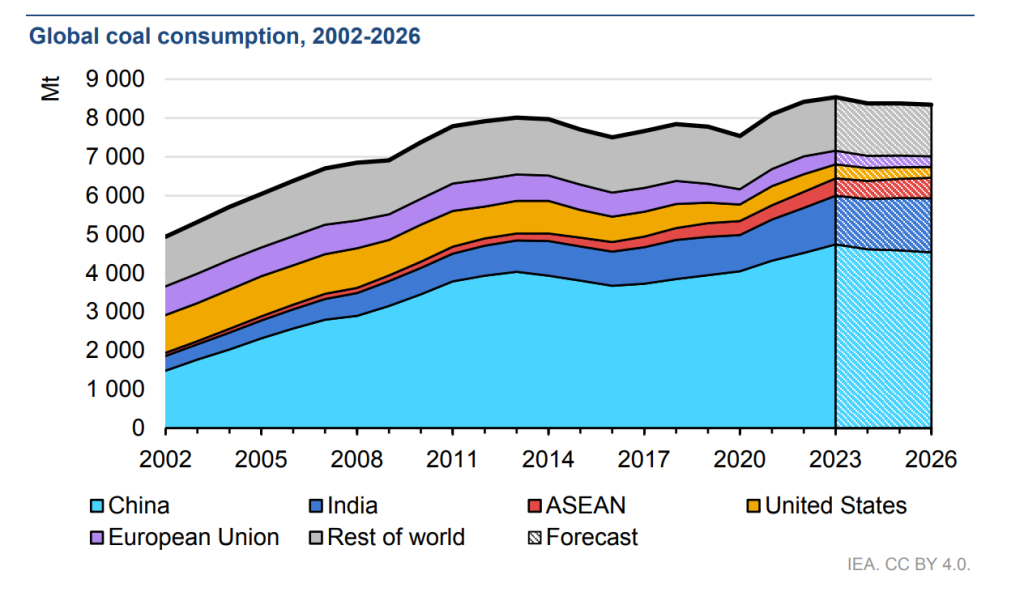
Global coal demand reached a record high this year and is projected to decline until 2026, marking the first anticipated drop in global coal consumption in the International Energy Agency’s (IEA) annual coal market report.
The Coal 2023 report forecasts a 1.4% rise in global coal demand in 2023, exceeding 8.5 billion tonnes for the first time. However, the increase varies significantly among regions, with notable declines projected in most advanced economies, including a steep drop of approximately 20% in the European Union and the United States.
Emerging economies like India and China are expected to witness robust demand growth, with an 8% increase in India and a 5% increase in China in 2023, primarily due to rising electricity demand and limited hydropower output.
Nevertheless, the report foresees a global coal demand decline of 2.3% by 2026 compared to 2023 levels. This decrease is attributed to a substantial expansion of renewable energy capacity expected to come online in the next three years.
Growth in renewable capacity
Over half of this global renewable capacity growth is projected in China, where coal demand will decrease in 2024 and remain steady until 2026. However, the outlook for coal in China depends on clean energy deployment, weather conditions, and economic shifts.
Despite the projected decline in global coal demand, the report indicates that consumption will remain over 8 billion tonnes by 2026. To align with the goals of the Paris Agreement, a much faster reduction in the use of unabated coal is required.
“We have seen declines in global coal demand a few times, but they were brief and caused by extraordinary events. This time appears different, as the decline is more structural, driven by the formidable and sustained expansion of clean energy technologies,” said Keisuke Sadamori, IEA Director of Energy Markets and Security. “A turning point for coal is clearly on the horizon – though the pace at which renewables expand in key Asian economies will dictate what happens next, and much greater efforts are needed to meet international climate targets.”
Spotlight on Southeast Asia
Asia, including China, India, and Southeast Asia, is expected to account for three-quarters of global coal consumption this year, marking a notable shift from one-quarter in 1990. Southeast Asia’s coal consumption is set to surpass that of the United States and the European Union for the first time in 2023.
While India and Southeast Asia will likely see significant coal consumption growth until 2026, advanced economies will continue to experience declining coal usage driven by expanding renewables amid subdued electricity demand growth.
Moreover, China, India, and Indonesia, the top global coal producers, are anticipated to achieve record production levels in 2023, contributing to over 70% of the world’s coal production.
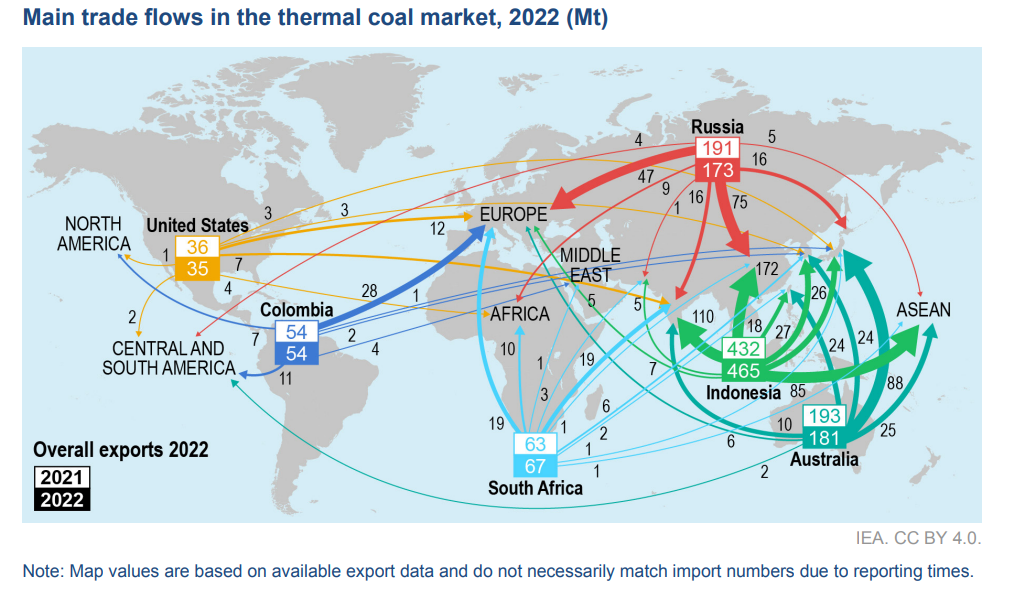
Global coal trade is predicted to shrink as demand decreases in the coming years, but trade is expected to reach a new peak in 2023. This surge in trade is propelled by substantial growth in Asia, with China’s imports projected to surpass previous records and Indonesia’s exports reaching a historical high in 2023.