Emirates Group has announced its best-ever financial performance for the fiscal year ending March 31, 2024. It boasted a record profit of Dh18.7 billion ($5.1 billion), marking a remarkable 71% increase from the previous year. This performance was underpinned by record revenue and a significant surge in cash assets. Both Emirates and dnata, subsidiaries of the Emirates Group, witnessed substantial profit and revenue growth during the same period.
The Group reported a record revenue of Dh137.3 billion ($37.4 billion), reflecting a robust 15% increase compared to the previous fiscal year. Additionally, the Group’s cash balance reached Dh47.1 billion ($12.8 billion), marking the highest level ever reported and representing an 11% increase from the previous year.
Combined Group profits for the last two years, at Dh29.6 billion, surpass pandemic losses of Dh25.9 billion during 2020-2022.
“Throughout the year, we saw high demand for air transport and travel related services around the world, and because we were able to move quickly to deliver what customers want, we achieved tremendous results,” said HH Sheikh Ahmed bin Saeed Al Maktoum, Chairman and Chief Executive, Emirates airline and Group. “We are reaping the benefit of years of non-stop investments in our products and services, in building strong partnerships, and in the capabilities of our talented people.”
The Group’s ongoing initiatives include a multibillion-dollar aircraft fleet and cabin renewal program, expansion of catering, cargo, and ground handling capabilities, adoption of advanced technologies, and enhancement of training and development programs.

In the fiscal year 2023-24, the Group invested Dh8.8 billion ($2.4 billion) in various projects to support its growth trajectory. The total workforce expanded by 10% to 112,406 employees, reflecting the Group’s commitment to recruiting and retaining talent to bolster its operations.
Sheikh Ahmed said: “We enter our 2024-25 financial year on strong foundations for continued growth. Emirates will receive delivery of 10 new A350 aircraft in 2024-25, adding to our fleet mix and supporting the next phase of its network growth. dnata will continue to leverage synergies and scale across its business divisions to grow its footprint and capabilities. In tandem, we are investing resources to minimise our environmental impact, develop our people, look after our customers and the communities we serve.”
“The business outlook is positive, and we expect customer demand for air transport and travel to remain strong in the coming months. As always, we will keep a close watch on costs and external factors such as oil prices, currency fluctuations, and volatile environments caused by socio-political changes. Our business model has been tested before, and I am confident in our resilience and ability to respond quickly to opportunities and challenges.”
He added: “Looking further ahead, the Dubai government has announced plans to start the next phase of expansion at Al Maktoum International Airport, which will eventually be the new hub for Emirates and dnata’s operations. This Dh128 billion ($35 billion) investment will significantly expand and enhance Dubai’s aviation and logistics infrastructure, supporting the city’s growth, and Emirates’ and dnata’s growth.
Emirates’ remarkable recovery
Emirates airline reported a record profit of Dh17.2 billion ($4.7 billion), surpassing the previous year’s results, driven by increased capacity deployment and strong demand across markets. Despite currency fluctuations, the airline demonstrated resilience, achieving an exceptional profit margin of 14.2%.
With increased capacity deployment and strong demand across markets, Emirates’ total revenue for the financial year increased 13% to Dh121.2 billion ($33.0 billion). Currency fluctuations and devaluations in some of the airline’s major markets, notably the Pakistani Rupee, Egyptian Pound, and Indian Rupee, negatively impacted the airline’s profitability by Dh2.0 billion ($0.6 billion).
Emirates witnessed a remarkable passenger and cargo capacity recovery, reaching near pre-pandemic levels.
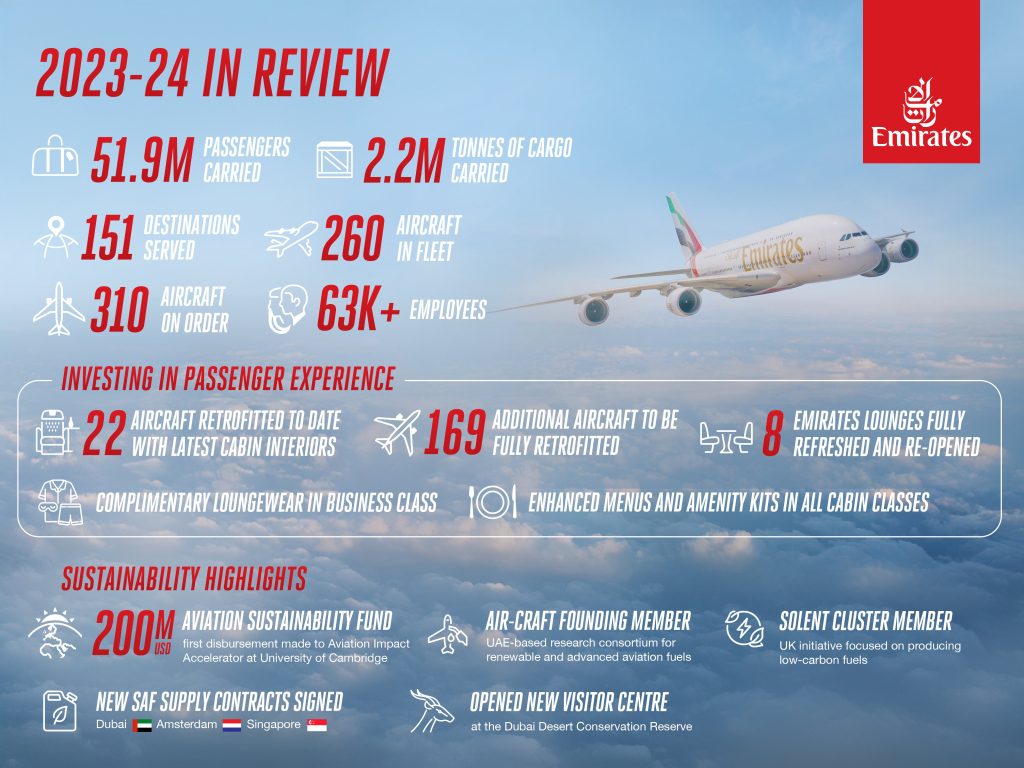
The airline restarted services to Tokyo Haneda, added capacity to 29 destinations, and launched new daily flights to Montréal, Canada. Emirates also inked codeshare and interline agreements with 11 new airline partners, further extending its network’s reach. By March 31, 2024, the Emirates network comprised 151 destinations across six continents, including 10 cities served by its freighter fleet only.
Emirates brought its flagship A380 and popular Premium Economy product to even more cities this year, as 16 more aircraft rolled out of its $2 billion cabin retrofit programme, fully refurbished with the airline’s latest signature products. As of March 31, 2024, the Emirates A380 served 49 destinations, and customers could enjoy Emirates’ Premium Economy experience to and from 15 cities worldwide.
Total fleet count at the end of March was 260 units, with an average fleet age of 10.1 years.
The airline’s operating cash flow stood at Dh37.6 billion ($10.3 billion) in 2023-24, which underpinned its strong commercial results.
The cargo division also delivered solid results, contributing 11% to the airline’s total revenue. Despite global logistics challenges, Emirates SkyCargo reported a revenue of Dh13.6 billion ($3.7 billion) and anticipates further growth by adding new Boeing 777Fs to its fleet.
dnata’s performance
dnata, meanwhile, reported a profit surge of 330% to Dh1.4 billion ($387 million) in the fiscal year 2023-24. dnata’s total revenue increased by 29% to hit a new record of Dh19.2 billion ($5.2 billion), driven by increased flight and travel activity worldwide. dnata’s international businesses account for 75% of its revenue, an increase of 3%pts from the previous year.
In 2023-24, dnata’s operating costs increased by 22% to Dh17.8 billion ($4.8 billion), in line with expanded operations in its Airport Operations, Catering & Retail, and Travel divisions. There was also continued inflationary pressure across all markets, mainly for labour and food supply.
dnata’s cash balance declined by Dh958 million to Dh4.2 billion ($1.1 billion), primarily due to Dh2 billion ($545 million) in dividend payments to its owner, ICD, plus the funding of investments and debt repayments. The business saw a positive operating cash flow of Dh1.9 billion ($507 million) in 2023-24, a reflection of the substantial improvements in revenue.
Revenue from dnata’s Airport Operations, including ground and cargo handling increased to Dh8.8 billion ($2.4 billion).
The number of aircraft turns handled by dnata globally grew by 9% to 778,026; and cargo handled increased by 5% to 2.9 million tonnes, reflecting new contracts won, and increased flight activity by dnata’s airline customers across markets.