

The global race to apply AI in finance is gaining momentum, and Abu Dhabi wants to be at the forefront. Presight, part of the G42 ecosystem, is developing sovereign AI infrastructure that aligns with regulatory demands and national security priorities. Through its partnerships with the Central Bank of the UAE and international institutions, the company is seeking to build finance tools that can meet global standards while serving the particular needs of emerging markets.
“Our partnerships across the G42 ecosystem, and with global leaders like Microsoft and Dow Jones Factiva, are all about co-developing finance-specific AI capabilities that are practical, trusted and sovereign by design,” said Thomas Pramotedham, CEO, Presight. “With Microsoft, we are co-developing verticalised solutions tailored for finance. This infrastructure allows us to train and serve finance grade models entirely within national borders, ensuring compliance with regulatory and data residency requirements. With MBZUAI, our collaboration focuses on both foundational and applied research. We also work together on startup acceleration and the Responsible AI Foundation, embedding ethical governance into the core of financial AI innovation.”

The difference here is where and how these systems operate. While global AI firms typically train models in centralised data centres, Presight is building tools that are deployed within the UAE’s sovereign cloud or in fully air-gapped environments in Africa and Asia. For countries wary of cross-border data transfers, this offers assurance. It also ties Presight’s growth to a broader geopolitical trend: nations seeking digital independence.
Auditability is not something we add later. It is built into every model we deploy. Every input, decision and output are logged so that transactions can always be traced.
Thomas Pramotedham
Financial regulators are increasingly insisting that sensitive data, such as payments, transactions and anti-money-laundering intelligence, remain within their jurisdiction. Presight has turned that requirement into a differentiator. It sits at the intersection of Microsoft’s cloud reach, MBZUAI’s research, and G42’s compute and semiconductor capacity. That means the company does not simply bolt AI onto finance, it shapes the full stack from infrastructure to compliance.
Presight’s finance stack
Presight’s suite for financial institutions spans three functional areas: risk and controls, compliance and forecasting. Each has been tested in pilot programmes with the Central Bank of the UAE, the Emirates Institute of Finance and commercial banks.
“Our finance suite delivers measurable outcomes with 10x decrease in audit processing cycle using our anomaly detection tools, closing books faster and redeploying staff to higher-value activities,” Pramotedham noted.
“Our finance suite delivers measurable outcomes with 10x decrease in audit processing cycle using our anomaly detection tools, closing books faster and redeploying staff to higher-value activities,” Pramotedham noted.

Fraud detection is a case in point. Instead of rules-based systems that trigger excessive false positives, Presight deploys adaptive models that adjust with new data. The outcome is lower costs and effective identification of fraud patterns. These tools are being enriched through the company’s memorandum with Dow Jones Factiva, which supplies global datasets on ownership structures, sanctions and adverse media. By fusing that information into anomaly detection engines, Presight is attempting to set a new standard in compliance reporting. This function has become one of the heaviest cost centres for banks worldwide.
The finance stack is not limited to the UAE. Markets from Sub-Saharan Africa to Central Asia are accelerating the digitisation of payments and banking, creating demand for sovereign-grade solutions. Here, Presight’s ability to localise models, respect regulatory boundaries and deploy on national clouds is giving it an edge over global competitors who may offer advanced technology, but lack the sovereign credibility to scale.
Today’s momentum is the result of years of building sovereign capabilities with purpose and discipline, not a passing surge
Trump visit and compute access
One of the main bottlenecks for AI companies globally has been access to compute. Advanced AI models require vast processing power and the most advanced semiconductors. In May 2025, during President Donald Trump’s state visit to Abu Dhabi, the UAE secured access to half a million Nvidia chips annually and announced plans for a 5GW AI campus. “Access to high-performance, local and affordable compute has long been a bottleneck in AI,” Pramotedham stated. “With the UAE US AI Campus and Stargate UAE, we will be able to accelerate the deployment of advanced solutions in finance, from sovereign risk analysis and real-time stress testing, to AI-driven liquidity management and market-wide fraud detection. What was once possible only in pilots will soon be deployed at sovereign scale.”

The deal was significant because Washington had previously restricted exports of Nvidia’s most advanced chips to the UAE on security grounds. The arrangement now permits US vendors to operate facilities inside the Emirates under tight safeguards, giving firms like Presight access to computing resources that had been off-limits. For Presight, this resolves one of the constraints that has limited the rollout of large-scale AI. Models that once ran in limited test environments can now operate across national payment systems or entire banking networks.
Stargate project
Beyond the AI campus, the UAE is building Stargate, a 10-square-mile AI complex scheduled to begin operations in 2026. The first phase is set to deploy 100,000 Nvidia Grace Blackwell chips, equivalent to one gigawatt of compute capacity.
“While it’s too early to discuss specific modules, what I can say is that we see tremendous potential for next-generation AI to support the financial sector, from more resilient forecasting to smarter risk analysis,” the CEO noted. “With the UAE-US AI Campus and Stargate UAE coming online, we will be well-positioned to accelerate adoption of solutions that were previously constrained by compute.”

In practical terms, Presight sees Stargate as the platform for modules that require heavy workloads: scenario planning across thousands of variables, generative models for sovereign risk and liquidity forecasting that integrates global macro data in real time. The infrastructure lowers the cost of training, increases the speed of deployment and crucially, keeps sensitive workloads inside the UAE’s jurisdiction.
We are not just a fintech vendor; we are embedded across energy, smart cities, media and government platforms
Thomas Pramotedham
Explainable AI
The most significant regulatory shift facing AI in finance is the demand for explainability. Regulators in Europe, the US and Asia have made clear that banks cannot deploy black-box systems that generate decisions without explanation.
“Explainability is the defining priority in the immediate future,” said Pramotedham. “Regulators and boards are clear: AI systems must show why decisions are made. Whether approving a loan, flagging a trade or triggering an AML alert, institutions can no longer rely on opaque black box models. That is why we are building explainable AI (XAI) modules that generate clear, auditable trails for every decision.
Auditability is not an afterthought, he added. “Auditability is not something we add later. It is built into every model we deploy. Every input, decision and output are logged so that transactions can always be traced. This ensures we meet both internal governance standards and third-party audits.”
The partnership with Dow Jones enriches these models with global compliance data, making alerts not only faster but better justified. “Our tools will not only raise red flags, they explain them, whether it is ownership structures, sanctions exposure or adverse media that triggered a potential AML alert,” he says. For boards and regulators, this capability could prove decisive. With fines for AML breaches running into billions globally and reputational damage immense, systems that can show the reasoning behind every flag may become indispensable.
H1 2025 performance
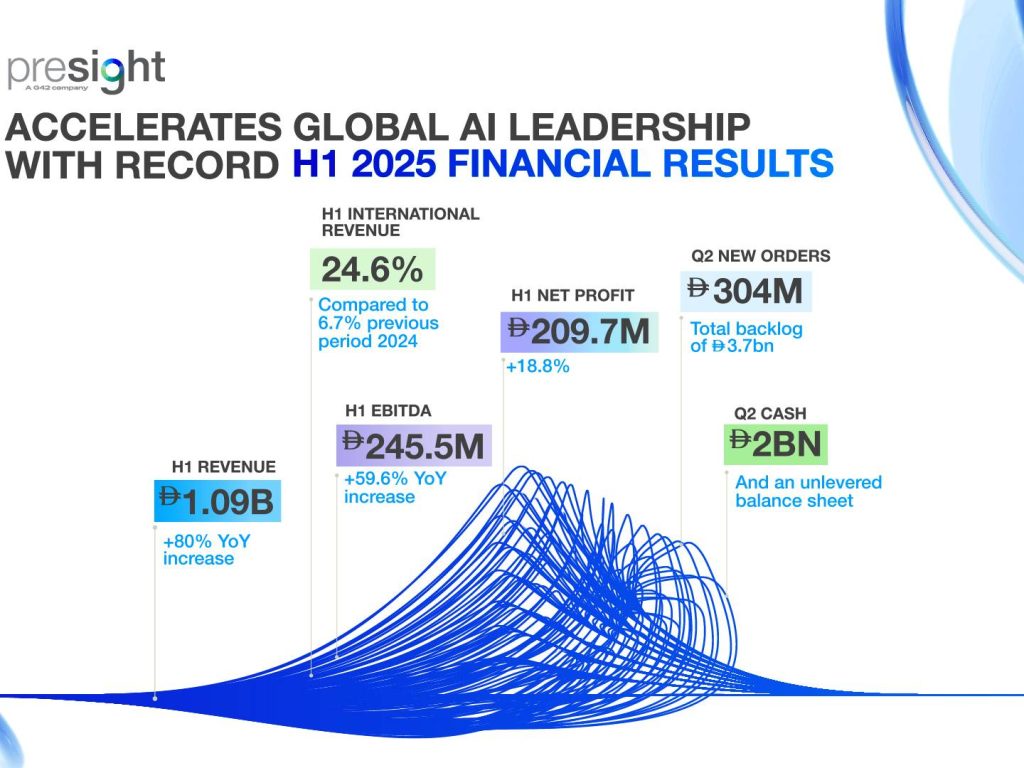
Presight’s financial performance reflects its momentum. The company reported an 80% increase in year-on-year revenue for the first half of 2025. Second-quarter revenue grew 53.5% and international markets accounted for 26.8% of the total. The backlog now stands at AED 3.7 billion, three times higher than the previous year, with over 90% of revenue tied to multi-year contracts.
“Today’s momentum is the result of years of building sovereign capabilities with purpose and discipline, not a passing surge,” Pramotedham stated. “Over the past three years, Presight has developed sovereign AI infrastructure, created vertical-specific solutions and expanded delivery hubs across the Middle East, Central Asia, Southeast Asia and Africa. Those foundations are now paying off with scale and sustainability.”
Global context shows the scale of opportunity. Research firm MarketsandMarkets estimates the AI in finance market to reach $190 billion by 2030. Banks are under pressure to cut costs, regulators are demanding stronger compliance and competition from fintech challengers is intensifying. Presight is betting that sovereign-grade, explainable AI provides the answer.
Startups in focus
Another growth lever is the company’s accelerator, which selects early-stage fintechs and plugs them into Presight’s ecosystem. “Our accelerator is a strategic extension of our roadmap, not a mentoring programme,” said Pramotedham. “Zypl.ai is addressing credit risk analytics in underserved markets. By deploying their models on our infrastructure and linking them to our client base, we are enabling solutions that can expand access to credit across frontier economies. Maiden Century brings fresh approaches to portfolio management and asset allocation, complementing Presight’s predictive analytics suite and positioning us more deeply in capital markets. Cobi, meanwhile, advances business intelligence tools that integrate seamlessly with our enterprise AI suite, helping financial institutions convert data into actionable insights.”
The first cohort attracted 120 applications from 17 countries. The three selected firms were showcased in Abu Dhabi before government and private-sector institutions. “Doors were opened, introductions were facilitated, deals were negotiated and investment was discussed,” Pramotedham added.
This structure gives Presight agility. Startups bring niche expertise, while Presight supplies compute, infrastructure and market reach. The outcome is a finance stack that can quickly adapt to new needs while retaining sovereign-grade assurance.

Priorities for 2026
Looking ahead, Presight has set three clear priorities: explainable AI, real-time risk scoring and anomaly detection.
“We are taking the modules already designed and proven and scaling them into production-ready systems trusted by central banks, regulators and global financial institutions,” said Pramotedham. “Under the Dow Jones collaboration, we are prioritising solutions for the most pressing global needs: KYC and hidden ownership discovery, sanctions intelligence, contextualised adverse media monitoring, ESG-linked compliance tracking and legal and policy risk interpretation. Similarly with our joint venture with the Central Bank of the UAE, we’re embedding AI into core national infrastructure, from CBDC rails to RTGS flows, while integrating explainable risk scoring and anomaly detection directly into the transaction layer.”
He says frontier areas, such as agentic AI and predictive forecasting, are also on the roadmap, but will follow once the immediate compliance modules are scaled. The focus now is on taking existing pilots to full production across sovereign clients.
Regional edge
Pramotedham believes Presight’s advantage comes from three traits. “Our edge comes down to three things: contextualisation, sovereignty and speed,” he says. “Too many AI solutions in Asia and Africa fail because they are designed for Western markets. We build on regional data, adapt to local regulations, offer sovereignty and often co-develop with governments and banks.
Sovereignty is critical. Data residency and security are non-negotiable in these markets, and we can deploy on sovereign clouds or even in fully air-gapped environments. That gives central banks and regulators confidence their data stays safe and compliant. And finally, we move faster. Across Central Asia and Africa, we have scaled from pilots to national deployments in record time.”

Breadth also matters. “We are not just a fintech vendor; we are embedded across energy, smart cities, media and government platforms,” he says. In markets where finance is tied to national infrastructure, that systemic presence becomes an advantage.
2026 checkpoint
By 2026, Presight expects the UAE’s new AI infrastructure to be fully operational, shifting workloads from limited pilots to sovereign scale. Explainable AI will be embedded in core financial systems, international revenues will likely account for a larger share and startups in the accelerator will expand the product pipeline.
“We are taking the modules already designed and proven and scaling them into production-ready systems trusted by central banks, regulators and global financial institutions,” Pramotedham noted.
If successful, Presight will have shown how sovereign AI, built with explainability at its core, can transform finance in the Global South and potentially reshape global standards.