
The Institute of International Finance (IIF) forecasts a surge in the consolidated gross foreign assets of the six Gulf Cooperation Council (GCC) countries to approximately $4.4 trillion by 2024.
This projection is supported by ongoing current account surpluses, estimated at $146 billion. On the other hand, consolidated foreign liabilities stand at around $1 trillion, resulting in a net foreign assets position of $3.4 trillion.
According to the latest report published by the IIF, nearly two-thirds of the gross foreign assets are managed by sovereign wealth funds (SWFs), diversified across public equities and fixed-income securities, while the remaining portion comprises official reserves and foreign assets of commercial banks invested in liquid assets.
Petrodollar investment
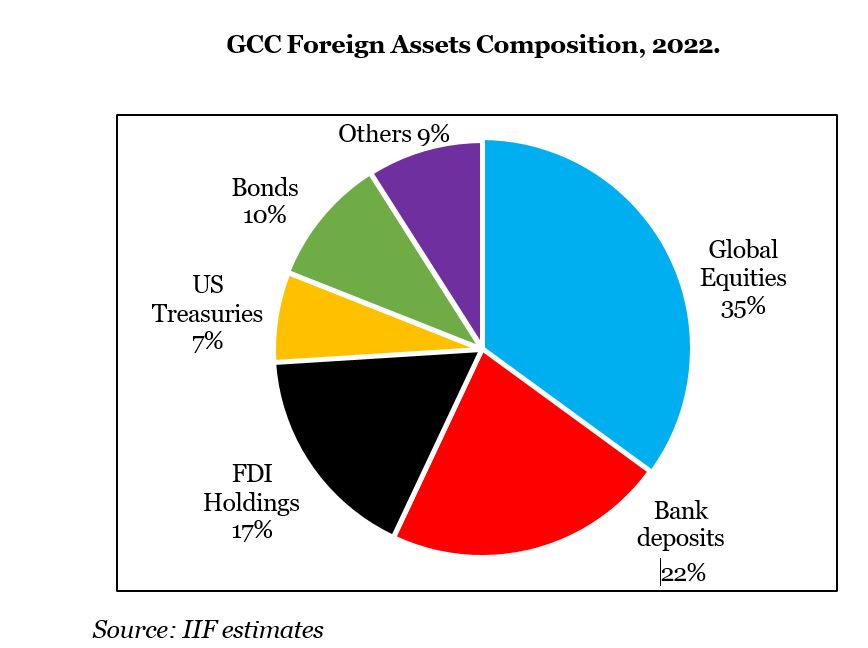
Investment details regarding petrodollars from the region are relatively scarce due to limited disclosure by GCC SWFs. Nonetheless, the IIF has tentatively estimated these investments using various sources. According to their estimates, approximately 35% of GCC investments are in equity, 22% in bank deposits, 17% in foreign direct investment abroad, 7% in US Treasuries, 10% in bonds, and the remaining 9% in less liquid investments, such as non-US bonds, mergers, acquisitions, and hedge funds.
Regionally, around 65% of investments are in North America and Europe, 20% in Asia Pacific, 10% in other Middle Eastern and North African (MENA) countries, and 5% in Sub-Saharan Africa and Latin America.
Shift in investment patterns
Recent trends suggest a shift in GCC SWFs’ investment patterns. Saudi Arabia, in particular, has shown a move towards global equities and foreign direct investments, steering away from conventional secure assets. Saudi holdings of US Treasury securities witnessed a notable decrease of nearly 40% from February 2020 to September 2023.
Since the unveiling of Vision 2030 in 2015, Crown Prince Mohammed bin Salman has pushed the Public Investment Fund (PIF) into investing in more riskier assets. Since then, investments in risky assets (primarily foreign equities and FDI) have grown from 20% of total foreign assets to over 40% in Q2 2023. Saudi Arabia has gradually reduced its foreign reserve assets to finance these riskier investments.
Three goals drive the push away from safer investment assets.
- The returns on riskier assets will help PIF reach its goal of managing $2 trillion in assets by 2030.
- It allows Saudi Arabia to diversify away from oil and acts as a potential hedge against declines in the price of crude oil.
- Riskier investments would help fund many of the projects envisioned in Vision 2030 (e.g., the megacity NEOM).
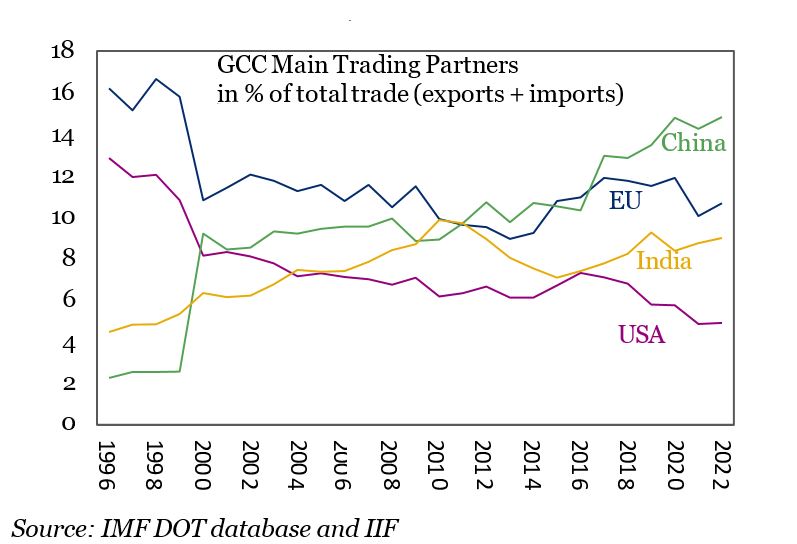
While trade is still mostly conducted in US dollars, GCC countries have slowly started signing bilateral trade agreements, allowing them to settle trade in other currencies. Saudi Arabia’s finance minister also announced in January 2023 that Saudi Arabia was open to using other currencies to settle oil contracts, though this has yet to materialise.
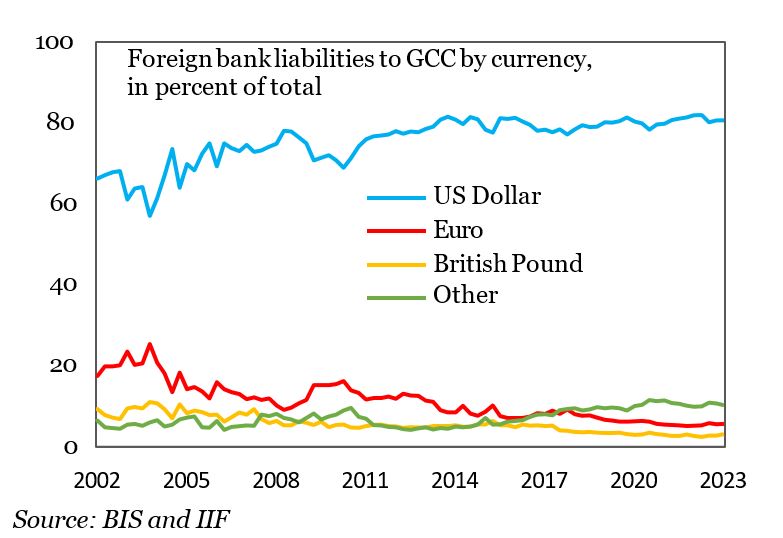
However, IIF foresees this shift to be limited in scope as all GCC currencies are pegged to the dollar, providing an anchor for the region’s financial stability. Furthermore, the currency composition of GCC assets held by BIS banks has remained stable (at around 80%), indicating that no drastic change has occurred.