
Bitcoin has dropped below $63,000 and is currently trading at $62,876, marking a 7.81% decrease in 24 hours.
On Tuesday, Bitcoin surged to an all-time high above $69,000, ending a two-year slump attributed to the recent approval of US Bitcoin ETFs. This surge was driven by the US physically backed wrappers demand and a shrinking market depth for the actual tokens. Interest in Bitcoin has returned to Asian markets, while over-the-counter desks’ liquidity is decreasing.
According to industry experts, the upcoming halving on April 22 may intensify the spread between supply and demand, exacerbating a supply squeeze.
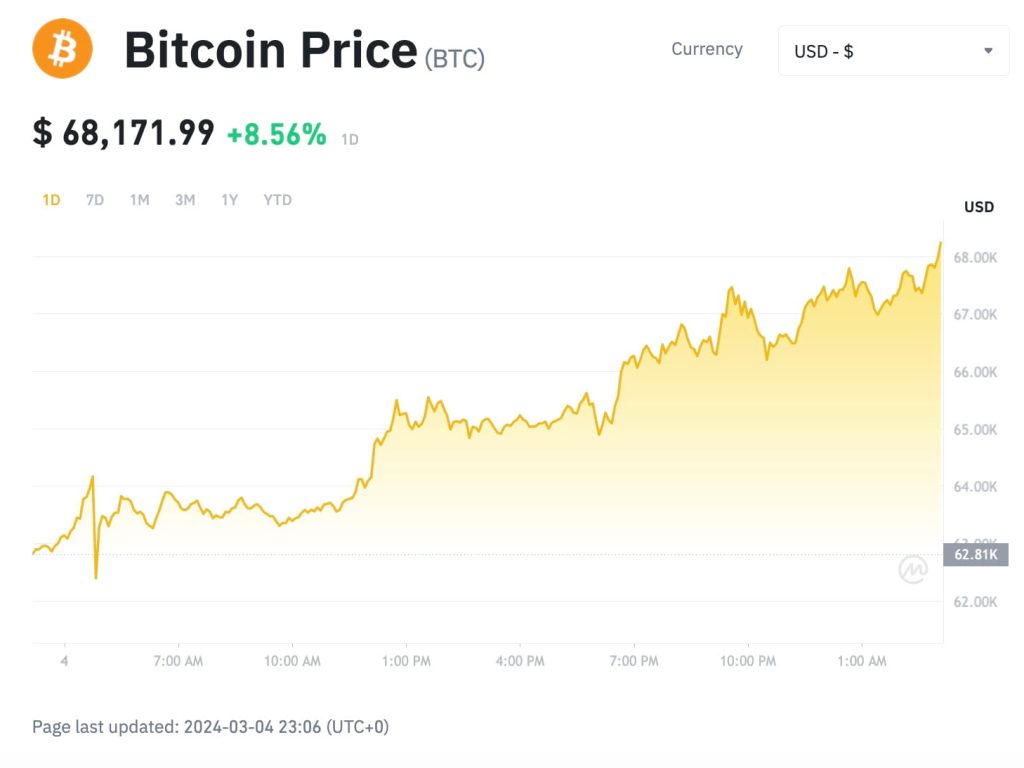
Liquidations of short positions, reaching $400 million on February 28, have become routine. US Bitcoin spot ETFs remain a dominant price driver, with cumulative net flows surpassing $16.4 billion.
As of last week, the cumulative net flows registered by the so-called ‘newborn nine’ (nine approved products, excluding Grayscale’s and Hashdex’s) have amounted to $16.4 billion, far outpacing Grayscale’s $8.9 billion in outflows, leading to an overall net inflow of around $7.5 billion.
“The market mood appears to be increasingly bullish, and Asian markets are once again becoming a key gauge for retail demand, explained Manuel Villegas, Digital Assets Analyst, Julius Baer. “Since the beginning of the year, Bitcoin’s price had experienced a minimal appreciation during Asian market hours, close to 2% out of the 55% mentioned above.”
However, since the start of last week, this figure has risen to 10%, which is more in line with previous cycles.
The 20-day moving average for net flows into 11 ETFs stands at approximately $300 million, while supply growth is around 925 Bitcoins per day, , which, at current prices is close to $55 million. The supply squeeze could intensify with sustained demand.
Token supply in exchanges has decreased by about 20% since the beginning of Q4 2023, and over-the-counter desks have significantly dried up. Derivatives markets show increasing bullishness.
“Looking forward, all eyes will be on the upcoming halving, which is expected in April,” said Villegas. “Meanwhile, US macroeconomics have not been a dominant driver of the current rally, even though net liquidity has slightly improved, interest rates are still high, and the asset class’s broader development is highly contingent on venture capital money.”
“That said, Bitcoin’s price has certainly discounted interest rate expectations for the year.”