Bitcoin has broken the $100,000 mark for the first time, extending a rally that began on the night of the US election, as investors continue to predict regulatory support from US President-elect Donald Trump.
The price of a single Bitcoin climbed as much as 6.1% on Thursday to $103,800, according to Bloomberg data. Since November 5, the price of the world’s oldest cryptocurrency has surged more than 40%.
Although Bitcoin’s price has been steadily climbing over the past month, Trump’s selection of crypto advocate Paul Atkins as his nominee for the role of Chair of the Securities and Exchange Commission (SEC), helped the cryptocurrency break this recent record. Should his nomination be confirmed, Atkins would replace crypto critic Gary Gensler, opening the door for a new era in the industry.
Trump—who once called Bitcoin a “scam against the dollar”—changed his view on cryptocurrencies during the last election campaign, gaining the support of the crypto community and appearing at industry events. He now stands behind his pledge to make the US the “Bitcoin and cryptocurrency capital of the world”, having promised to create a strategic stockpile of the cryptocurrency.
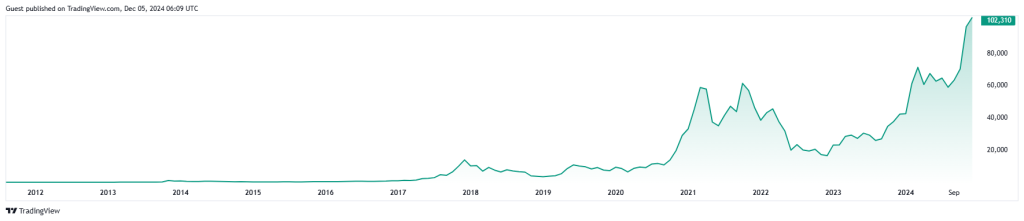
Bitcoin’s price evolution (2012-2024)
Bitcoin was launched in 2009, during the aftermath of the global financial crisis by Satoshi Nakamoto, a pseudonym used by a person (or group) with a vision of a peer-to-peer network free of government control.
Since its creation, the cryptocurrency has suffered from extreme price volatility. Bitcoin closed the year 2023 having surged 157%, after crashing 64% the year prior. At the moment, the token’s price marks a 135% year-to-date rally.
Even before Trump’s election victory, Bitcoin had had a very positive year, with growth driven, in part, to the increase in demand funnelled into exchange-traded funds (ETFs) operated by major financial institutions, such as BlackRock. These Bitcoin-based ETFs now hold about $100 billion in assets.
The $100,000 price, however, pushes the market value of Bitcoin to just shy of $2 trillion, overtaking Saudi Aramco’s $1.79 trillion valuation. Moreover, $2 trillion represents an amount bigger than the government bond markets of nations like Spain and Brazil—and a valuation not far from the growth of the UK’s entire FTSE 100 Index.