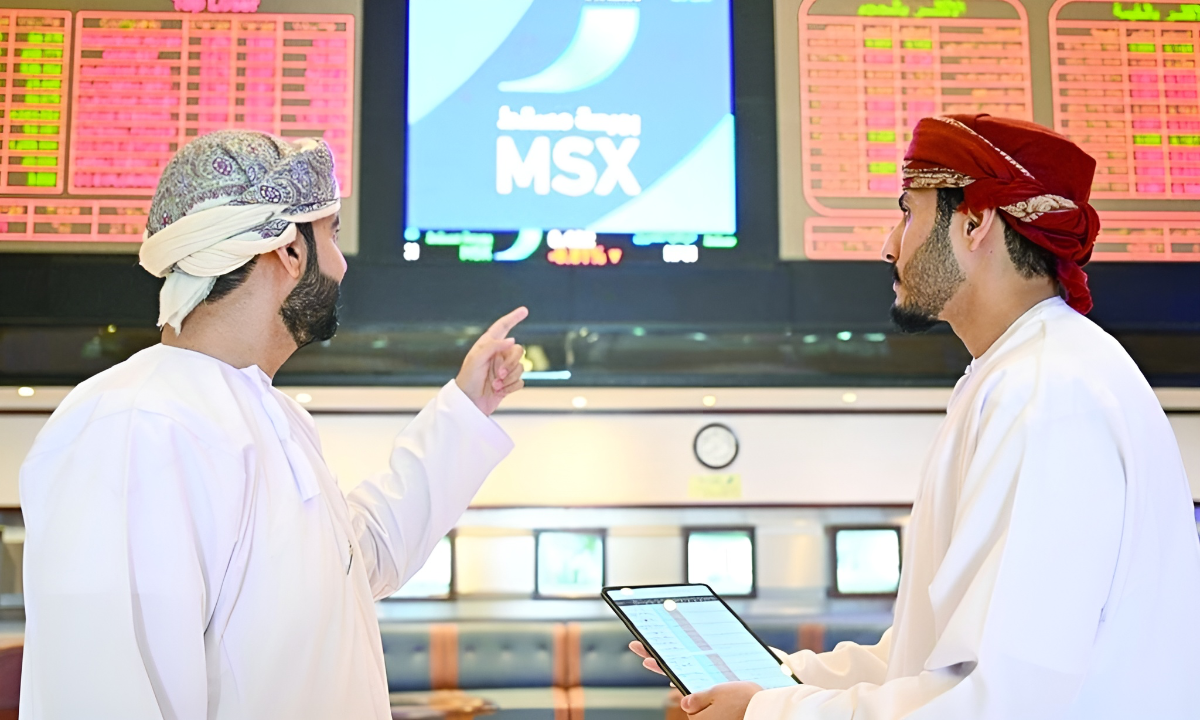
The Muscat Stock Exchange (MSX) climbed to its highest level since 2008 this week, breaking through the 8,000 mark on Wednesday on the back of sustained buying interest and strengthened investor confidence.
The MSX30 Index rose by 1.41%, or 111.4 points, breaking the 8,000 mark.
While short-term sentiment has been supported by firm energy prices, amidst the partial closure of the Strait of Hormuz, analysts say the rally in Oman’s equities is increasingly underpinned by structural reforms, market deepening, and a re-rating of sovereign risk.
Privatisation Pipeline
Under Oman Vision 2040, Muscat is divesting several of its leading state-owned enterprises in turn opening up Omani champions to private sector capital.
“The MSX is experiencing a fundamental structural shift, driven by the Oman Investment Authority’s (OIA) privatisation mandate. The market is no longer just about banking; it is now anchored by high-performing energy and industrial ‘blue chips’ like OQGN (OQ Gas Networks) and OQEP (OQ Exploration and Production), said Nassr Al-Naabi, Omani Economic Analyst and Strategist.
The anticipated listing of OQ Base Industries is expected to further expand the market’s sectoral depth and reinforce the pipeline of state-backed issuances.
“These entities provide what global investors crave: stable cash flows, high dividend yields, and world-class governance, making MSX a primary destination for ‘value investing’ in the GCC,” said Al-Naabi.
This shift is repositioning the MSX as a yield-oriented market, with relatively high dividend payouts compared to regional peers.
Reform and Regulatory Changes
A full liberalisation of the Omani capital markets is a key objective for the Sultanate.
“Beyond just regulations, we are seeing the creation of a sophisticated ‘market ecosystem,’ The introduction of liquidity providers and market makers has improved trading depth.
Furthermore, the “transparency required by international standards is now a reality, making it easier for institutional investors to model their entry and exit strategies with confidence,” said Al-Naabi.
Together, these factors have contributed to a re-rating of Omani equities, shifting investor perception from a recovery story to one of gradual expansion.
IPOs: International Institutional Interest
Oman has traditionally relied on domestic capital with one of the lowest rates of net FDI inflows across all six GCC economies.
While Oman’s FDI inflows remain smaller in absolute terms than the UAE and Saudi Arabia, its FDI-to-GDP ratio is among the highest in the GCC highlighting the growing importance of foreign capital to its economy.
However, Al-Naabi was keen to highlight how the MSX boom is being driven by new trends across capital inflows. “We are seeing a synergistic influx. While local pension funds and the OIA are providing the ‘anchor liquidity’, the quality of recent IPOs has attracted significant international institutional capital.”
“Global funds are particularly drawn to Oman’s energy and infrastructure sectors because they represent resilient, inflation-hedged assets. The successful oversubscription of recent energy listings is a clear testament to this global appetite,” said the analyst.
Risk Reduction Helps Investor Certainty
“It was the ‘turning point’. Regaining investment-grade status removed the ‘risk ceiling’ for many global institutional funds whose mandates previously restricted them from Oman,” says Al-Naabi.
It reduced the cost of borrowing and significantly improved the ‘risk-reward’ profile of Omani equities. It signals to the world that our fiscal discipline is yielding tangible results, shifting the narrative from recovery to expansion,” said the analyst.
Geopolitics Positioning
Oman’s geographic positioning, outside the Strait of Hormuz, and its neutral foreign policy stance offer a degree of insulation from regional disruptions.
However, analysts caution that geopolitical factors are supportive rather than foundational to the equity rally. The primary drivers remain domestic: fiscal consolidation, asset monetisation, and capital market reform.
Oman holds export hubs, from Mina Al Fahal to the global logistics powerhouse of Asyad Group in Duqm and Salalah, strategically located outside the Strait of Hormuz.
Bahrain, Kuwait, and Qatar remain reliant on Hormuz transit, with no scalable alternative routes capable of offsetting disruptions.
This logistical immunity to regional choke-points, combined with sustained high energy prices, is compounding Oman’s status as a ‘safe haven’ for energy supply and investment.
Taken together, Oman’s equity market appears to be undergoing a gradual structural re-rating, supported by reforms that are expanding both the depth and accessibility of the market.
Whilst cyclical factors such as energy prices have contributed to recent gains, the longer-term trajectory of the MSX will likely be determined by the pace of institutional reform and the credibility of its transition toward a more diversified, investor-accessible market.
Stay Up to Date with the Latest Updates at Finance ME
Analysis: IFC Oman is Carving a Niche in High-Growth Financial Sectors
Post-War Realities: Why Saudi Arabia Will Accelerate Localisation
Presight Director: AI is Becoming Core Financial Infrastructure