Nvidia doubled its profits in the second quarter of 2024, reaching $165 billion and reporting higher-than-expected sales of $30 billion, a 122% annual increase. But it still wasn’t enough.
The company’s shares fell 6.4% on Thursday before pairing back losses to a 3.4% fall later in the dayon. The sudden drop in its share price wiped over $100 billion from its stock market value.
The fall in the company’s stock was due to Nvidia being unable to beat trader’s ambitious expectations of even better results, as well as worries of signs of slowing growth, as the firm reported a sequential decline in gross margin—from 78.4% to 75.1%—and delays in its new chip line.
The decline followed an initial 8% drop in after-hours trading on Wednesday due to some traders cashing in on recent gains, hoping for even better results.
“Judged from the initial market reaction in extended trading hours the most loftiest expectations were clearly not met,” said Peter Garnry, Chief Investment Strategist at Saxo Bank. “The stock price reaction is also far from the historical average of about 7-8% absolute 1-day move after earnings and the 10% anticipated by the options market this time. Key for sentiment in Nvidia shares is how management talk about the outlook on the conference call.”
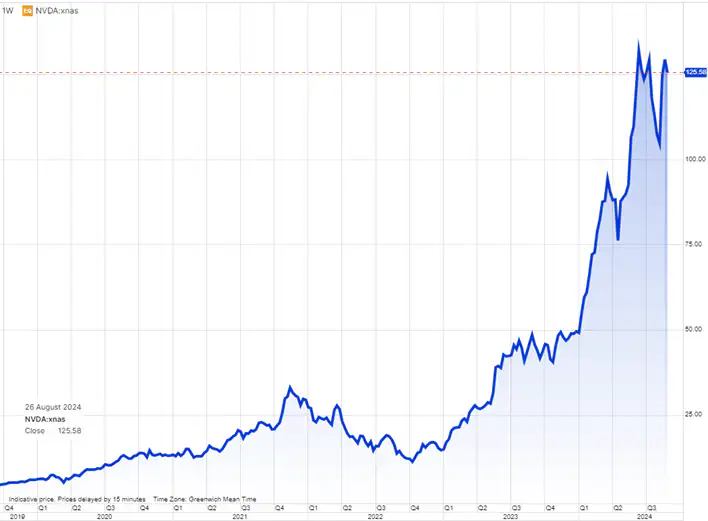
In the past year, Nvidia has become one of the most important players in the tech sector, leading artificial intelligence (AI) stocks. In 2024 alone, the company’s stock has risen by 150%, making up a third of the S&P 500’s gains this year. Its rapid growth allowed Nvidia to surpass the $3 billion market valuation mark , becoming the most valuable company worldwide.
As such, although the company’s results were positive, investors may have wanted more or just took the opportunity to sell a winning stock.
Nonetheless, experts believe that, despite the drop, investors still have reason to remain confident on the Nvidia stock, with the perspective of the new Blackwell chips being described as a key indicator of its future growth. The company’s fiscal Q4 gross margin is expected to be in the 73% to 74% range as Nvidia ramps its Blackwell series processors.
“Overall, investors should be pleased with Nvidia’s results and outlook. It confirms that there will likely be another AI investment wave as the big technology companies will invest heavily in the new Blackwell chips as they are more energy efficient and have significantly more compute power for both training and inference,” said Garnry. “Another take-away is that the competition is not even close to take market share from Nvidia and thus the investment case still looks solid.
Nvidia is currently valued roughly at a 12-month free cash flow yield of 3% compared to around 4.5% for MSCI World.
The company forecast revenue of $32.5 billion, plus or minus 2%, for Q3 2024, compared with analysts’ estimates of $31.8 billion and implying a 80% growth from the year-ago quarter. Nonetheless, the prediction was below the top-end of market estimates at $37.90 billion.