

Inflation and interest rates are among the key indicators investors track to predict market behaviour. Yet, for the next week, the world’s eyes are focused on a single event: the 2024 US Presidential election.
The identity of the next US President will drive the country’s fiscal policy and international agenda. However, the likelihood of an extremely close result –with the additional threat of contested victory– is setting the stage for volatility across most asset classes, including stocks, bonds, currencies and cryptocurrencies.
In light of the tensions arising from the 2020 election and the events of January 6, financial analysts are gearing up for different potential scenarios, which John Hardy, Chief Macro Strategist at Saxo Bank, has broken down into the following:
- Republican win: Markets could react strongly to the potential tax cuts and deregulation expected from a clear Trump victory, though risks include a spike in treasury yields and tensions from new tariffs.
- Democratic win: An uncontested Harris win could lead to market volatility on corporate tax hikes, while concerns about US deficits could fuel inflation fears.
- Close result uncertainty: Delayed results or contested outcomes could increase volatility, impacting both US and global markets.
Uncertainty is certain
Whether former President Donald Trump or Vice President Kamala Harris emerges victorious, the outcome is certain to have a knock-on effect on the global financial markets.
Volatility is the most widely expected reaction from the markets, with several volatility benchmarks having risen in the past few days, as polls continue to point towards an extremely close race. The Ice BofA Move index, for instance, is up almost 40% in October, having hit a yearly high earlier in the week.
“The 2024 US presidential election is expected to cause short-term market volatility due to policy uncertainty, with different impacts depending on a Democrat or Republican wins,” said AvaTrade’s Chief Market Analyst, Kate Leaman.
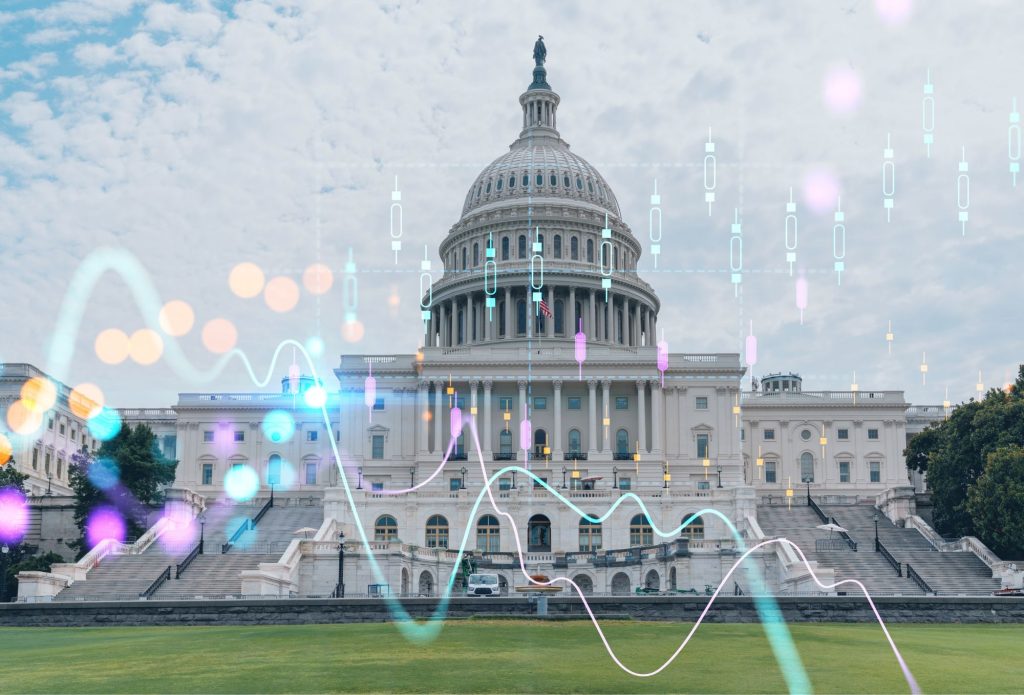
Despite the expected market volatility, Leaman stressed the economy’s resilience, highlighting how fluctuations will likely be temporary. “While elections can cause short-term market fluctuations, the long-term impact on stock markets is usually limited,” she said. “Markets tend to stabilise as new policies are implemented and the economy adjusts to the new administration.”
Bonds, stocks and currencies: what to expect
Stocks
Changes in US fiscal policy and election outcomes can significantly impact various financial markets. Historically the US equities market has demonstrated a tendency to perform better in pre-election periods than in the year immediately following an election. The former is already true of 2024, with the S&P 500 currently up 23%. In the past three months alone, the index rose 7.29%, boosted by the Fed’s decision to cut interest rates by 50 bsp.
In the weeks preceding the election, strong inflation and earnings data have maintained markets calm. Nonetheless, the VIX index of expected equity market swinging sits above its 2024 average signals possible turbulences ahead.
“Election years and unexpected summer gains show that anticipating the market can be risky, and that consistent, long-term investing is often a more profitable strategy,” said John Plassard, Senior Investment Specialist at Mirabaud.
US Treasury bonds
US government bond yields have traditionally wung sharply post-election. This was the case following Trump’s victory in 2016 when the 2-year bond yield nearly doubled amid expectations of aggressive fiscal spending.
In 2024, the bond market’s course is set for volatility, with its trajectory being dependent on the elected administration’s fiscal and trade policy strategies, in addition to the evolution of inflation and interest rates. Monetary easing paired and expansionary fiscal policies could stoke inflation fears, pushing bond yields higher, while a conservative fiscal path could stabilise yields.
“The unwinding of severe deflationary fears in the late-autumn drove the initial rebound in US 10-year yields from its September lows near 3.6% to back above 4% for the first time since July,” said Norman Villamin, Group Chief Strategist, UBP. “The moves since early-October however, have instead begun removing the prospect of Fed rate cuts through 2025 – from below 3% to now just above 3.5% by late-2025.”
The US dollar
Since the Fed’s September rate cut, the US Dollar Index has risen by around 4%, withe the USD outperforming the other G10 nations. However, the currency’s path after the 2024 election is expected to be contingent on the winning candidate’s monetary policy and global risk sentiment.
Traditionally, there have been expectations that a Trump victory would strengthen the USD. However, both UBP and Julius Baer have warned that this would not be the case necessarily, due to the potential impact of his trade policies and tariffs.
“We note that investors held a short USD position ahead of the Fed’s September meeting, and subsequent price action suggests that we are likely seeing a short squeeze,” said a UBP report. “Cleaner positioning suggests that the potential for explosive moves on a Trump victory is limited, because investors have already closed their short positions.”
Cryptocurrencies
Crypto assets tend to rise in times of political uncertainty. However, a Trump win is also expected to give the sector a boost, as the former President has spoken about backing crypto enthusiasts and cutting regulations. In the lead-up to the election, Bitcoin surged to $73,577 just $173 shy of its all-time high of $73,800.
“The surge in the price of Bitcoin is seen as a bet on a Republican victory, as Donald Trump has emerged as the pro-crypto candidate,” said Vijay Valecha, Chief Investment Officer at Century Financial, pointing out that options traders are betting that Bitcoin could reach $80,000 by the end of November, regardless of the election outcome.
Gold
The year 2024 has been one of a gold rush, driven by geopolitical uncertainties and high interest rates. In the lead-up to the vote, the commodity continues to show bullish momentum above the pivot at $2,778. The close result expected in November is likely to drive gold’s price higher, as investors flock to safe-haven assets.
Learning from the past: the 2000 race
Although the 2024 election is perceived as historic in many regards, the US has faced many close elections in the past, including the 2000 race between then-Governor George W. Bush and Democratic Vice President Al Gore, which required a recount of the Florida votes.
At the time, the S&P 500 fell by 12% between election day on 7 November and the market low on 20 December, a week after Gore’s defeat. However, the lack of preparation for such a scenario and the start of the bursting of the internet bubble had a role to play in the market’s reaction at the time.
“Investors should bear in mind that a market crash occurred in the contested election
of 2000, and that we face similar short-term volatility and downside risks in the current
election,” Plassard said. “However, it would be unwise to alter long-term equity positions based on these atypical election risks, as such situations are often fleeting. Even if events after Election Day lead to lawsuits and uncertainty, the markets will move forward.
“The stakes are simply too high for companies and the United States to do otherwise.