

The rise of generative AI (genAI) technologies is not only transforming banking and financial products—it’s also taking over the job market. Christine Lagarde, President of the European Central Bank, has predicted that artificial intelligence will impact 60% of jobs in advanced economies and 40% of job opportunities worldwide over the next two years.
Many companies have already embarked on this journey of AI adoption, and employees will soon follow suit. But, how can financial institutions adopt AI technologies without losing the human element? The key is, as always, investing in people.
“Organisations have been told they need to adopt a digital mindset but, with the advent of genAI, the stakes are higher than ever,” said Marketa Simkova, Partner and Head of People and Organization at KPMG Lower Gulf. “Combining human and machine capabilities is key.”
The AI economy
AI adoption is set to become a key economic indicator. In the US, AI technologies, together with robotic process automation (RPA), are estimated to be able to replace almost 30% of hours worked by employees by 2030. According to PwC, the Middle East is predicted to accrue 2% of the total global benefits of AI in 2030, equivalent to $320 billion. The largest gains are expected to be experienced by Saudi Arabia, where AI could contribute over $135.2 billion to the economy by the end of the decade, equivalent to 12.4% of the Kingdom’s gross domestic product (GDP). In relative terms, the UAE is expected to see the largest impact, at close to 14% of 2030 GDP.


When it comes to the financial sector, firms are already leveraging the benefits of AI and automation to increase efficiency and productivity. A 2023 EY report found that nearly all (99%) of the financial services leaders surveyed are either already using or planning to use genAI within their organisation in the short term. Moreover, AI is currently being leveraged by firms for a number of financial use cases, ranging from cash flow event predictions to credit score adjustments, as well as fraud detection and risk management.
“We don’t have to debate the importance of it [AI] anymore: it is important,” Jamie Dimon, CEO of JP Morgan Chase, wrote in a letter to shareholders, where he likened the economic impact of AI technologies to that of “the printing press, the steam engine, electricity, computing and the internet, among others.”
“It is no longer a question of whether jobs will be replaced by AI technologies; but of which ones”
Many of the largest financial institutions are taking advantage of AI’s analytical capabilities. JP Morgan Chase has claimed to have a new system that can reportedly compliance check 12,000 agreements in just a few seconds, saving 360,000 hours of work per year. Moreover, in a recent earnings call, BNY Mellon’s CEO boasted that the bank’s research analysts can now wake up two hours later than usual, thanks to AI algorithms that read overnight economic data and create a written draft of analysis to work from, The New York Times reported. The possibilities are infinite—and genAI has only just entered the picture.
The AI anxiety
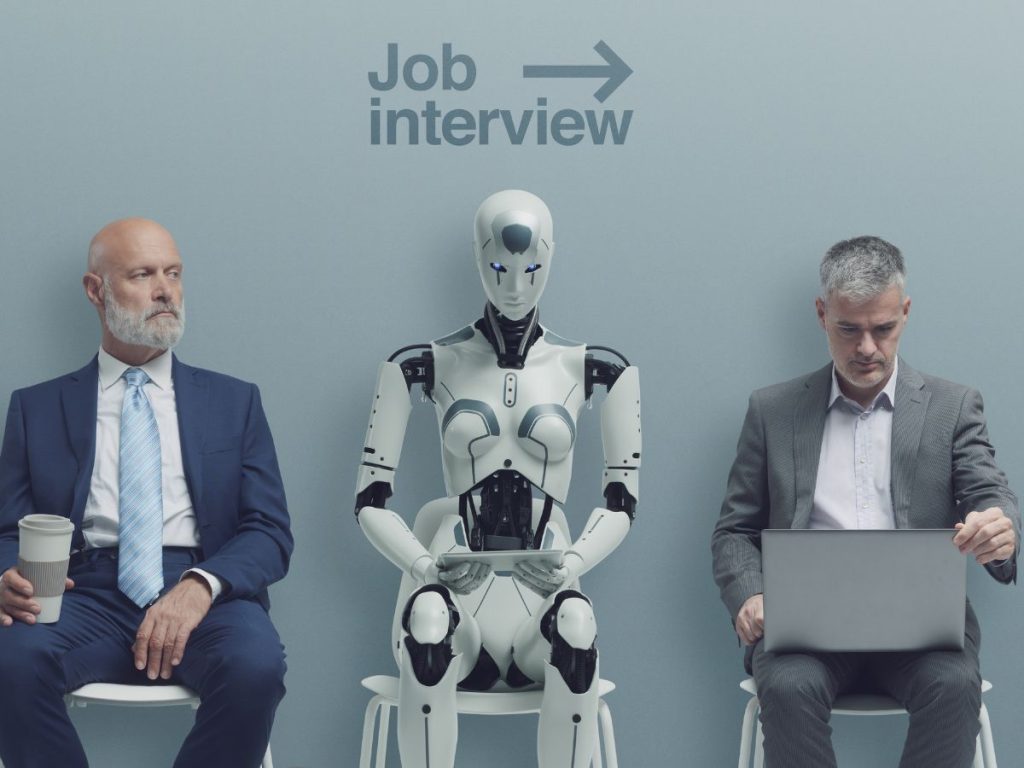
As a result of the rapid adoption of AI, the threat of being replaced by an algorithm is now looming over workers. At this moment in time, it is no longer a question of whether jobs will be replaced by AI technologies; but of which ones. KPMG Lower Gulf’s latest Future of Work 2024 report found that 37% of employees believe new technology will automate up to 30% of their jobs, while 24% think it could automate as much as half. The survey interviewed over 4,000 employees globally, including UAE experts. Of all the people surveyed, many reported feeling overwhelmed by new technology and inadequately prepared to maximise its benefits, as well as fearful of losing their positions.

Notably, part of this preoccupation comes from firms still not being completely clear on how new technologies will change their workforces, pointed out Ruth Svensson, Global Head of People and HR Center of Excellence, KPMG International. “Many firms are learning as they go, due to the rapid evolution of technology,” she said. “This uncertainty requires more communication, not less. If companies don’t work quickly to close the communication void seen in our survey, employees’ anxiety and threat response may only escalate.”
Despite the fears regarding job security, the survey also showed a significant interest in adopting AI from finance professionals, who seek to improve resource allocation and employee engagement. Over half (64%) of respondents are satisfied with their current productivity tools and 60% have a positive view of technology’s impact on their work.
However, in the EY survey, the level of excitement or trust in the use of AI varied depending on the specific sector respondents belonged to. Insurance experts were those most likely to feel nervous about AI implementation (24%), while banking and capital markets leaders had the lowest levels of scepticism (17%), followed by wealth and asset management experts (21%). Overall, one in five respondents said they were unsure about the potential impact of genAI on their organisation. The same percentage did not feel confident that their companies are well-positioned to take advantage of the technology’s potential.


“Companies must remember that human beings are still at the core of the digital world of work,” Simkova added. “Organisations will first need to be very clear on how new technologies will change their workforces and then empower their people with the right tools to adapt to change.”
The future of finance work
AI is undoubtedly poised to transform the financial sector—it already has. However, the key to the question of whether jobs will be replaced by algorithms is the nature of the work itself. Largely, the majority of experts agree that AI is poised to take over the more mechanical, data-analysis and report-writing-related tasks, while human employees will still be needed to make decisions based on the data, develop creative products and strategies; and manage relationships.
“AI will not eliminate the need for humans in the financial services workforce, but it will significantly change their role within it,” said Anna Zeitlin, Partner, Addleshaw Goddard. “Humans are likely to take on more strategic roles, and jobs that require personal interactions. They will slowly be needed less and less in jobs that can be automated, such as fraud detection and reporting. These efficiencies will give the industry a huge scope to expand and innovate, and it will look completely different ten years from now!”
Accenture has expressed a similar view. The consulting firm estimated that AI could replace or supplement nearly three-quarters of bank employees’ working hours across the industry. Moreover, a New York Times investigation claims Goldman Sachs is already making this transition. The investment bank has reportedly assigned 1,000 developers to test an algorithm capable of turning enormous amounts of financial information into page presentations that mimic the bank’s typeface, logo, styles and charts.
“Historically, the advent of new technologies has often led to job disappearance, but also job creation”
In contrast, Deutsche Bank’s genAI tool is said to be capable of answering questions about publicly traded companies, and even identifying clients that would be interested in a bond offering. Shannon Cole, senior director analyst, research in the Gartner Finance practice, has also predicted the adoption of AI will result in the automation of transaction processing functions such as procure to pay (P2P) and order to cash (O2C), affecting a large portion of jobs in the sector.
“Armies of staff in these processes will be replaced by small teams of specialists focused on process excellence, data governance and application management,” Cole predicted. However, advisors, market analysts and roles that rely on creativity, unstructured data and human interaction—vital to the sector—are still expected to remain in human hands.


The human touch
The discussion of AI in the financial sector can be summarised in a simple question: Can AI really replace the human touch? While AI algorithms are expected to significantly transform how the industry—and every industry—operates, the technology is not yet perfect and, perhaps, it never will be.
In a world where accuracy is key, data bias or inaccuracies can have terrible consequences and so, the risks of such occurrences must be minimised. A recent City report warned of AI chatbots’ tendency to make up information, stating that companies will need human employees keeping watch, to prevent automated bots from spewing false information “and negatively affecting the business financially or its reputation.”
“While there’s a whole world of possibilities and efficiencies AI can create for financial services in areas ranging from data analysis to customer service optimisation, blind optimism and hype around the technology can ultimately have a counterproductive impact on a business,” added David Kadio-Morokro, EY Americas Financial Services Innovation Leader. “Planning, education and an agile test-and-learn strategy for implementation are imperative for those looking to make the most of AI’s potential benefits.”
Historically, the advent of new technologies has often led to job disappearance, but also job creation. The world of work is ever-changing and new forms of employment are always arising. The US economy had three times more compliance officers in 2023 than in 2000. We are standing at the edge of a significant change in the finance sector, one as unpredictable as it is unstoppable. However, the adoption of AI technologies might serve to make companies, particularly financial institutions, give more value to the human element than ever before, as they will be able to occupy the spaces that no technology can reach—yet.