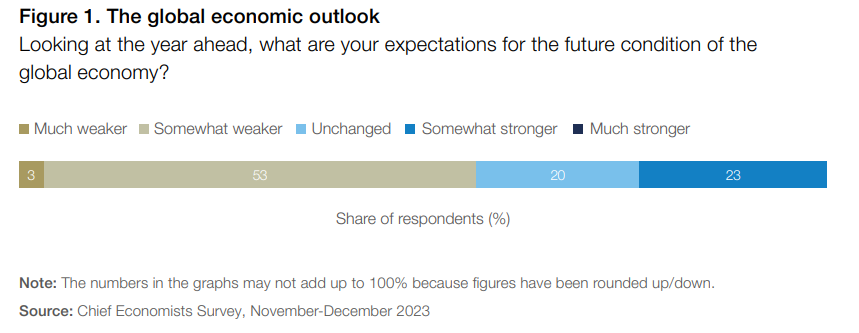
The majority of chief economists surveyed by the World Economic Forum (WEF) have said they expect a slowdown of the global economy in 2024. This would result from tight financial conditions, growing geopolitical tensions, and continued volatility.
While 56% of experts surveyed said they expect a “weakening” of the economy over the next 12 months, another 43% said they predict “unchanged or stronger conditions”, according to the January 2024 Chief Economists Outlook released today by the WEF.
The report reflects a pairing down on expectations for high inflation in 2024. The majority of experts have also said that they expect labour markets (77%) and financial conditions (70%) to loosen broadly in 2024.
Despite these predictions, regional growth outlooks vary widely and “no region is slated for very strong growth in 2024,” the report reads.
Breakdown by region
The report has focused on two key developments that it believes will determine the year ahead: the uncertainty created by geopolitical tensions, and the rise of artificial intelligence (AI).
The Middle East and the United States and the Middle East have been predicted to witness “moderate” or “strong” growth (61% and 56%) in 2024, while 77% of respondents said Europe will see “weak” or “very weak” growth, with only 23% predicting “moderate” growth in the next 12 months.
“Amid accelerating divergence, the resilience of the global economy will continue to be tested in the year ahead”
Saadia Zahidi, Managing Director, World Economic Forum
South and East Asia are the survey’s most promising economies, with 93% and 86% of respondents predicting strong or moderate growth in each region. In this context, China becomes an exception. Instead of the strong growth the country was set to achieve, 69% of experts now believe China will see “largely moderate” growth in 2024, as a result of weak consumption, lower industrial production and property market concerns.
In contrast, 70% of respondents predicted “moderate” or “strong” growth in Latin America and the Caribbean over 2024, while 65% of respondents said they expect to see “moderate” growth in Sub-Saharan Africa.
What will happen with inflation?
The report’s most positive predictions show widespread confidence in lower inflation rates. In Europe and the US, the share of respondents expecting high or very high inflation has declined from, 71% and 47%, respectively, to 13% between September and November/December 2023.
The expectations for lower inflation strengthened across Asia, with the majority of experts surveyed saying they expect moderate inflation in East Asia and Pacific (30%), Central Asia (21%), and South Asia (19%). In China, 76% of respondents said they expect low or very low inflation.
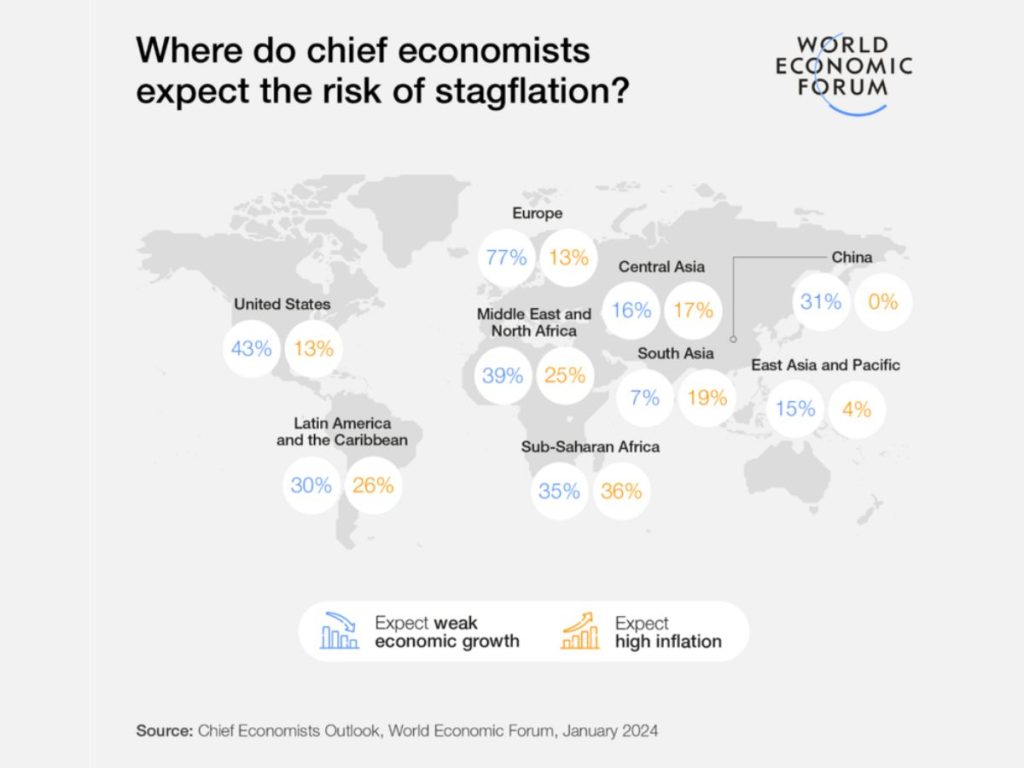
Nonetheless, more than a quarter of respondents still expect high or very high inflation in Sub-Saharan Africa (36%), Latin America and the Caribbean (26%), the Middle East and North America (25%).
Rising trends
Overall, the report reflects a strong consensus that recent geopolitical developments will increase localisation (86%) and stoke volatility in the global economy (87%) and in stock markets (80%).
Almost six out of ten (57%) also expect it to increase inequality and widen the North-South divide in the next three years.
In contrast, respondents have shown optimism regarding the rise of AI systems, particularly in high-income economies. In these locations, the majority of experts believe AI solutions will increase the efficiency of output production (79%) and innovation (74%).