
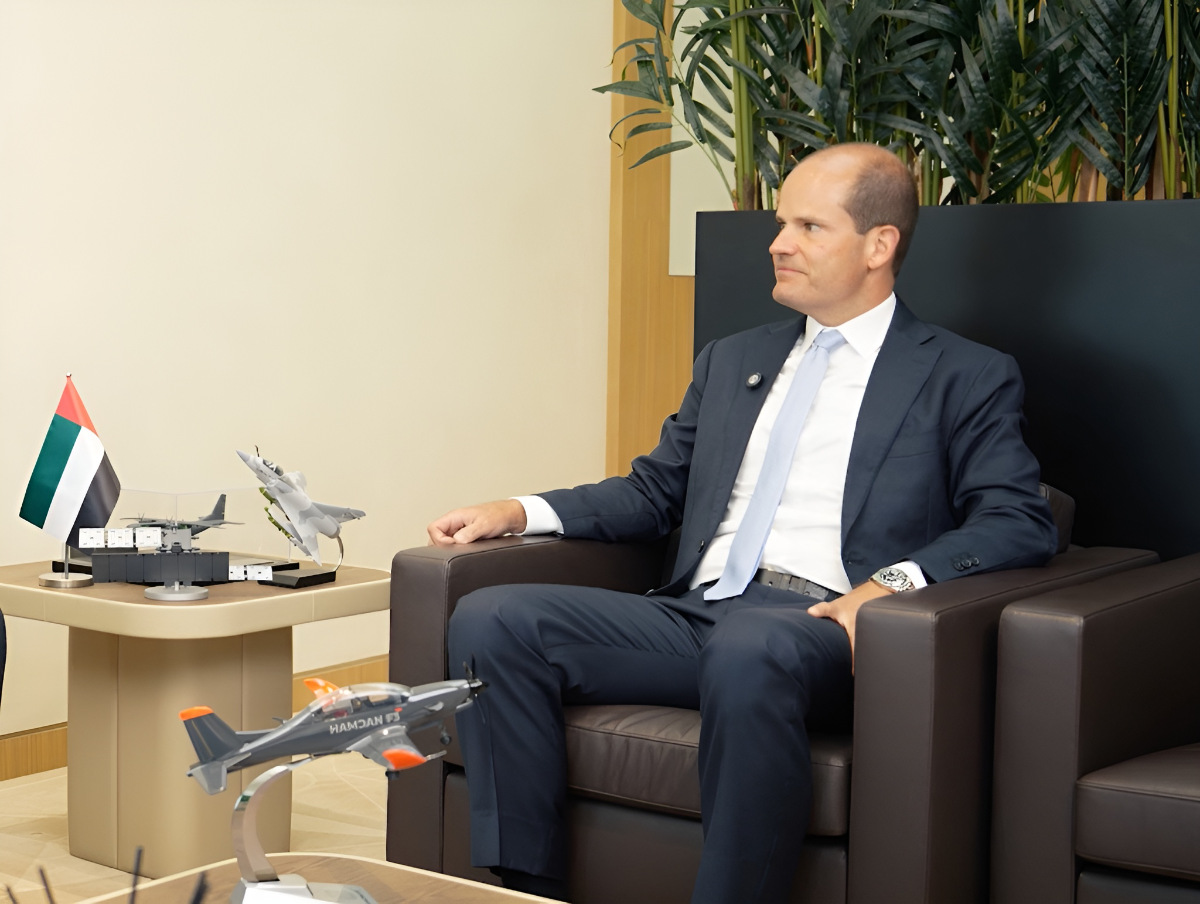
In a sector built on risk-management, Rodrigo Torres, Group CFO and President of the EDGE Group, explains why financing sovereignty demands risk-taking in an era of geopolitical uncertainty.
I speak to Torres live from the EDGE Group’s headquarters in Abu Dhabi.
Defence and Risk
Defence and the risk associated with defending is at the forefront of everyone’s minds right now. Whether it is defending the nation, defending the national economy, or the skies above us: a homegrown defence industry is critical to the success of the markets. Business confidence and the decisions that pass C-suite everyday revolve around certainty: a sentiment that reassures businesses that short term uncertainty will pass and fundamentals matter.
In the UAE, strong taxation frameworks, human capital, and the ease of doing business continue to anchor investment. Yet shifting alliances, rapid technological acceleration, and rising geopolitical tensions, are redefining both defence and the business model behind it.
Once dominated by legacy contractors in the United States and Europe – the global defence landscape is being reshaped by new entrants with a different mandate: building security domestically than outsourcing it.
At the centre of this shift is the EDGE Group. The UAE’s state-backed defence and technology firm is positioning itself as a cornerstone of a homegrown industry in the GCC.
For Rodrigo Torres, Group CFO and President, the mandate is deliberately unconventional: “we didn’t set out to build a typical defence company… we set out to build capability.”
That demands a fundamental rethink of finance. Building capability requires taking risk than avoiding it. While most CFOs are trained to mitigate exposure, defence finance calls for a more expansive, CEO-like mindset: one that embraces calculated risk in pursuit of long-term strategic advantage.
Under Torres, the distinction between managing returns and building sovereign capability is not a trade-off, but a strategy.
Engineering a Defence Ecosystem
EDGE was created through consolidation, bringing together over thirty-five entities under a single platform. The goal was not simply efficiency, but integration – aligning capabilities to accelerate the UAE’s domestic defence industry.
“We had this additional mission and objective, which was to develop a company that was not a typical defence company, but a company that could enhance technology for the country from a defence standpoint,” said the Group CFO.
From the outset, the firm’s mandate extended beyond procurement or manufacturing, instead opting to develop advanced technologies – particularly in surveillance, intelligence, and autonomy – that could underpin national security for decades to come.
“The main priority was the surveillance capability of the country. The framework was to bring as much as we could, technology, and develop this together with the twenty-five companies,” the Group CFO said.
This approach reflects a broader shift in how nations think about defence.
Rethinking Risk in Defence Finance
For Torres, risk is part-and-parcel of the KPI as CFO unlike other sectors.
Risk is fundamental… it is part of any defence company, the CFO said.
Expanding on this, it isn’t a “typical ROI calculation.” Often you need to go beyond and really understand that you are going to bring the firm to a different level, he said.
Rather than relying on traditional financial metrics alone, EDGE approaches investment through staged execution.
“The way to manage risk is really to do things in steps, in milestones, and really understand what type of risks you are taking, and how you manage the milestones through that, every time testing the situation of each one of the risks.”
This structured flexibility is paired with diversification: “the second thing is understanding which geography and which customers, which areas of industry you are taking risk, so you can control the situation.”
Critically, responding to the team’s needs is crucial. Your team is all out there, and they will see things faster than you. You need to have a “constant feedback loop” of the organisation, which you can act into.
Ultimately, in defence if you don’t take risk, you’re not going to be a firm that can really grow.
Profit vs Sovereignty
Underlying every investment decision is a tension rarely seen outside defence: the balance between profitability and sovereignty.
Whilst the EDGE Group is state-owned, rather than relying on the private sector pressures, its fundamentals as a firm remain the same: to maximise profit and minimise costs.
Torres admitted that the task isn’t easy, but it’s about balancing different priorities.
“We need to understand what the balance is between bringing the surveillance capability, IP, knowledge or even transfer production to the country versus doing things abroad.”
Sometimes this causes opportunity costs: you need to balance what really matters from our surveillance capability, whilst understanding what can be done in a “cheaper… more optimised and synergetic way.”
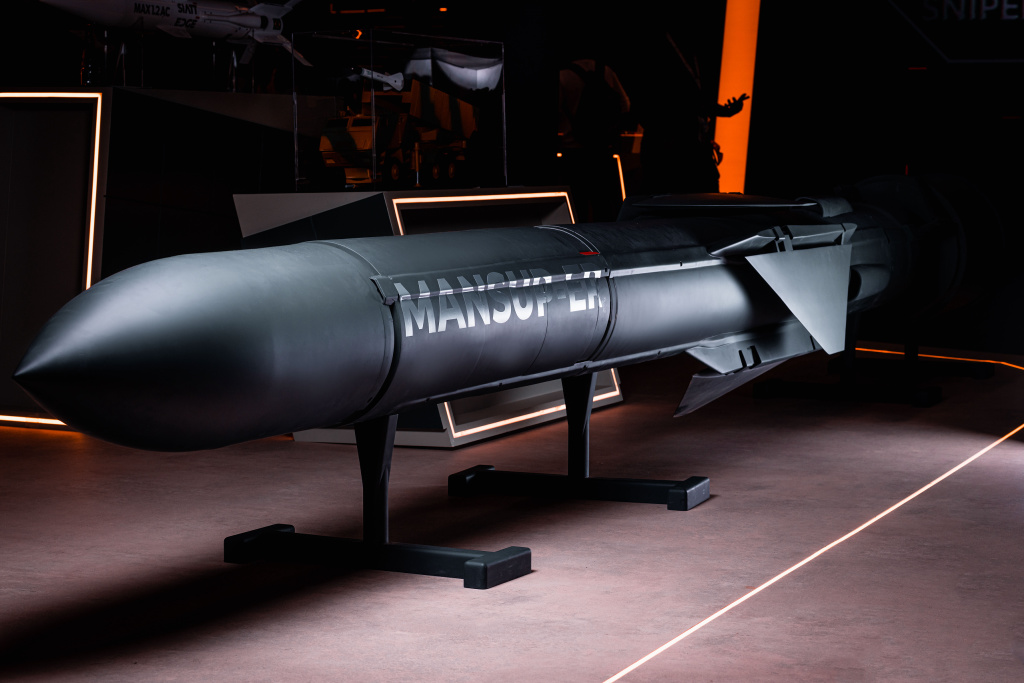
One example Torres shared pointed to the Brazilian navy: the EDGE Group and the Brazilian Navy collaborated on a strategic partnership, by sharing IP and capabilities, to produce the MANSUP anti-ship missile system.
A Global Expansion Strategy
EDGE has prioritised global growth in alignment with UAE foreign policy.
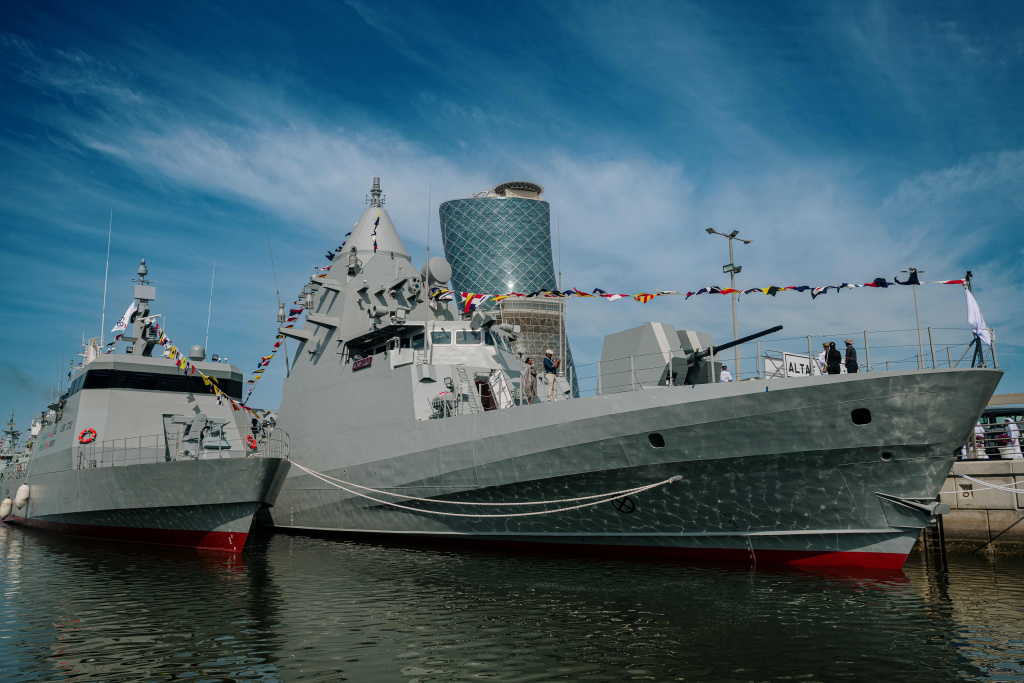
UAE foreign policy has prioritised CEPA agreements with the world’s industrial economies whilst the Group has placed significant emphasis on expansion in the LATAM region, with Brazil in 2025 and Ecuador in February 2026.
According to Torres, Brazil is the most relevant country from a defence spending standpoint, but also a commercial venue.
The firm has conducted two M&As with two companies in the country.
One of these acquisitions predates the MoU signed in 2024, with Brazil, as EDGE announced a 50% acquisition in Brazilian smart weapons and high-tech systems specialist in 2023: SIATT.
Brazil also offers both technological depth and efficiency. “Brazil has a lot of legacy aerospace… a lot of universities that invest in the sector. We saw a potential for a partnership on R&D, from an engineering standpoint.”
What is unique in Brazil, they develop with a “very low budget.” In doing so, Brazil offers R&D opportunities and cost management within a push for a multi-vector foreign policy by the UAE.
Ecuador is another strategically important state. “It is a combination of defence and law enforcement,” as well. EDGE is targeting integrated security challenges, spanning illegal fishing, piracy… in this area where the firm can use a lot of technology – either cameras, radars, and surveillance.
Navigating a Multipolar World
EDGE’s expansion occurs at a time of rising geopolitical uncertainty, when defence expenditure and equities boom, following the war(s) in Ukraine and now Iran.
Global military expenditure hit £2.7T (2024), the highest level on record, whilst the most popular defence ETFs are returning 14% on average in the six months up to March FY26.
Europe became the core of this defence trend, as NATO members increase defence expenditure, driving demand for a wave of goods produced by defence giants such as Leonardo, Indra, and Rheinmetall.
German arms maker Rheinmetall expects a 45% growth in FY26, following profits of 1.68B euros in FY25. Projections for hiked spending on missile restocking and air defence is likely to sustain defence stock highs in FY26 following the ongoing wars in Ukraine and Iran.
Torres was keen to recognise the geopolitical backdrop as a “huge opportunity” for EDGE.
“If you look back at the Cold War, the world was investing $1.6T. Now the world will go to 3T very fast in the next five to six years.”
Conflicts such as the Russo-Ukrainian War are reshaping demand patterns.
We see Europe as a large opportunity… before our focus was Africa, Southeast Asia, and Latin America, but now we are shifting our strategy to look at Europe better.
This pivot is being executed through partnerships with companies such as Indra Sistemas and Leonardo. EDGE announced joint ventures with both defence giants.
“We believe that we need a strong partner to operate in Europe.”

Technological Frontier
Looking ahead, EDGE is doubling down on next-generation technologies.
AI and autonomy are top of the list.
We are looking a lot at AI, and we are looking a lot at autonomy. These areas represent not just innovation, but scale.
After a period of acquisitions in the last two to three years, the focus is now shifting: “we acquired around 25 companies… what we want to do now is really to think what is next.”
Each one of these acquisitions has been complementary to the firm’s portfolio based on subsystems and the technological edge that grants EDGE.
A New Model for Defence
Looking ahead, Torres was keen to reflect on the achievement of the firm’s success and future opportunities ahead. AI and autonomy are two components that are very scalable, offering EDGE the ability to expand the economies of scale whilst
The goal is clear: “this is really pushing the technology beyond the conventional technology.”
The Bigger Picture
As defence, technology and finance continue to converge, firms like EDGE are redefining the parameters of a homegrown GCC defence sector with a CFO embracing risk than shying away from it.
Systems are being built, integrated through international subsystems than typical weapons manufacturers, as the firm braces itself for a new era of multipolarity.
In this model, returns are no longer measured only in profit—but by power, capability, and control.
Stay Up to Date with the Latest Updates at Finance ME
Hawala Meets Crypto: Dickon Johnstone on the GCC’s Next AML Test
Post-War Realities: Why Saudi Arabia Will Accelerate Localisation