The Palestinian territories are nearing “economic freefall,” according to the World Bank’s latest assessment of the conflict’s impact on GDP, debt, jobs and the cost of living.
In its September 2024 update, the bank claimed the Palestinian territories suffered a 35% decline in GDP in the first quarter of 2024, in what was described as the region’s “largest economic contraction on record.”
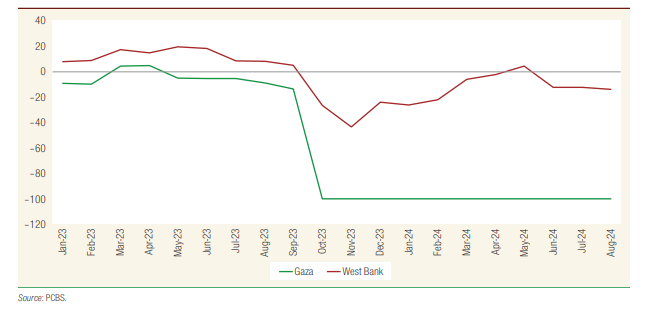
The West Bank economy contracted by 25% during the same period, with trade, services, construction and manufacturing sectors experiencing the most significant declines.
The situation is direr in Gaza. The territory suffered an 86% GDP contraction in Q1 2024, leading its contribution to the Palestinian economy to fall from 17%—the previous year’s average—to less than 5%. The World Bank stressed how the “near-complete halt of economic activity has left the Strip in a deep recession.”
“Close to 100% of the Gaza population lives in poverty”
World Bank
The report stressed the challenges posed by the elevated amounts of borrowing from public and private entities. It estimated the Palestinian Authority’s (PA) financing gap would reach $1.86 billion in 2024, more than double the gap of 2023, which “may pose elevated risks for a systemic failure”, especially affecting public service delivery. However, the PA is set to receive donor contributions and grant allocations from the World Bank and the European Commission in the near term as part of a comprehensive reform plan.
Over the past year, unemployment has reached record highs in both the West Bank and Gaza. As a result of job losses and shortened work hours, 87.2% of workers in the West Bank saw their household incomes shrink since the conflict’s onset. Damage to agricultural infrastructure has also hindered farming activities and increased production costs and a severe cash shortage is impacting the ability of Gazans to access humanitarian assistance and deposits through ATMs and remittances through money transfer operators.
“The halt of most commercial operations in Gaza has left most households without any source of income, while the cost of basic commodities has skyrocketed by close to 250%,” the report stressed.
Gaza and West Bank Industrial Production Index (2019=100)
The agriculture sector, which offers informal employment to 90% of Gaza’s population, has seen over 70% of croplands damaged, “pushing nearly 2 million people to the edge of widespread famine” and causing 15% of Gaza’s population to experience “famine-like conditions, with an almost complete lack of food.”
“Close to 100% of the Gaza population lives in poverty,” the report read.
To mitigate the worsening economic recession and escalating geopolitical tensions, the World Bank has called for: a cessation of the reversal of unilateral decisions regarding deductions from Clearance Revenues, the scaling up of international funding, the imposition of measures to facilitate trade as well as private sector activities, and a commitment from the Palestinian government to implementing the reform agenda, with a particular emphasis on governance and fiscal sustainability.