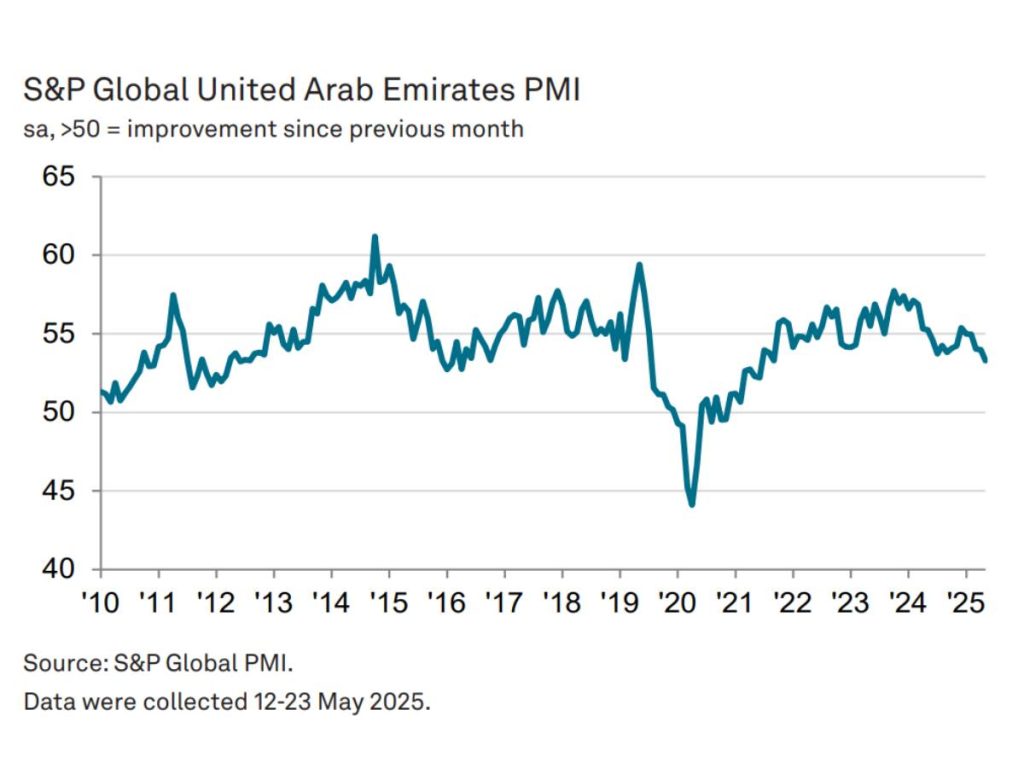
The UAE’s non-oil private sector expanded at its slowest rate in nearly four years in May, according to S&P Global’s Purchasing Managers’ Index (PMI), signalling a deceleration in output growth and a sharp drawdown in inventories.
The seasonally adjusted UAE PMI dropped to 53.3 in May from 54.0 in April, marking its lowest level since September 2021. While the reading remains above the neutral 50.0 mark, indicating ongoing expansion, it points to cooling momentum across the non-oil economy.
Companies cited strong but easing demand as new order volumes rose at a slower pace. The growth in output, although solid, was the weakest in almost four years, with some firms citing uncertainty tied to global economic conditions and US tariffs as a drag on activity.
Input stocks were depleted at a record pace, with May posting the fastest inventory reduction since the survey began in 2009. Despite a slight rise in purchases, the rate of growth in input buying was the slowest in 28 months. Firms also reported softer backlogs, with the accumulation of outstanding work falling to a 16-month low.
Employment, however, picked up, recording its strongest rise in a year as firms responded to sustained demand and elevated workloads.
Input cost inflation eased to its lowest rate since December 2023. Just 5% of respondents reported month-on-month cost increases. Selling prices rose for the fifth consecutive month, though the pace was marginal as some firms offered discounts to stay competitive.
Business sentiment weakened. Only one in ten firms expected an increase in activity over the coming year, marking the lowest level of confidence since January.
According to David Owen, Senior Economist at S&P Global Market Intelligence, firms appear to be preparing for softer growth ahead, even as inflationary pressures ease.
In Dubai, the PMI held steady at 52.9 in May, its joint-lowest since early 2022. New orders rose at a four-month high, driven by improved client sentiment and promotional efforts. Output continued to expand, though at one of the slowest rates since 2021. Stocks of purchases declined for the first time in 2025, and job creation remained subdued.