The UAE’s non-oil private sector continued to expand in April, although the growth rate hit its slowest pace in eight months due to the impact of the floods, caused by the worst storms the country has seen since records began in 1949.
The heavy rainfall affected supply chains, increased backlogs and lowered sales, according to the seasonally-adjusted S&P Global UAE Purchasing Managers’ Index.
The most recent PMI slowed to 55.3 in April from 56.9 in March and an almost five-year high of 57.1 in February, marking the weakest score since August 2023. Nonetheless, it remained firmly above the 50 mark, as optimism towards future business activity rose to the second-strongest level in four years, after September 2023.

The period saw UAE businesses experiencing strong demand, demonstrated by an increase in new order volumes. The rate of expansion also picked up from February’s six-month low. Export sales also saw modest growth in the past two months.
In turn, nearly 31% of respondents saw activity grow over the latest survey period, including higher new orders and growth in the number of projects in their pipelines. However, many businesses “struggled to finalise new work”, the report found. This led to the greatest upturn in backlogs of work on record, alongside that seen in June 2018.
“Backlogs of work increased considerably in April, which was linked to temporary business disruptions and elevated pressure on operating capacity,” said Tim Moore, Economics Director at S&P Global Market Intelligence.”Non-energy businesses are nonetheless still highly upbeat about their year ahead growth prospects.”
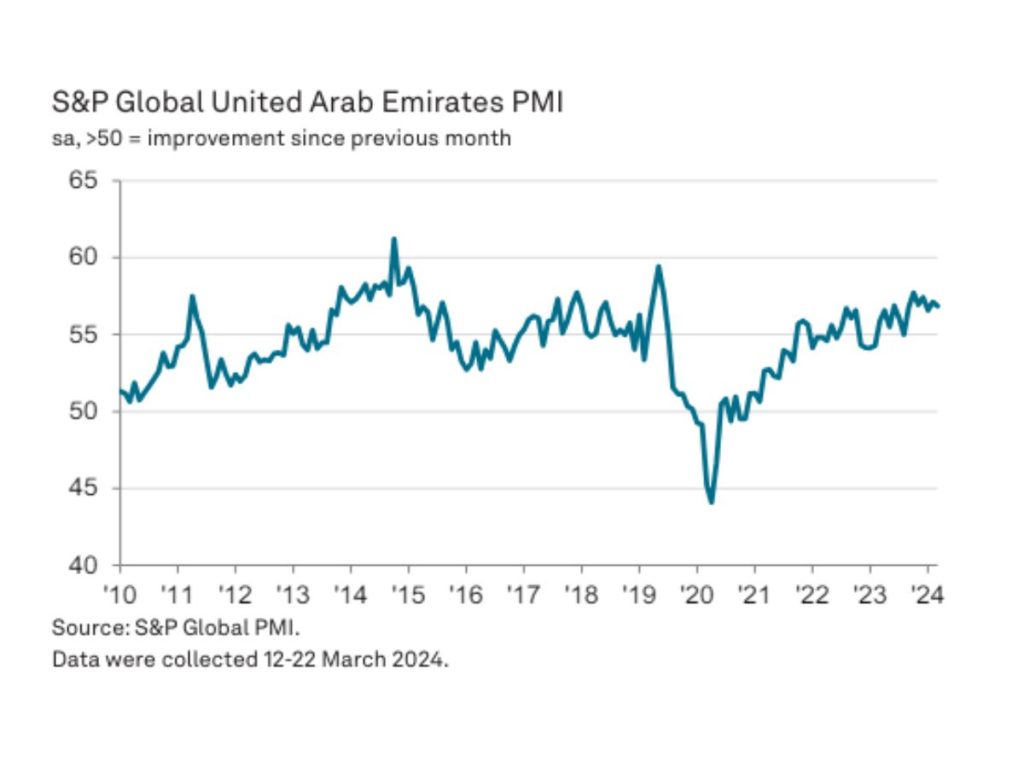
The April data also show faster rises in purchasing prices and staff costs, as a result of rising inflation and the Red Sea crisis. Moreover, the disruption to input freight arrivals due to the shipping crisis were said have affected business capacity and delivery times.
At the same time, the first half of April saw an increase in job creation within the UAE private sector, driven by new projects getting off the ground.

“While the surge in backlogs is concerning as an indicator of business health, the pent-up demand should support activity growth for even longer once these issues are resolved,” added David Owen, Senior Economist at S&P Global Market Intelligence.
The S&P Global Dubai Purchasing Managers’ Index also edged lower during this period, decreasing to 55.1 in April, from the 58.0 score achieved in March.