The MENA region received $338.7 billion in crypto value between July 2023 and June 2024, representing a healthy 11.73% annual growth and accounting for 7.5% of the world’s total transaction volume, according to the latest Chainalysis report.
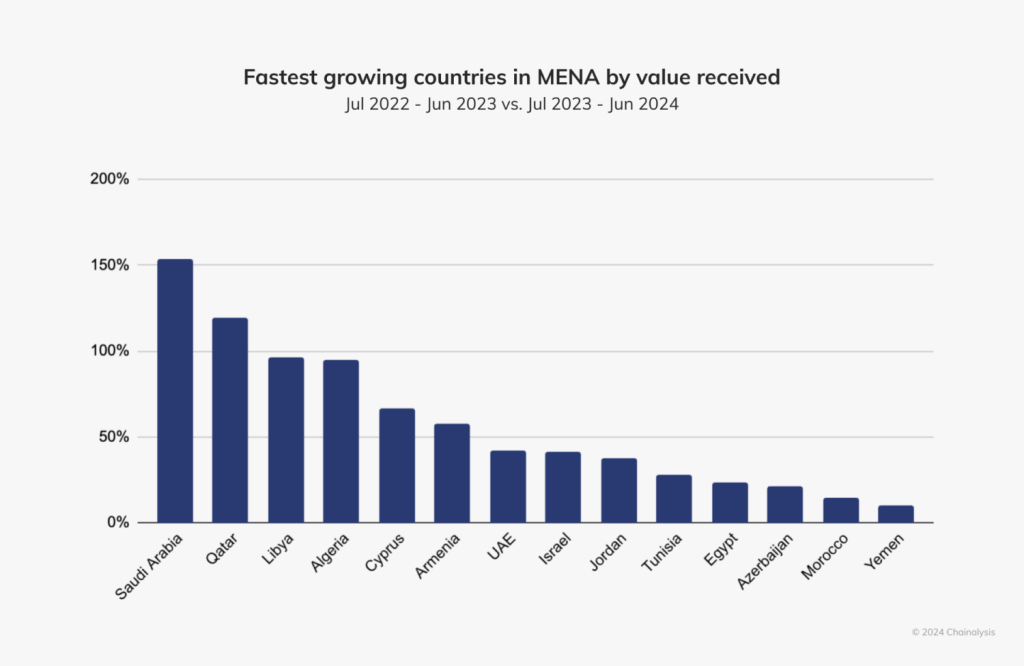
This growth was especially pronounced in mature markets like Saudi Arabia and the UAE which received $47.1 billion and $34.0 billion, representing impressive growth of 153% and 42% respectively, compared to the same period a year prior.
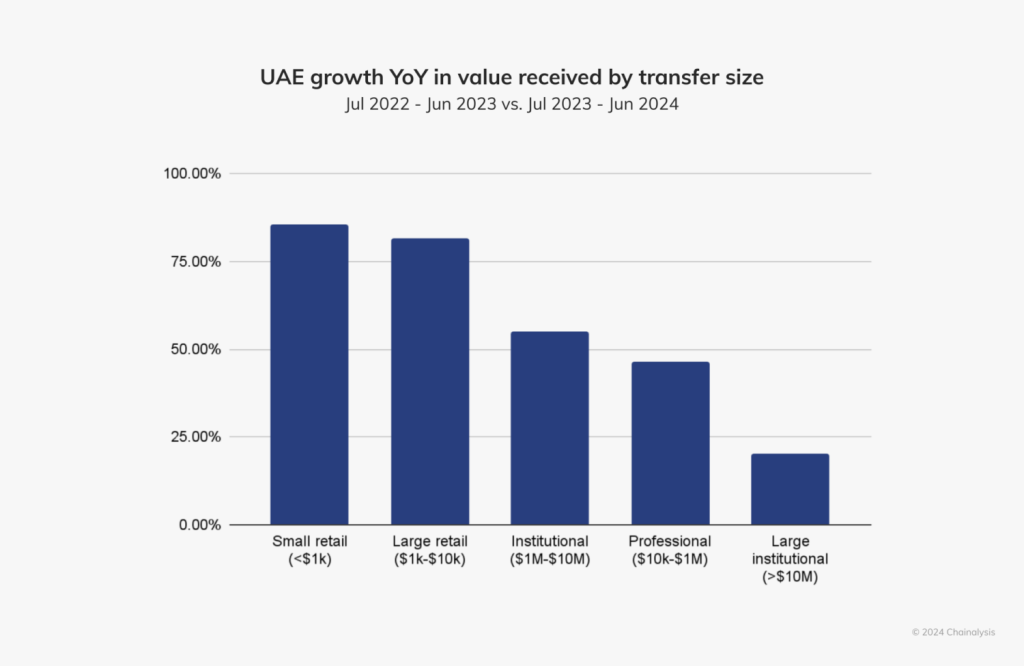
The majority of crypto activity in the region is driven by institutional and professional-level activity, with 93% of value transferred consisting of transactions of $10,000 or above, the report said. In the UAE, large institutional, institutional and professional-sized transfers posted YoY growth of 20.1%, 55.1% and 46.3% respectively. In Saudi Arabia, their growth was more pronounced, reaching rates of 236.3%, 145.8% and 99.7% respectively.
Saudi Arabia remains the fastest-growing crypto economy in the MENA region—growing by 154% year-over-year (YoY). Qatar follows closely as the region’s second-fastest-growing market, growing by 120% YoY.
CEX vs DeFi
Centralised exchanges (CEXs) remain the primary source of crypto inflows across MENA, indicating a preference for traditional platforms over decentralised (DeFi) platforms.
However, DeFi is gaining tracking in the UAE and KSA, with 30.9% and 32.4% of the transaction volume share in each country taking place over decentralised exchanges (DEXs). This was mainly attributed to the nations having young populations —around 63% of its citizens are under 30 years old— and progressive regulatory stance for DeFi platforms which has fostered clarity around specific classes of crypto participation, particularly in the UAE. Users in Türkiye and Qatar, in contrast, remain heavily reliant on CEXs.
“Traditional financial institutions such as banks are actively exploring their roles within the crypto ecosystem, showcasing the growth of a crypto-TradFi nexus,” noted Arushi Goel, Head of Policy for MENA at Chainalysis. “This engagement is further supported by a robust and evolving regulatory framework.”
Currently, neither Saudi Arabia nor Qatar have a comprehensive regulatory framework in place for virtual asset service providers (VASPs) and therefore do not yet have local CEXs.
The rise of stablecoins
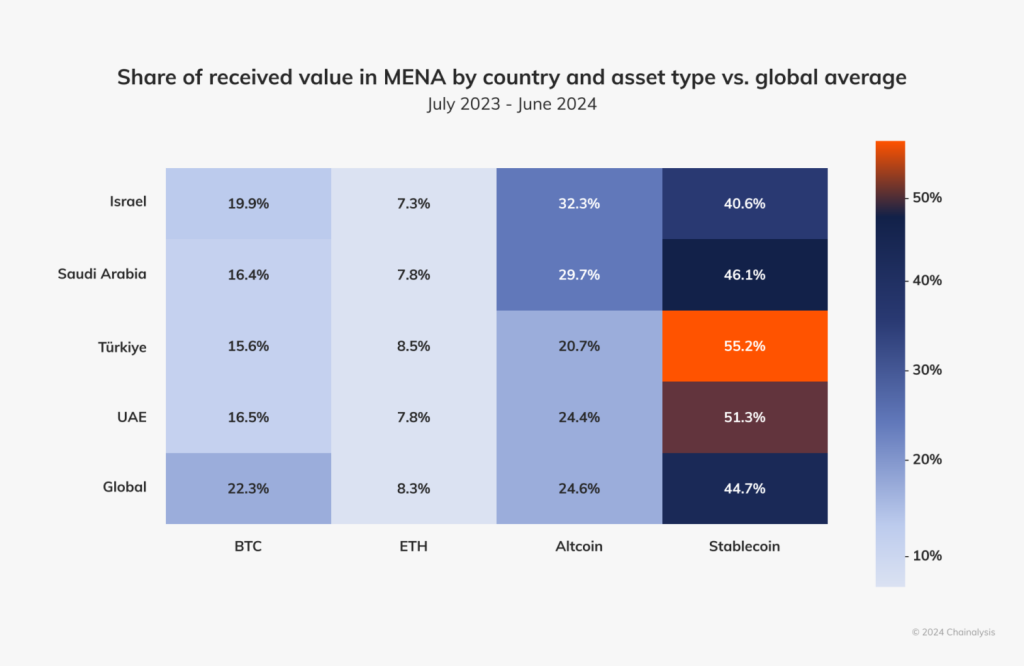
Looking at the types of crypto assets gaining tracking, the data from Chainalysis highlighted an increased interest in stablecoins. In Saudi Arabia and the UAE, the volume of stablecoins received—46.1% and 51.3% respectively—surpassed the global average (44.7%).
The volume share of Bitcoin received was significantly lower than the global average of 22.3%, reaching 16.4% and 16.5% in the UAE and Saudi Arabia.
Despite the MENA crypto market ranking in seventh place worldwide, the region includes two countries ranked in the top 30 of the global crypto adoption index: Türkiye (11th) and Morocco (27th), capturing $137 billion and $12.7 billion of value received, respectively.
Saudi Arabia’s crypto dominance
Saudi Arabia’s focus on blockchain innovation, central bank digital currencies (CBDCs), gaming and fintech innovation, as well as its young population, have helped the Kingdom become the fastest-growing crypto economy in the MENA region.
This growth is further supported by the arrival of several traditional financial (TradFi) powerhouses like Rothschild and Goldman Sach to the Kingdom. Lazard, who has maintained a presence in the country since 2011.
The UAE’s regulation lead
The UAE continues to showcase significant success in the crypto space. Between July 2023 and June 2024, the country received over $30 billion in crypto transactions, ranking among the top 40 globally in this regard. Unlike most countries globally, the UAE’s crypto activity is growing across all transaction size brackets.
“The UAE continues to experience rapid growth in the crypto space, driven by a combination of regulatory innovation, institutional interest, and expanding market activity,” said Chainalysis Cybercrime Research Lead, Eric Jardine.
“Moreover, unlike most countries globally, the UAE’s crypto activity is growing across all transaction size brackets, signalling a more balanced and comprehensive adoption landscape.”
The UAE has been fostering an attractive environment for crypto investments. Many VC funds and blockchain businesses set up shop in the UAE. Tether, the issuer of the world’s most traded cryptocurrency, also recently announced plans to launch a stablecoin pegged to the Dirham.
The country is at the forefront of international efforts to regulate digital assets. The Securities and Commodities Authority (SCA) regulates virtual assets services, while the Central Bank of the UAE (CBUAE) oversees payment token services. The two financial free zones have established distinct virtual asset asset frameworks and Dubai’s Virtual Assets Regulatory Authority (VARA) was the world’s first standalone regulator for virtual assets.
Looking ahead, Chainalysis stressed how the regulatory strides made in 2024 will be crucial in shaping the future of crypto in MENA. “As blockchain technology, tokenization, and cryptocurrency become more integral to the global financial landscape, these fast-growing markets will benefit from providing further legal and regulatory certainty to sustain growth and attract international interest, solidifying MENA’s increasingly prominent role in the global crypto ecosystem,” the report concluded.