

Global sukuk issuance is forecast to remain at between $160 to $170 billion in 2024, according to S&P Global Ratings. The market recorded a very positive first half of the year, with the total issuance reaching $91.9 billion over the first six months of 2024, a slight increase from last year’s $91.3 billion.
A significant factor in this growth is the 23.8% rise in foreign currency issuances, which hit $32.7 billion by June 30, 2024, up from $26.4 billion the previous year. Saudi Arabia, the United Arab Emirates (UAE), Oman, Malaysia, and Kuwait were the main contributors to this increase.
The improved outlook in relation to interest rate cuts has also benefited foreign currency-denominated sukuk issuance. S&P Global expects the US Federal Reserve to start cutting rates in December 2024, according to the report. Additionally, high financing needs in core Islamic finance countries have driven the increased issuance, funding economic transformation programmes in Saudi Arabia and growth in the UAE’s non-oil economy.
However, the market might face disruptions starting next year with the adoption of AAOIFI’s Standard 62 guidelines. These guidelines, which transition the industry toward asset-backed sukuk by requiring the real transfer of underlying assets to investors, could impact the market depending on investor and issuer response, S&P researchers warned.
Despite potential challenges, existing sukuk are unlikely to be disrupted as any changes in contractual obligations would require investor consent.
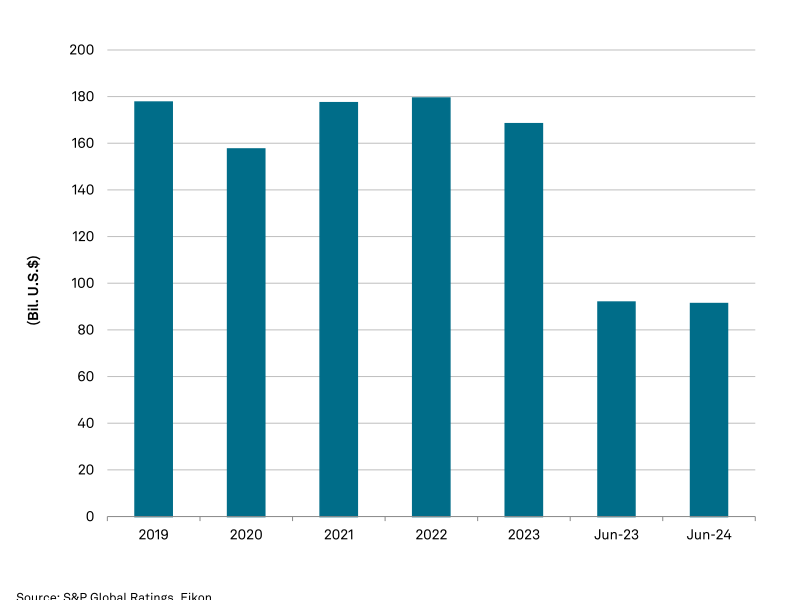
In the first half of 2024, local currency-denominated sukuk issuance declined by 8.8% year-on-year, primarily due to lower issuances in Türkiye, Pakistan, UAE, and Malaysia. Türkiye saw the most significant drop due to monetary tightening and better fiscal policy coordination.
Conversely, foreign currency-denominated sukuk continued to increase, driven by high financing needs, stable rates, and clear future rate cut paths. Saudi Arabia’s government and banks played a significant role in this increase, financing various projects related to the country’s economic transformation plan.
The AAOIFI’s proposed Standard 62 could further fragment the market, requiring sukuk holders to assume ownership and risk related to underlying assets. This could make sukuk more expensive and expose investors to new asset-related risks and legal issues.
Sustainable sukuk issuance reached $5.2 billion in the first half of 2024, down from $5.7 billion the previous year. The issuance volume is expected to hover around $10 billion-$12 billion without major policy accelerations or regulatory actions.