
This year’s Stay Secure study reveals the significance of AI in digital commerce whilst underlining the opportunities for Visa to build trust with the consumer in the Gulf.
AI Brings Personalisation and Efficiency
Digitalisation is improving satisfaction in two-fold: tools like conversational shopping agents can independently locate goods, cross-compare pricing, whilst managing orders at the click of a button whilst tailoring every selected good to consumer taste and preferences.
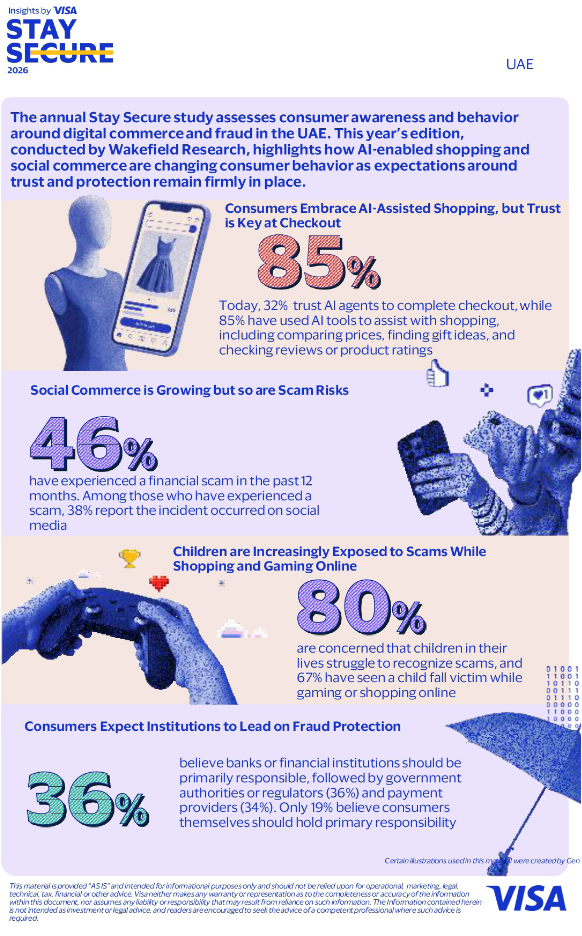
For example, up to 85% of consumers used AI to shop in the UAE. Specifically, AI tools are used to assist with shopping including comparing prices, finding gifts, and checking reviews.

AI & Agentic
Yet the gap between trusting everyday AI and agentic is significant by perception. Just 32% of UAE consumers trust AI agents to complete checkout. Issues of automation, control, and oversight are among the key barriers to trust when it comes to agentic AI.
85% of UAE consumers used AI in commerce
Consumer Concerns
Yet digitalisation is a double-edged sword for many consumers.
Visa’s study finds that up to 69% of UAE consumers have purchased goods through social commerce. Meanwhile, up to 46% of UAE consumers have experienced a financial scam in the past 12 months.
Among those who have experienced a scam, 38% report the incident occurred on social media, more than those who encounter scams on other platforms such as websites, online marketplaces, or shopping apps.
AI is therefore helping consumers, yet issues of fraud remain a barrier for building consumer trust to make digital commerce ready for the next step in AI.
Trusted Technology is the Solution
However, technology is the answer albeit with trust at the heart of it. As AI adoption grows, consumers increasingly view technology as part of the solution to fraud.
Up to 57% feel that AI has made scams easier to recognise while 85% believe AI will play a critical role in protecting consumers from fraud in the future.
Stakeholder Responsibility
Consumers believe that issues of fraud lie with their bank or payment app.
Up to 36% of UAE consumers believe banks or financial institutions should be primarily responsible with an equal share saying the same for government authorities or regulators.
Just 19% of UAE consumers take responsibility for protecting themselves against online fraud.
Just 34% of UAE consumers believe payment providers are responsible, while only 19% believe consumers themselves should hold primary responsibility.
Shared Responsibility
Security is a shared responsibility across the ecosystem.
At VPF26 in Paris, Charles Lobo, Visa’s Regional Risk Officer, spoke on the importance of security as a collective effort: “we are all responsible,” Lobo told Finance Middle East. Dibayajyoti Sen, Head of Risk in the GCC at Visa, agreed with that sentiment noting the importance of “secure-by-design payment systems.”
Visa continues to scale up its digitalisation programme, by supporting digital commerce with its leading partners in the UAE and broader GCC, through new applications such as the Visa Intelligent Commerce. Yet the future of digital commerce requires equal participation from all stakeholders to close the gap between digitalisation and consumer distrust in the Gulf specifically.
About the 2026 Stay Secure Study
The data was commissioned by Visa and conducted by Wakefield Research (January-February 2026). The study involved a survey of 5,800 adult participants aged 18 and upwards, ranging from 17 CEMEA markets, including all six GCC economies: Bahrain, Kuwait, the Kingdom of Saudi Arabia, the United Arab of Emirates, the Sultanate of Oman, and Qatar.
Stay Up to Date with the Latest Updates at Finance ME
Sarah Al-Shawwaf: Vision 2030 Has Unlocked the Potential of Saudi Women
World Bank Projects 2.4% Growth for Oman in FY26
EDGE’s Rodrigo Torres on Risk, Sovereignty and Defence Finance in a Multipolar World