

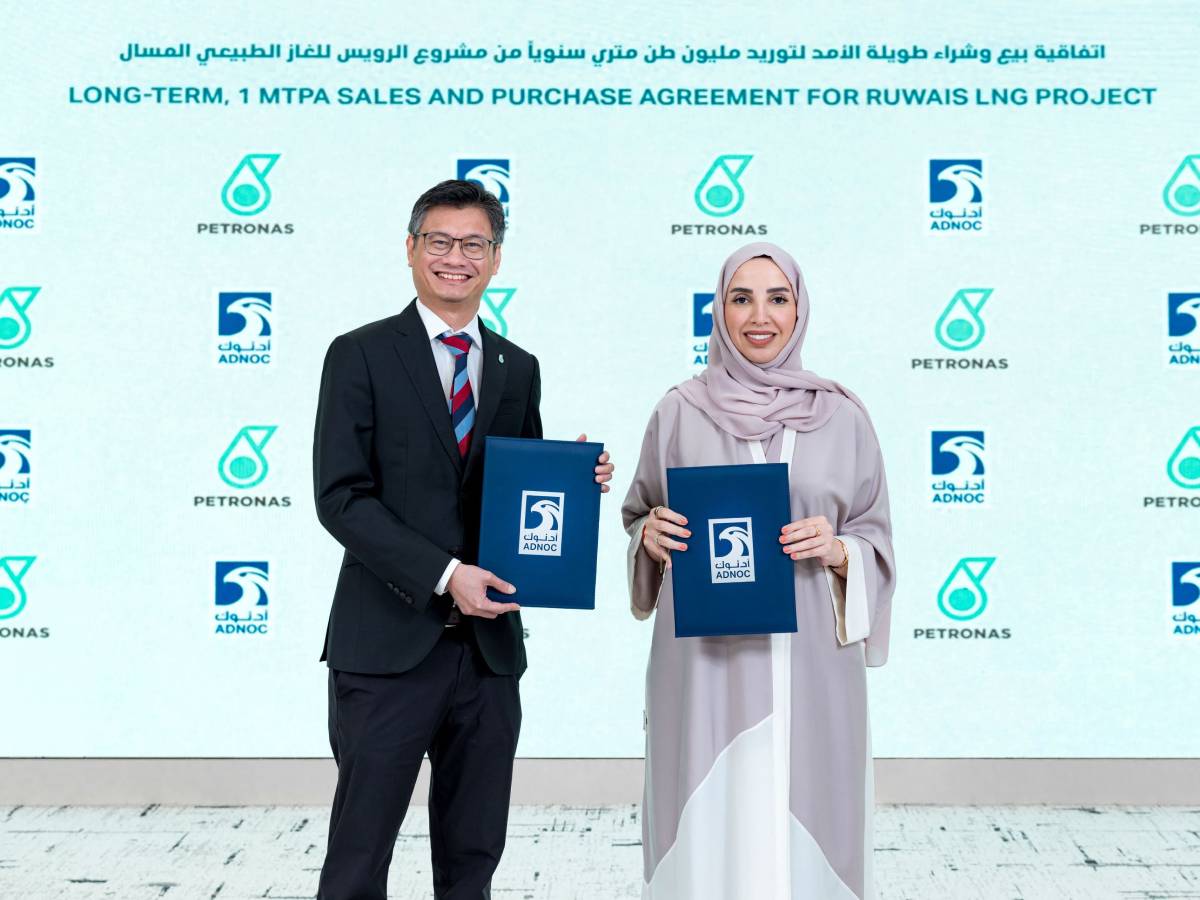
ADNOC has signed a 15-year Sales and Purchase Agreement (SPA) with Malaysia’s Petronas to supply 1 million tonnes per annum (mtpa) of liquified natural gas (LNG) from the Ruwais LNG project. The agreement converts a previous Heads of Agreement into a definitive deal.
The Ruwais LNG project, under development in Al Ruwais Industrial City, Abu Dhabi, will begin commercial operations in 2028. Deliveries under this agreement will commence upon project completion. To date, over 8 mtpa of the project’s production capacity has been committed to international customers through long-term contracts.
“Natural gas plays a critical role in meeting the world’s energy needs, and we are proud to partner with Petronas to deliver lower-carbon LNG through this landmark agreement. This milestone further underscores ADNOC’s role as a reliable global energy supplier and supports growing demand in Asia for cleaner, more sustainable energy solutions.”
The Ruwais LNG project, comprising two 4.8 mtpa liquefaction trains with a combined capacity of 9.6 mtpa, will more than double ADNOC Gas’ current LNG production capacity to approximately 15 mtpa. ADNOC Gas plans to acquire ADNOC’s 60% stake in the Ruwais LNG project at cost, estimated at $5 billion, in the second half of 2028.
Shamsairi Ibrahim, Vice President of LNG Marketing & Trading at Petronas, commented, “This partnership with ADNOC marks a significant milestone in strengthening Petronas’ business with the UAE, complementing our upstream activities while reinforcing the strategic economic relationship between the UAE and Malaysia. This collaboration bolsters our LNG portfolio with a reliable supply of lower-carbon energy to meet Malaysia’s domestic demand, enhances security of supply for our customers and fosters deeper government-to-government collaboration.”
The Ruwais LNG plant will be the first LNG export facility in the Middle East and Africa region to operate on clean power, minimising carbon intensity. The facility will integrate artificial intelligence and advanced technologies to enhance safety, reduce emissions, and improve efficiency.